Most people approach PMP practice exams incorrectly. They treat them as tests to memorize answers rather than tools for understanding concepts. This approach fails when the real exam presents variations they have not seen before.
The Problem With PMP Memorization
Memorizing answers to specific questions give you a false sense of preparedness. The PMP exam tests conceptual understanding. If you’re just recalling certain previous questions, you’ll run into trouble. When exam questions vary slightly from practice questions, memorization won’t help you.
Go for Understanding Over Memorization
The goal of practice questions is to understand the reasoning behind correct answers, not to memorize them. This requires a different study process.
When you get a practice question wrong or disagree with the answer, don’t just move on. Make sure you understand why the provided answer is correct, read the explanation and if the source is cited, review it (e.g. in the PMBOK Guide 8th Edition).
Identify the underlying concept or principle being tested. Is this about scope management? Risk responses? Stakeholder engagement? The Project Charter? Go there directly and learn why they made the answer that way.
Using the PMBOK Guide for Source Material
If you have your PMI Membership, you will have access to the PMBOK Guide online, and you can use its search function to locate relevant sections. When a practice question tests knowledge about the project charter, search for “project charter” in the guide and read the official definition and application.
This approach connects practice questions directly to source material rather than treating them as isolated items to memorize.
This method develops the conceptual mastery that transfers to exam performance, regardless of how questions are worded or scenarios are framed.
The PMP exam requirements changed in 2026 and the application process has been updated to match. Here is a step-by-step walkthrough of what to expect when you apply.
Step 1: Create Your PMI Account
Go to pmi.org and create a free account in the top right corner. You will need your first name, last name, country or region, email address and password. Once registered, you are part of PMI’s system.
Step 2: Navigate to the PMP Application
From PMI’s homepage, select Certifications and then Project Management Professional (PMP). This takes you to the application page. PMI will ask if you are ready to apply and will confirm that you understand the requirements: specific education and experience levels and 35 contact hours of professional project training.
Step 3: Confirm Education and Experience Requirements
The application reviews your eligibility. If you have a high school diploma, you need five years of project management experience leading and managing projects, teams and change. If you hold an associate degree or bachelor’s degree, the requirement is less. Regardless of education level, you must complete 35 contact hours of project management training.
Step 4: Add Your Academic Credentials
Enter your highest level of education, whether that is a high school diploma, associate degree, bachelor’s degree or graduate degree. If PMI audits your application (approximately 10% of all applications are audited), you will need to provide a copy of your certificate or diploma. Have these documents available before starting your application.
Step 5: Add Your Project Management Experience
This section is where you document the projects you have managed. For each project, enter the organization name, your job title (this does not have to be “Project Manager” — titles like Coordinator, Lead or Manager are acceptable as long as you performed project management tasks), the start date and end date, and a project summary. Your summary should emphasize that you led projects, led teams and led change. Participation alone does not qualify. PMI allows you to count projects from the last ten years, even if you only need five years of documented experience to meet the requirement.
Important: Project dates cannot overlap. You cannot count two projects at the same time toward your experience requirement.
Step 6: Add Your Professional Project Training
Document your 35 contact hours of project management education. Enter the training organization, course title and total hours completed. These hours must come from eligible project management training and must total exactly 35 hours. Once entered, save your training information.
Step 7: Specify Exam and Certificate Details
Enter the name exactly as you want it to appear on your certificate and select your region. The application also asks if you need exam accommodations or special arrangements. PMI provides an exam accommodation guide that explains reasonable adjustments available to candidates with specific needs. Review this guide if applicable to your circumstances.
Step 8: Submit Your Application
Once you have completed all sections, click Submit. PMI will notify you immediately whether your application is approved or audited. If audited, you will receive an email asking for additional documentation. You may be asked to have your manager confirm your project experience via DocuSign or another verification method. Provide the requested information to complete the audit process.
Step 9: Payment Options
After your application is approved, you proceed to payment for the exam. PMI currently offers exam insurance for $45 for members. This insurance covers the cost of a re-sit if you do not pass on your first attempt. Without insurance, re-sit fees are $275 for members or $375 for non-members.
All re-sits must be used within 12 months of your initial exam date. You have a maximum of three attempts within any 12-month period.
Remember
The application process is straightforward once you understand the sequence of steps. Prepare your education credentials, project documentation and training records before you begin to streamline the process.
PMI has made a significant change to their study materials and if you are preparing for your CAPM or PMP this year, you need to know about it.
PMI Removed Key Guides and Standards
Previously, there were several guides available for study. The Process Groups: A Practice Guide showed the step-by-step process for managing a project. The PMBOK Guide 6th edition was very similar (almost identical) to this, and it was the perfect way to learn about project management. The PMBOK Guide 7th edition was also available, and provided a nice overview of project management and comprehensive references of tools, methods and artifacts. These were the standard study materials for PMP candidates.
Now, if you go to PMI’s website and search for any of these previous guides, including the PMBOK Guide 7th edition, you will find only one result: the search redirects directly to the PMBOK Guide 8th edition. PMI has removed the previous guides from their website entirely.
Why This Matters Specifically for CAPM Students
This is particularly significant for CAPM candidates because the CAPM Exam Content Outline(ECO) directly references the PMBOK Guide 7th edition and the Process Groups Practice Guide. These two guides are no longer available for purchase or download from PMI. Yet the exam is still based on them.
The Good News
There are two important pieces of good news to ease your concerns. First, the PMBOK Guide 7th edition and the Process Groups Practice Guide content is still covered in detail in comprehensive study courses, like my course on Udemy. You can still access this material as part of the course.
Second, the PMBOK Guide 8th edition contains essentially the same material as the previous 7th and 6th editions. The content is 90 to 95 percent identical between the PMBOK Guide 8th edition and the earlier guides including the Process Groups Practice Guide and PMBOK Guide 7th edition. The process is almost the same, and the key concepts and tools are also almost the same.
The Core Content Remains the Same
Both old and new editions follow the same fundamental structure:
Initiating a project, Planning the work, Executing the plan, Monitoring and Controlling performance and Closing the project.
The same project management processes appear in both. Scope management, scheduling, cost estimation and budgeting work the same way. Quality management, risk management, stakeholder management and communications all follow the same principles.
The knowledge areas and process groups are organized slightly differently in the 8th edition but the core content you need to know remains constant.
What You Should Do (CAPM and PMP)
Study the PMBOK Guide 8th edition. It contains everything you need for both the CAPM and PMP exams. You are not at a disadvantage by studying the newer edition. The fundamentals of project management have not changed.
If you have access to the previous editions through other sources, they are excellent supplements. But the 8th edition is sufficient on its own.
PMI’s move to consolidate on the 8th edition makes sense. It simplifies their product line and ensures all candidates study from the same primary source.
Projects are everywhere and the world needs good project leaders. By studying the right material, understanding project management principles and putting in consistent effort, you will pass your CAPM or PMP exam. Study with focus, practice with discipline. I believe in you.
If you are taking the new PMP exam (2026), you will see between five and ten questions on artificial intelligence. These questions test your understanding of AI risks and adoption in project management. Here are ten project management PMP Exam scenarios that reflect how AI appears on the actual exam.
Question 1 – Automation vs Augmentation
You are managing a project to deliver a new battery type for electric vehicles. The project sponsor suggests using AI to autogenerate weekly status reports and using AI for pattern recognition to adjust the return on investment for new risks and their responses. What AI strategies are these respectively?
Typically we have Automation, Assistance, and Augmentation for AI to help us.
Question 2 – Mitigating Bias in AI
A project manager wants to reduce the risk of bias in an AI tool used for resource allocation decisions across multiple departments. Which of the following best mitigates this risk?
The PMBOK Guide identifies three bias mitigations: diversifying training datasets, periodic bias testing and involving different teams in AI development.
Question 3 – AI Output Validation
You are the project manager for a global initiative using an AI tool to draft stakeholder communications. Checking these communications is taking additional time. A contractor argues that AI generated content should not be reviewed since the AI has already checked it. What should you emphasize when responding?
Question 4 – Data Licensing Issues
You are leading a project where the team uses an AI tool to summarize contractual obligations. During a risk workshop, the legal department flags that portions of the training data may have been sourced without proper licensing. How will you raise this in the risk register?
Question 5 – AI Decisions
You are overseeing a project where AI is used to draft procurement communications with external vendors. A vendor requests details on how the tool selects wording and what data influenced the recommendations. Your team has not documented this. What does this gap reflect?
Question 6 – Reviewing Without Consent
Your team uses an AI tool to analyze team performance data, including personal work patterns and communication logs without informing team members or securing consent. After learning about this, one team member raises concerns. What does this scenario show?
Question 7 – Who Is Accountable?
You are managing a project that uses AI to prioritize vendor selections. After implementation, stakeholders discover the AI recommended a supplier with significant compliance issues. Senior management asks who is responsible. What is the best response?
Question 8 – Safety and AI Deployment
You are leading a project that deploys an AI system to monitor equipment in a manufacturing plant. During testing, the AI occasionally recommends actions that could create unsafe operating conditions. What should you do before approving deployment?
Question 9 – AI and Sustainability
You are managing a project that introduces AI to optimize delivery routes across multiple distribution centers. Executives ask how AI can support the organization’s long-term sustainability goals. What should you recommend?
Question 10 – How to Reduce AI Risk
You are managing a project that introduces AI to automate customer support decisions. Before deployment, stakeholders express concerns that relying too heavily on AI could expose the organization to unexpected risks. What is the best action to reduce these risks?
Bonus Question 11 – Risk Mitigation
Your project sponsor asks you to automate items and reduce costs when it comes to project risk management. What is the best use of AI automation?
You Can Pass Your PMP
Between five and ten questions on your PMP exam will cover AI risks and adoption. These questions appear as scenario-based situations just like these. They test your understanding of the three strategies (automation, assistance, augmentation) and the ethical concerns (bias, privacy, transparency, accountability, copyright, reliability, safety and sustainability).
Study these questions. Understand the PMBOK Guide 8th edition sections on artificial intelligence. Know that AI should augment human judgment, but humans are still accountable. Good governance and monitoring are essential.
If you made it through all eleven questions, well done. That extra effort shows you are serious about passing your PMP exam. I truly believe that with this work and consistency, you can pass your PMP
The new PMP exam has been out for several weeks now and feedback is in. Here is exactly what you will see on the exam so you know what to expect and what to study.
Artificial Intelligence Questions (5-10)
Between five and ten questions will cover artificial intelligence or the risks of AI adoption. These appear as normal project management scenarios. The content covers typical AI risks – bias in data, copyright issues, privacy concerns and sustainability. The good news is these questions are mostly common sense, so apply basic project management thinking to AI risks just as you would to any other risk.
Case Study Questions (8-12)
The new exam introduces case study questions as a new format at the beginning of the exam. A case study is a longer scenario that you read through in full. After reading it, you answer three to four questions about that specific scenario.
Here is something important to know about timing – because the case study section comes first on your exam, you complete all the case study questions and then they give you your first 10-minute break. This break comes very early in the exam, and creates a timing imbalance. After the break, you have approximately 170 questions remaining, split into two blocks of roughly 85 questions each with only one break between them. This means the second half of your exam is a long stretch without a break. Be aware of this timing structure so you can manage your energy and pacing accordingly.
Drag and Drop Questions (2 to 10)
These questions work exactly like they did on the previous exam – you are given a description and you drag it to match its correct definition or category. For example, you might see “Stakeholder Register” and drag it to its proper description. You will see around five of these questions, though the number could vary slightly.
Graphical Questions (Around 5)
You will see graphical or chart-based questions similar to the previous exam. You might be shown a burndown chart, a trend chart or another visual representation of project data. Then you answer questions about what that chart tells you. For example, “Is the project on track or off track based on this burndown chart?” Around five questions will use this format.
The remaining 90% of questions are exactly like the previous PMP exam. These are scenario-based questions. You read a scenario where something is going wrong on a project. You apply your project management knowledge to solve it.
These questions are multiple choice with typically two answers that seem to be correct. This is what makes them challenging. You have to distinguish between the good answer and the better answer by understanding the real life project management concepts.
Some of these questions may be multi-select, meaning you choose two or three correct answers out of five or six options.
What This Means for Your PMP Study
The core of the exam remains the same. Situational project management questions still make up the vast majority of what you will encounter. Your existing study resources and practice questions will prepare you well.
So read and practice full scenarios. Learn to extract key information quickly from longer passages. Practice answering multiple questions about a single scenario.
Familiarize yourself with AI risks in project management – these are in the new PMBOK Guide, 8th Edition.
The drag and drop and graphical question types are not new to the PMP exam. They appeared on previous versions.
Getting Your PMP
If you are studying the PMBOK Guide 8th Edition, you will recognize most of what you see. Case studies and increased AI content are new elements, but both fit within standard project management thinking.
Practice situational questions relentlessly, know the Project Management Process and key concepts (tools & techniques), and you will pass your PMP exam.
If you are going for your PMP in 2026, there are two significant changes coming that you should know about.
Change 1: PMP Training Requirements (Late 2026)
Currently, you need 35 hours of project management training to qualify for the PMP exam. These hours can come from any eligible course provider. Training can be live in-person, live virtual with an instructor or self-paced on-demand courses. PMI does not require a specific provider.
In late 2026, PMI is making a change to the PMP live training eligibility requirements to ensure consistent quality preparation worldwide: live training will have to be provided by an:
A PMI Authorized Training Partner (ATP)
A China Registered Education Provider (REP)
Eligible accredited academic programs through PMI
If your live training does not come from one of these sources, it will not be eligible. You could complete the course and discover later that the hours do not count toward your PMP application.
The Good News – Self Paced Study
Self-paced courses remain completely eligible.This includes online courses through platforms like Udemy, Coursera and others that are not from authorized partners. If you choose self-paced learning, you have complete flexibility and can learn from any reputable provider.
Self-paced courses are also typically more cost-effective than live instructor-led training. You can learn at your own pace, on your own schedule.
What Does This Mean For You?
If you are planning to take live training, verify that the provider is a PMI Authorized Training Partner before you enroll. Ask the provider directly if they are an ATP. If they are not, your hours may not count.
If you are planning to take self-paced training, you have no restrictions. You can take courses from any provider you choose and be confident the hours will count.
Change 2: PMP Exam Price Increase (Effective August 6, 2026)
The cost of the PMP exam is increasing for non-members.
Previous non-member price: $555 USD
New non-member price (effective August 6, 2026): $675 USD
This is an increase of $120 USD.
The good news here is that if you are a PMI member, your exam price is not changing. It remains at approximately $405 (it can vary by region).
PMI membership typically costs around $140 USD per year depending on your location. Here is the math. If you pay $140 for membership and $405 for the exam, your total is $545. If you do not have membership, you pay $675 for the exam alone. The membership pays for itself, plus a bit extra.
Additional PMI Member Benefits
As a PMI member, you also receive:
Digital downloads of all PMI project management bodies of knowledge (this is worth the membership price alone),
Access to the PMBOK Guide, Agile Practice Guide and other resources,
Member discounts on PMI courses and certifications,
Networking and professional development opportunities,
A cheaper exam experience at $405 versus $675.
So, if you have not yet started studying, consider getting PMI Membership and your 35 hours of training through a self-paced course. This gives you flexibility and ensures your hours count regardless of future changes.
If you plan to take live training, verify that your provider is a PMI Authorized Training Partner.
The $140 PMI membership cost pays for itself through the exam discount alone, plus you get access to all the study resources you need.
Study hard and work at it consistently, and I know that you too can pass your PMP exam.
We use the PMP Fast Track to answer PMP questions quickly and easily. Check it out!
Question 1 – How Should This Initiative Be Managed?
Leadership at Stratus Innovations proposes a new customer platform involving multiple teams with a fixed release date. How should this initiative be managed?
Question 2 – Categorizing Project Benefits
Daniel is preparing a business case for a mobile banking platform. Expected outcomes include increased transaction revenue and improved customer satisfaction. How should these benefits be categorized?
Question 3 – Accounting for External Influences
While developing the project management plan for a new online banking platform, you identify regulations, organizational culture and IT infrastructure as factors that may influence the project. How should these be accounted for?
Question 4 – Classifying Templates and Procedures
Rose’s PMO requires her to use standard project plan templates and follow established procedures from previous projects. How should she classify these templates and procedures?
Question 5 – What Type of Organizational Structure Is This?
You are assigned as project manager with full authority over the project budget, resources and decision-making. What type of organisational structure are you working in?
Question 6 – No Budget or Additional Authority
Liam wants to start a process improvement initiative using only his existing team members with no additional budget or authority. What type of organizational structure is he working in?
Question 7 – Which Function Is Not Associated with Projects?
Sophia performs coordination, collaboration, expertise application and ongoing operational support on her project. Which of these functions is not associated with projects?
Question 8 – Who Performs This Role?
An employee secures funding, provides strategic direction and removes organizational obstacles to ensure project success. What role is this person performing?
Question 9 – What Does the Project Management Team Do?
Roy’s project management team collaborates with stakeholders and managers to align with organizational objectives and secure resources. Which of the following is something the project management team would do?
Question 10 – When Will the Project Deliver Value?
A project sponsor asks when their cloud platform implementation will begin delivering value. What should you tell them?
Question 11 – Managing Quality on a Chip Fabrication Project
A functional manager raises concerns about the quality of deliverables being passed to their department. How should quality be managed on the project?
Question 12 – Conflict Between Vendor Teams
A conflict arises between vendor teams over shift allocations, creating tension and affecting productivity on a government mega project. How should the project manager address this?
Question 13 – Cost and Risk at the Start of a Project
An executive raises concerns about increasing staffing costs and identified risks early in a refinery expansion project. What should you tell them about how cost and risk behave over the project life cycle?
Question 14 – Which Development Approach Is This?
A drug development project operates in a highly regulated environment with phase-gate approvals, strict change control and extensive upfront planning. Which development approach is being used?
Question 15 – Short Iterations and One Person Responsible for Scope
A mobile application team works in short iterations, delivers features regularly and refines their approach based on feedback. One person is responsible for the approved scope and its value. Which development approach is being used?
Question 16 – Combining Two Approaches
A new enterprise platform has a software component with constantly evolving requirements and a data center infrastructure built using upfront planning and formal change control. Which development approach should be used?
Question 17 – Stakeholders Unavailable and Success Criteria Unclear
On a CRM upgrade project, many stakeholders are unavailable, others are disengaged and the success criteria is unclear. What are these examples of?
Question 18 – Business Case Approved, What Comes Next?
The business case for a new patient record system has been approved and key stakeholders have been identified. Senior leadership wants to start immediately. What should you do next?
Question 19 – Rising Costs and Stakeholder Concerns About Value
During planning for a retail expansion, material costs rise significantly and stakeholders question whether the project is still worthwhile. What should you review?
Question 20 – What Will Elijah Not Do?
Elijah is documenting initial cost and duration estimates for a data center expansion based on uncertain factors such as utility availability and vendor timeline accuracy. What will he not do with these uncertain factors?
Question 21 – Collecting High-Level Strategies into One Document
After a kickoff meeting, multiple team leads have provided their high-level strategies for the project. You need to collate these into a document that can change and be configured over time. What should you do next?
Question 22 – Defining Evaluation Criteria Before Contacting Vendors
A project team is defining evaluation criteria, contract types and whether to build internally or outsource. No vendors have been contacted yet. What should the project manager do next?
Question 23 – Multiple Vendors With Different Ideas About the Project
Multiple vendors have expressed interest in submitting a proposal but each has a different understanding of what the project involves. What should the project manager do?
Question 24 – Conflicting Approaches to Acquiring Materials and Services
Different teams are proposing conflicting approaches for acquiring materials and services, causing delays in procurement planning. What should the project manager do to align the overall approach?
Question 25 – Internal Production or External Supplier?
A critical component can be produced internally or sourced from a specialized supplier. There is pressure to begin quickly and the budget is limited. What should the project manager do next?
Question 26 – Standard Components Available From Multiple Suppliers
A project requires standard electrical components with clearly defined specifications. Multiple suppliers are available at different price points. What type of procurement document should be issued?
Question 27 – Confusion Over Requested Modifications
Several modifications have been requested throughout a project and there is now confusion about what should be implemented and in what sequence. What should the project manager do next?
Question 28 – Stakeholder Concerns About Output Consistency
During execution, a stakeholder raises concerns about the consistency and reliability of outputs being produced. What should the project manager do?
Question 29 – Unauthorized Access to Project Data
Midway through execution, a security officer reports unauthorized access to sensitive project data. What should the project manager do first?
Question 30 – Recurring Defects Caused by Inconsistent Procedures
Quality inspections repeatedly identify defects caused by inconsistent procedures across shifts, leading to rework and delays. What should the project manager do to address the underlying cause?
Question 31 – Identifying Process Gaps and Improving Performance
During execution, inconsistencies are observed in how teams follow procedures and organizational standards. Leadership wants to identify gaps and improve overall performance. What is the most appropriate action?
project team is missing deadlines due to inconsistent task execution. Junior members are completing unnecessary work while senior members report inefficiencies and defects. What should the project manager do?
Question 33 – Capturing a Solution From a Conflict Resolution Session
Conflict arises between developers and compliance officers during execution. The project manager facilitates a session and finds a solution. What should be done with this new information?
Question 34 – Discrepancies Between Expected and Actual Results
After completing a critical migration phase, discrepancies are discovered between expected and actual results, leading to rework and missed deadlines. What should the project manager do next?
Question 35 – Project Going Off Track With Stakeholders Wanting an Update
During execution, cost and schedule data shows the project is going off track. Stakeholders are starting to notice and want an update. What should the project manager do first?
Question 36 – Deliverables Repeatedly Submitted Late for Quality Checks
A project team is repeatedly submitting deliverables late for internal quality checks despite clear expectations being set. The project manager wants to prevent further occurrences. What should be done?
Question 37 – Stakeholder Proposes a Design Change After Baselines Are Approved
After baselines are approved, a stakeholder proposes a design change that may impact cost and schedule. The team is ready to implement it immediately. How should the project manager handle this?
Question 38 – Multiple Change Requests Being Handled Differently
Several change requests are raised simultaneously and team members are handling them in different ways. The project manager is finding it hard to keep track. What should be done next?
Question 39 – Team Divided on Approach With Time Running Out
A critical update must be implemented immediately to prevent system failure but the team is divided on the best approach and time is limited. What should the project manager do?
Question 40 – What Should the Project Manager Not Do During Closure?
As a project nears completion, stakeholders are pushing to release resources quickly. The project manager wants to ensure proper administrative closure. What should she not do next?
Question 41 – Confirming What Was Completed During Project Handover
A project component has been handed over to operations but team members are still being pulled back to support ongoing issues. The project manager wants to confirm what activities and items were completed during the handover. What should they review?
Question 42 – Establishing a Consistent Approach Before Defining Requirements
Leadership wants the team to follow a consistent approach to ensure only value-adding work is performed before detailed requirements are defined. What should be the next step?
Question 43 – Differing Stakeholder Expectations About Features and Functionality
Early discussions on a new mobile application reveal conflicting stakeholder expectations about features and functionality. How should the team gather requirements to ensure the solution delivers value?
Question 44 – Two Project Streams Combined With Confused Requirements
Two parallel project streams using different approaches are merged into one initiative. There is now confusion about the varied requirements and how they will be delivered as project scope. What should the project manager do?
Question 45 – Requirements That Define Organizational Goals and Long-Term Outcomes
The team is gathering requirements that define the organization’s overall goals and intended outcomes for a new initiative, ensuring alignment with long-term objectives. What type of requirements are these?
Question 46 – Inconsistent User Experiences With Unclear Root Cause
Users report inconsistent experiences with a new wearable device but the root cause is unclear. The team has competing improvement ideas and stakeholders want a solution based on real user needs. What should the project manager do next?
Requirement discussions are being dominated by the highest paid and loudest voices in the room, leading to missed requirements with delivery approaching. How should the project manager handle this?
Question 48 – Team Has Only Generated a Handful of Ideas
A requirements gathering team is working well together but has only produced a small number of ideas. The project sponsor wants to speed up the process. What should the project manager do next?
Question 49 – Selecting the Highest Value Feature for the Next Sprint
Only one feature can be added to the next sprint. Each option has a different value potential and development time. Which feature should be selected to maximise value delivered?
Question 50 – Team Struggling to Find Proven Improvement Ideas
During planning, a team struggles to identify ways to improve the product within a short timeframe. The project sponsor wants proven ideas based on what has worked in similar projects or organizations. What should the project manager do next?
Question 51 – Organizing Deliverables Into Manageable Components
A product development team needs to clearly organize all deliverables and decompose the work into manageable components to support planning and execution. What should the project manager do next?
Question 52 – Adding More Detail to Work Packages
A project manager has elicited requirements and turned them into project scope. He now wants to add more detail to the work packages to ensure clarity and alignment across the team. What should he do next?
Question 53 – Stakeholders Requesting More Information on Quality Issues
During monitoring, inconsistencies in deliverable quality are identified on a pharmaceutical project. Stakeholders request additional information on these issues to support improvements. What should the project manager produce?
Question 54 – Client Reviewing Outputs for Formal Approval
Several completed components have passed internal quality checks on a bridge construction project. The client is now reviewing outputs against agreed criteria to determine formal approval. What should the project manager obtain as an input to support the client’s decision?
Question 55 – Leadership Concerned About How Schedule Decisions Are Being Made
Leadership expresses concern about how schedule decisions are being made and controlled throughout a nationwide fiber network project. What should the project manager do next?
Question 56 – Leaders Want to See the Plan for Managing the Schedule
Business leaders want to see the plan for managing the schedule on a security project. What does the project manager need to know before creating the schedule management plan?
Question 57 – Stakeholders Approve the Final Schedule
After multiple iterations analyzing sequence, durations and resources, stakeholders approve the final schedule on a core banking upgrade. What should the project manager do next?
Question 58 – Same Engineer Needed for Overlapping Critical Activities
Several critical activities require the same specialized engineer at overlapping times, creating unrealistic workload expectations and risking delays. What should the project manager do?
Question 59 – Near-Term Work Is Clear but Future Work Is Uncertain
A team struggles to finalize the schedule because near-term requirements are clear but work planned for later is uncertain due to evolving requirements. There is pressure to begin quickly. What should the project manager do?
Question 60 – Packaging, Labelling and Inspection With Specific Timing Dependencies
Packaging design must be finalized before mass production, labelling can begin once initial drafts are approved and quality inspection must wait two days after production finishes. What should the project manager do next?
Question 61 – Reviewing Schedule Performance With a Basis for Interpreting Results
A project manager monitors schedule performance and sees differences that might require action. She has a basis for interpreting the current results. What should she use to make the required decisions?
Question 62 – Multiple Sequencing Scenarios With No Agreement on the Best Path
A complex project has multiple parallel activities competing for limited scheduling options. Delays are emerging and the team cannot agree on the best sequencing approach. How should the project manager proceed?
Question 63 – Completion Date Moved Earlier With No Budget Increase
A hospital construction project has its completion date moved earlier but the budget cannot be increased. Several activities could overlap. What approach should the project manager apply to shorten the timeline?
Question 64 – Team Asking How Financial Activities Will Be Handled
During early planning, the team raises questions about how financial activities will be handled, including acceptable estimate ranges and triggers for escalation. What should the project manager show them?
Question 65 – Finalizing the Financial Plan With Interest From External Organizations
A project manager is finalizing the plan to manage finances on a carbon capture project. Large organizations with significant interest in the project outcomes are identified. What should she do next?
Question 66 – Quick Estimate Needed With Limited Information
A project manager needs a quick estimate to support early planning discussions. Detailed information is limited but a senior team member has worked on a similar project before. What estimating approach should be used?
Question 67 – Products Returned by Customers Due to Defects
After product release, several units are returned due to defects requiring repairs and replacements. The project manager needs to categorize these costs within quality-related expenses. What type of cost is this?
Question 68 – Potential Soil Instability Identified During Planning
A team identifies potential soil instability during planning that may require additional foundation work. The sponsor wants to handle the uncertainty without inflating the budget unnecessarily. What should the project manager do?
Question 69 – Individual Cost Estimates Developed but No Single Approved Budget Yet
Cost estimates have been developed for individual activities and a single approved version of the budget is now needed to track and measure future performance. What should the project manager do first?
Question 70 – Senior Leaders Question the Accuracy of Cost Estimates
Cost estimates for individual work packages have been completed but senior leaders question their accuracy and are concerned about project delivery. What should the project manager do next?
Question 71 – Reviewing Budgeted Work, Completed Work and Actual Spending
A project manager reviews budgeted work, completed work and actual spending to evaluate performance trends and determine whether corrective action is needed on a metro expansion project. What is she doing?
Question 72 – What Will Kevin Not Do During Stakeholder Identification?
A project manager is identifying stakeholders and analyzing their interests, influence and potential impact on a warehouse automation project. What is something he will not do during this process?
Question 73 – Stakeholder Group Files a Complaint After Not Being Consulted
A local fisherman’s association files a complaint after not being consulted during the launch of a coastal bridge repair project, delaying permits. What should the project manager do first?
Question 74 – Many Stakeholder Opinions With No Clear Focus
Recent design changes on a metro rail upgrade trigger mixed reactions from regulators, local businesses and commuters. The project manager wants to ensure she is focusing on the right stakeholders. What should she do next?
Question 75 – Identifying Gaps in Stakeholder Engagement
A project manager reviews how stakeholders are responding and determines the degree of involvement needed for project success, then identifies gaps to guide engagement strategies. What should she use to represent this information?
Question 76 – Stakeholders Complaining They Are Not Being Involved
Early in planning a hospital expansion, a project manager receives complaints that some stakeholders are not being involved. Parts of the business were not engaged for the most recent release, resulting in dissatisfied users. What should she do next?
Question 77 – Stakeholders Avoiding Updates and Providing Minimal Feedback
Multiple teams receiving the benefit of a digital banking rollout frequently avoid updates and provide minimal feedback. What should the project manager do?
Question 78 – Communication Styles Differ Across Three Countries
Stakeholders across the US, India and Germany have different communication styles, requirements are being missed and misunderstandings are frequent. What should the project manager do next?
Question 79 – Stakeholders Not Receiving the Latest Project Information
Several stakeholders complain they are not being updated with the latest project information despite a weekly report being sent. What should the project manager do next?
Question 80 – Stakeholder Participation Has Been Declining for Weeks
Stakeholder participation on a rail expansion project has continued to decline and key decisions are not being made, threatening project delivery. What should the project manager do next?
Question 81 – Sensitive Information Sent to the Wrong Stakeholders
A confidential project update containing sensitive budget and staffing information was accidentally distributed to a broader stakeholder group than intended. What should you do next?
Question 82 – Team Members Blaming Each Other for Mistakes
As a wind farm project begins, the team is making mistakes and producing rework, with members blaming each other for not doing their jobs correctly. What should the project manager do?
Question 83 – Conflict Over Roles and a Missed Deadline
A newly formed team has experienced several conflicts over the past two weeks, with members performing tasks others feel responsible for. The team has just missed their first deliverable date. What should the project manager do next?
Question 84 – Small Tasks Taking Far Too Long
Several small tasks that should take hours are being given weeks to complete, causing the scope of those tasks to expand and straining the budget. What principle does this reflect and what should the project manager apply?
Question 85 – Multiple Resource Combinations With No Clear Best Option
A nationwide telecom rollout involves multiple possible combinations of crews, equipment and timelines, making it difficult to identify the most efficient allocation. Which technique would best address this?
Question 86 – Determining Resource Types and Quantities
After defining scope and sequencing activities, the team determines the types and quantities of resources required to deliver each work package. What should the project manager do next?
Question 87 – Department Leads Arguing Over Specialist Resources
Two department leads are arguing over the release of key specialists assigned to the project, each insisting their internal deadlines take priority. What is the most appropriate action?
Question 88 – Team Members Frustrated With Unresolved Obstacles
Midway through execution, team members voice frustration that their concerns are being dismissed and blockers remain unresolved, causing work to stall. What should the project manager do?
Question 89 – Recurring Collaboration Issues With Nothing Delivered
A software delivery team completes iterations but recurring collaboration and workflow issues continue to slow progress. Nothing usable has been delivered in some time. What should the project manager do next?
Question 90 – High-Performing Team Waiting for Direction
A global team has worked through conflicts and built trust but still waits for the project manager’s direction before making decisions, creating bottlenecks. What should the project manager do next?
Question 91 – Team Challenging Each Other With Disagreements Slowing Progress
A data migration team has recently come together. Members challenge each other’s approaches, disagreements slow progress and priorities are frequently debated. Which stage of team development is the team currently experiencing?
Question 92 – Team in the Same Building But Struggling to Collaborate
A software development team is distributed across different departments within the same building and using video conferencing to collaborate. Misunderstandings about requirements are increasing and the team is taking too long to learn the new system. What should the project manager do next?
Question 93 – Stakeholder Unable to Attend Meetings or Read Reports
A key stakeholder becomes resistant after missing several important project updates. They are unable to attend meetings and do not read emailed reports. What should the project manager do?
Question 94 – Conflicting Views on Whether Resources Are Performing
Team leads on a nationwide rollout have conflicting views on resource performance, with some reporting issues and defects and others saying performance is fine. It is unclear whether any action is needed. What should the project manager do?
Question 95 – No Clear Agreement on How Risks Will Be Managed
Future threats are being raised by stakeholders but there is no clear agreement on how risks will be identified, analyzed or monitored, and planning is slowing as a result. What should the project manager do next?
Question 96 – Team Identifies Potential Negative Events During a Workshop
During a workshop, the team identifies several potential events that could negatively affect the project. Some want to move on quickly while others are concerned about the impact. What should the project manager do next?
Question 97 – New Team Needs a Structured Approach to Identifying Risks
A project manager wants to get ahead of potential impacts but the team is new to the industry and will need a structured approach to risk identification. What should he do next?
Question 98 – Multiple Risks but Not Enough Budget to Address All of Them
The project team identifies several risks that could impact cost, schedule and quality during planning. Due to limited budget, not all risks can be addressed at the same time. What should the project manager do next?
Question 99 – Risk Cannot Be Fully Removed but Its Impact Can Be Reduced
A project manager identifies a risk that could delay a key deliverable. The risk cannot be fully removed but its likelihood or impact can be reduced with the right actions. What should he do?
Question 100 – Planned Risk Response Requires Additional Work and Impacts the Budget
A planned response to a major risk requires additional work and impacts both the timeline and the budget. The team is ready to proceed. What should the project manager do next?
Question 101 – Are There Enough Reserves to Cover Remaining Risk Responses?
Several identified risks have recently occurred on a warehouse automation project, costing a significant amount. The project sponsor asks if the project is on track and whether there is enough to cover remaining risk responses. What should the project manager do?
Question 102 – Who Is Getting Value From the Project?
A new project manager takes over a digital transformation project where there are concerns about whether the initiative will deliver expected business value after rollout. She needs to know who is getting value from the project. What should she do next?
Multiple versions of design documents are being used by different teams on a medical device project, causing inconsistencies and rework. Changes are not clearly tracked or controlled. Which approach should the project manager use to establish version control?
Question 104 – Large Set of Ideas With No Clear Patterns
A requirements workshop produces a large set of ideas from multiple stakeholders, making it difficult to identify patterns and move forward. What should the project manager do next?
Question 105 – New Project Manager Unfamiliar With Internal Departments
A new project manager joins a large aerospace project unfamiliar with internal departments and reporting lines. Key stakeholders are being missed and coordination is suffering. What should he do next?
Question 106 – Defining Activity Relationships to Avoid Delays
Flooring installation must wait until painting is fully completed, but furniture assembly can begin once painting has started. Which sequence best reflects these relationships?
Question 107 – Vendor Proposals Too Different to Compare
Stakeholders disagree on which supplier to choose, citing different priorities such as cost, experience and technical capability. The proposals are too different to compare fairly. What should the project manager do next?
Question 108 – Contractor Claims Additional Costs Due to Unexpected Conditions
A contractor submits a claim for additional costs due to unexpected site conditions. Both parties want to resolve the issue quickly without involving external parties. What should the project manager do?
Question 109 – Small Feature Additions Slipping Through Without Review
Stakeholders continue requesting small feature additions during development and the team implements them without formal review. Timelines are slipping and costs are increasing. What is causing this situation?
Question 110 – Selecting the Highest Return on Investment
A project sponsor wants to prioritize several system upgrade proposals using return on investment. Proposal A returns 45%, Proposal B 90%, Proposal C 135% and Proposal D 110%. Which should be selected?
Pep Talk
One hundred and ten questions covering the entire PMBOK Guide 8th edition from start to finish. If you have worked through all of these, you have done more exam preparation than most candidates ever will. You know the content, you know the question format and you know how to think through a scenario under pressure. You are ready. Go pass your PMP.
We use the PMP Fast Track to answer PMP questions quickly and easily. Check it out!
Question 101 – Are There Enough Reserves to Cover Remaining Risk Responses?
Several identified risks have recently occurred on a warehouse automation project, costing a significant amount. The project sponsor asks if the project is on track and whether there is enough to cover remaining risk responses. What should the project manager do?
Question 102 – Who Is Getting Value From the Project?
A new project manager takes over a digital transformation project where there are concerns about whether the initiative will deliver expected business value after rollout. She needs to know who is getting value from the project. What should she do next?
Multiple versions of design documents are being used by different teams on a medical device project, causing inconsistencies and rework. Changes are not clearly tracked or controlled. Which approach should the project manager use to establish version control?
Question 104 – Large Set of Ideas With No Clear Patterns
A requirements workshop produces a large set of ideas from multiple stakeholders, making it difficult to identify patterns and move forward. What should the project manager do next?
Question 105 – New Project Manager Unfamiliar With Internal Departments
A new project manager joins a large aerospace project unfamiliar with internal departments and reporting lines. Key stakeholders are being missed and coordination is suffering. What should he do next?
Question 106 – Defining Activity Relationships to Avoid Delays
Flooring installation must wait until painting is fully completed, but furniture assembly can begin once painting has started. Which sequence best reflects these relationships?
Question 107 – Vendor Proposals Too Different to Compare
Stakeholders disagree on which supplier to choose, citing different priorities such as cost, experience and technical capability. The proposals are too different to compare fairly. What should the project manager do next?
Question 108 – Contractor Claims Additional Costs Due to Unexpected Conditions
A contractor submits a claim for additional costs due to unexpected site conditions. Both parties want to resolve the issue quickly without involving external parties. What should the project manager do?
Question 109 – Small Feature Additions Slipping Through Without Review
Stakeholders continue requesting small feature additions during development and the team implements them without formal review. Timelines are slipping and costs are increasing. What is causing this situation?
Question 110 – Selecting the Highest Return on Investment
A project sponsor wants to prioritize several system upgrade proposals using return on investment. Proposal A returns 45%, Proposal B 90%, Proposal C 135% and Proposal D 110%. Which should be selected?
Pep Talk
One hundred and ten questions down and you have worked through the entire PMBOK Guide 8th edition. That is a serious investment in your exam preparation. You are ready. Keep going!
We use the PMP Fast Track to answer PMP questions quickly and easily. Check it out!
Question 91 – Team Challenging Each Other With Disagreements Slowing Progress
A data migration team has recently come together. Members challenge each other’s approaches, disagreements slow progress and priorities are frequently debated. Which stage of team development is the team currently experiencing?
Question 92 – Team in the Same Building But Struggling to Collaborate
A software development team is distributed across different departments within the same building and using video conferencing to collaborate. Misunderstandings about requirements are increasing and the team is taking too long to learn the new system. What should the project manager do next?
Question 93 – Stakeholder Unable to Attend Meetings or Read Reports
A key stakeholder becomes resistant after missing several important project updates. They are unable to attend meetings and do not read emailed reports. What should the project manager do?
Question 94 – Conflicting Views on Whether Resources Are Performing
Team leads on a nationwide rollout have conflicting views on resource performance, with some reporting issues and defects and others saying performance is fine. It is unclear whether any action is needed. What should the project manager do?
Question 95 – No Clear Agreement on How Risks Will Be Managed
Future threats are being raised by stakeholders but there is no clear agreement on how risks will be identified, analyzed or monitored, and planning is slowing as a result. What should the project manager do next?
Question 96 – Team Identifies Potential Negative Events During a Workshop
During a workshop, the team identifies several potential events that could negatively affect the project. Some want to move on quickly while others are concerned about the impact. What should the project manager do next?
Question 97 – New Team Needs a Structured Approach to Identifying Risks
A project manager wants to get ahead of potential impacts but the team is new to the industry and will need a structured approach to risk identification. What should he do next?
Question 98 – Multiple Risks but Not Enough Budget to Address All of Them
The project team identifies several risks that could impact cost, schedule and quality during planning. Due to limited budget, not all risks can be addressed at the same time. What should the project manager do next?
Question 99 – Risk Cannot Be Fully Removed but Its Impact Can Be Reduced
A project manager identifies a risk that could delay a key deliverable. The risk cannot be fully removed but its likelihood or impact can be reduced with the right actions. What should he do?
Question 100 – Planned Risk Response Requires Additional Work and Impacts the Budget
A planned response to a major risk requires additional work and impacts both the timeline and the budget. The team is ready to proceed. What should the project manager do next?
Pep Talk
One hundred questions down working through the PMBOK Guide. You are covering resources, stakeholders and risk and building real depth across the full exam. Keep going.
We use the PMP Fast Track to answer PMP questions quickly and easily. Check it out!
Question 81 – Sensitive Information Sent to the Wrong Stakeholders
A confidential project update containing sensitive budget and staffing information was accidentally distributed to a broader stakeholder group than intended. What should you do next?
Question 82 – Team Members Blaming Each Other for Mistakes
As a wind farm project begins, the team is making mistakes and producing rework, with members blaming each other for not doing their jobs correctly. What should the project manager do?
Question 83 – Conflict Over Roles and a Missed Deadline
A newly formed team has experienced several conflicts over the past two weeks, with members performing tasks others feel responsible for. The team has just missed their first deliverable date. What should the project manager do next?
Question 84 – Small Tasks Taking Far Too Long
Several small tasks that should take hours are being given weeks to complete, causing the scope of those tasks to expand and straining the budget. What principle does this reflect and what should the project manager apply?
Question 85 – Multiple Resource Combinations With No Clear Best Option
A nationwide telecom rollout involves multiple possible combinations of crews, equipment and timelines, making it difficult to identify the most efficient allocation. Which technique would best address this?
Question 86 – Determining Resource Types and Quantities
After defining scope and sequencing activities, the team determines the types and quantities of resources required to deliver each work package. What should the project manager do next?
Question 87 – Department Leads Arguing Over Specialist Resources
Two department leads are arguing over the release of key specialists assigned to the project, each insisting their internal deadlines take priority. What is the most appropriate action?
Question 88 – Team Members Frustrated With Unresolved Obstacles
Midway through execution, team members voice frustration that their concerns are being dismissed and blockers remain unresolved, causing work to stall. What should the project manager do?
Question 89 – Recurring Collaboration Issues With Nothing Delivered
A software delivery team completes iterations but recurring collaboration and workflow issues continue to slow progress. Nothing usable has been delivered in some time. What should the project manager do next?
Question 90 – High-Performing Team Waiting for Direction
A global team has worked through conflicts and built trust but still waits for the project manager’s direction before making decisions, creating bottlenecks. What should the project manager do next?
Pep Talk
Ninety questions down. You are working through the heart of the PMBOK Guide and building real exam instincts with every scenario. Keep going!







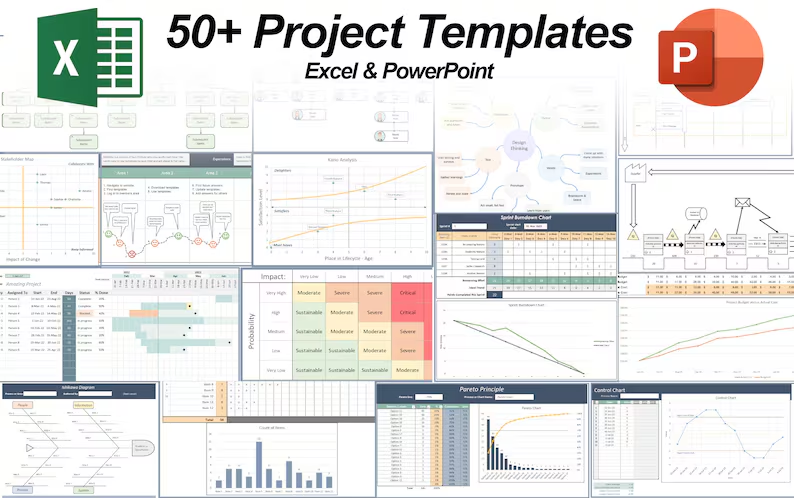 50+ Project Management Templates in Excel and PowerPoint (Gantt Chart, Risk Matrix and more!)
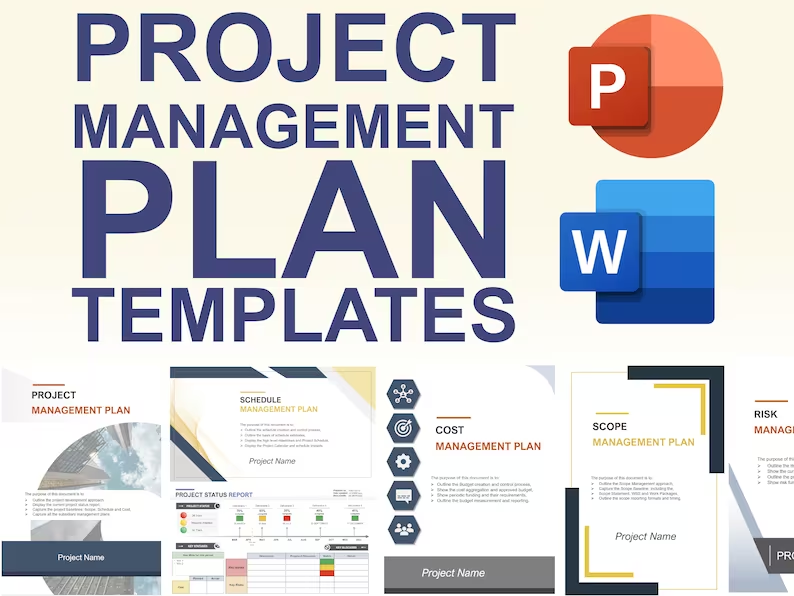 Pre-made Project Management Plan Templates: Save 100 HOURS!