All posts by David McLachlan

Early and Frequent Feedback – The Agile Practice Guide

– Back to the Agile Practice Guide (all) –

Core Agile Practices

There are certain core Agile practices that, when you do them with your team, they increase your team’s engagement and results. You also don’t need to call yourself “Agile” – if you are doing some or all of these Agile core practices then you could class yourself as an Agile team, and you will no doubt already know the benefits they bring.

This particular core practice is “Early and Frequent Feedback”.

Check out the video and article now!

Early and Frequent Feedback

When you’re working on an Agile project or delivering in an Agile way, your projects will usually have short iterations.  These short iterations are usually time-boxed pieces of work from two to four weeks, where you deliver something or showcase something for feedback. By releasing something in short cycles what we’re actually doing is enabling a project team to receive early and continuous feedback on the product’s quality throughout the development life cycle.

Continue reading Early and Frequent Feedback – The Agile Practice Guide

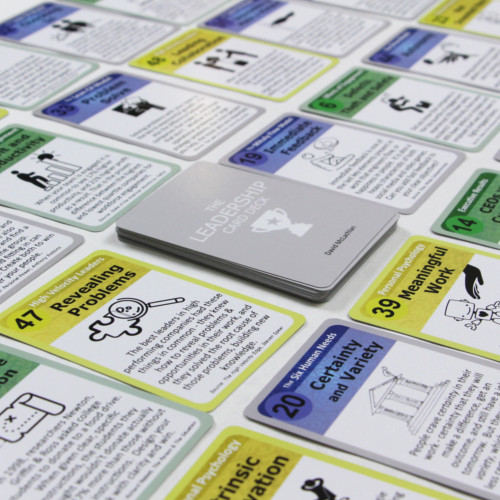
Meaningful Work – Quote by Teresa Amabile

– See all the Leadership Quotes here –

“Of all the things that can boost inner work life, the most important is making progress in meaningful work.”


In 2011, Teresa Amabile revealed some research she and her team had been working on that completely upended what was previously thought about leadership and engaging your employees.

It wasn’t fear-based, it wasn’t money-based, and it wasn’t necessarily touchy-feely “let’s hug it out”-based.

Meaningful Work

Source: Harvard Business Review – The Power of Small Wins

To find these new answers Teresa had 26 project teams across seven companies fill out diaries at the end of each work day.  The result was writings that revealed what made people the happiest in their work, and what made them want to continue working even when they didn’t have to – in other words, “Discretionary Effort”, the holy grail of any Employee Engagement initiative.

Continue reading Meaningful Work – Quote by Teresa Amabile

The Agile Whole Team Approach | Agile Practice Guide

– Back to the Agile Practice Guide (all) –

Agile Core Practices

Looking at the core Agile practices from the Agile Practice Guide is a great way to see if a team is really Agile, even when they may call themselves something different.  This is direct from the Project Management Institute and Agile Alliance.

Watch the video below to find out now!

The Whole Team Approach

The Whole Team Approach means involving everyone with the knowledge and the skills necessary to ensure project success. What that means is instead of having to gather different people from all around the organization or another area to actually work on your project in little bits and pieces, we’re including them all in the one, whole team. They’re one hundred percent dedicated to the project and can really deliver much more quickly.

The team should be relatively small, as successful teams have been observed with as few as three people and as many as nine people. The reason for that is when you’ve got only three people, the communication channels are much smaller and much easier. You can’t have a lot of side conversations or a lot of extra conversations on scope, and overall the communication is much simpler. When you’ve got twenty people for example or many different people you could have conversations in many different channels, and from many different people as well.  All of a sudden the communication becomes a lot more complex.

Continue reading The Agile Whole Team Approach | Agile Practice Guide

The Agile 12 Clarifying Principles

– Back to the Agile Practice Guide (all) –

The Agile 12 Clarifying Principles

These are the principles that dig deeper into the Agile Manifesto and mindset. Check out the video and article below to see if your team truly follows the Agile concepts in the way that is right for you.

We’ve already had a look at the Agile manifesto and mindset where we value the items on the left:

  • Individuals and interactions
  • Working software
  • Customer collaboration
  • Responding to change

…more than the items on the right, which are your typical linear methods or waterfall approach. Now we’re delving into it in a little bit more detail using the Agile 12 clarifying principles. When we’re delivering in an Agile way of course you know we’re using iterations where we’ve got time boxed work of between two to four weeks and we’re often delivering an increment to the customer, which is a “feature” that they can see, feel and touch, just to make sure that everything is on track, that they understand what’s being delivered and that the requirements are fit for purpose. So number one is:

1. Our highest priority is to satisfy the customers through early and continuous delivery of valuable software.

And that’s done through that iterative and incremental approach that we will be looking at in this series. You’ve got iterations of between two to four weeks where we’re putting all that feedback back into the product and we’re getting that feedback from the customer. And increments, where we’re delivering a feature so that the customer can just tell for themselves whether the requirements are fit for purpose.

Continue reading The Agile 12 Clarifying Principles

The Agile Manifesto and Mindset

– Back to the Agile Practice Guide (all) –

The Agile Manifesto and Mindset

Do you know where Agile all began?  The manifesto behind one of the fastest growing project management and product development methodologies of the new millennium?

Check out the video and article below as we go through the Agile manifesto and mindset.

Where it all began.

In 2001 a group of individuals representing the most widely used lightweight software development methodologies agreed on a common set of values and principles which later became known as the Agile Manifesto.

The Agile Manifesto contains four statements of values, and this is where it all began. You’ll see that there’s many methodologies or many Agile practices that come out of Agile that you’ll learn about soon, but they all stem from these core principles and these core values that came about in 2001. The four Agile Values are:

We value individuals and interactions over processes and tools.

So while processes and tools are important we value individuals and interactions more than processes and tools, and you’ll see that in the practices of agile where we have daily stand-ups and we’re really interacting to remove blockers on a daily basis rather than letting them simmer. So this is where we’re interacting and we’ve got the whole team approach where everyone who’s needed to be in a project is actually within that team – you don’t have to go externally or find them in other departments, they’re all within the one team. You can talk to them quite quickly and immediately. Next we prefer:

Continue reading The Agile Manifesto and Mindset

What is Servant Leadership in Agile Project Management?

– Back to the Agile Practice Guide (all) –

Do you know what it means to be a Servant Leader in Agile Project Management? Whether you’re a Scrum Master, Project Manager, facilitator or coordinator, understanding Servant Leadership will help you.

Check out the video below, now!

Servant Leadership – Agile practices

From the Agile Practice Guide, by the Project Management Institute and Agile Alliance. Agile approaches emphasise servant leadership as a way to empower their teams. Servant leadership is the practice of leading through service to the team – so in other words you’re the leader, you’re the boss, but your customers are actually your team members.  As a servant leader you’re here to serve them as well and help them get what they need so that they can do the best job that they possibly can.

That means understanding and addressing the needs and development of the team members to enable that highest possible performance.  Servant leaders approach project work in this order – first of all we start with the “why”.  That’s a classic book from Simon Sinek, and many people have written about it.  We don’t start with what we’re doing we actually start why we’re doing it.

Continue reading What is Servant Leadership in Agile Project Management?

When to Use Agile, Waterfall, Iterative or Incremental Project Life Cycles

– Back to the Agile Practice Guide (all) –

Project Development Lifecycles

Project Life Cycle Deep Dive!

Do you know when to use Agile, and when to use Waterfall?  Do you know the difference and benefit of using iterations versus increments, or both?  From the Agile Practice Guide from the Project Management Institute (PMI) and Agile Alliance, we look at the four types of Project Lifecycles and the best times to use them.

Check out the video below now!

We’re looking at the characteristics of project life cycles from the Agile Practice Guide from the Project Management Institute and Agile Alliance.

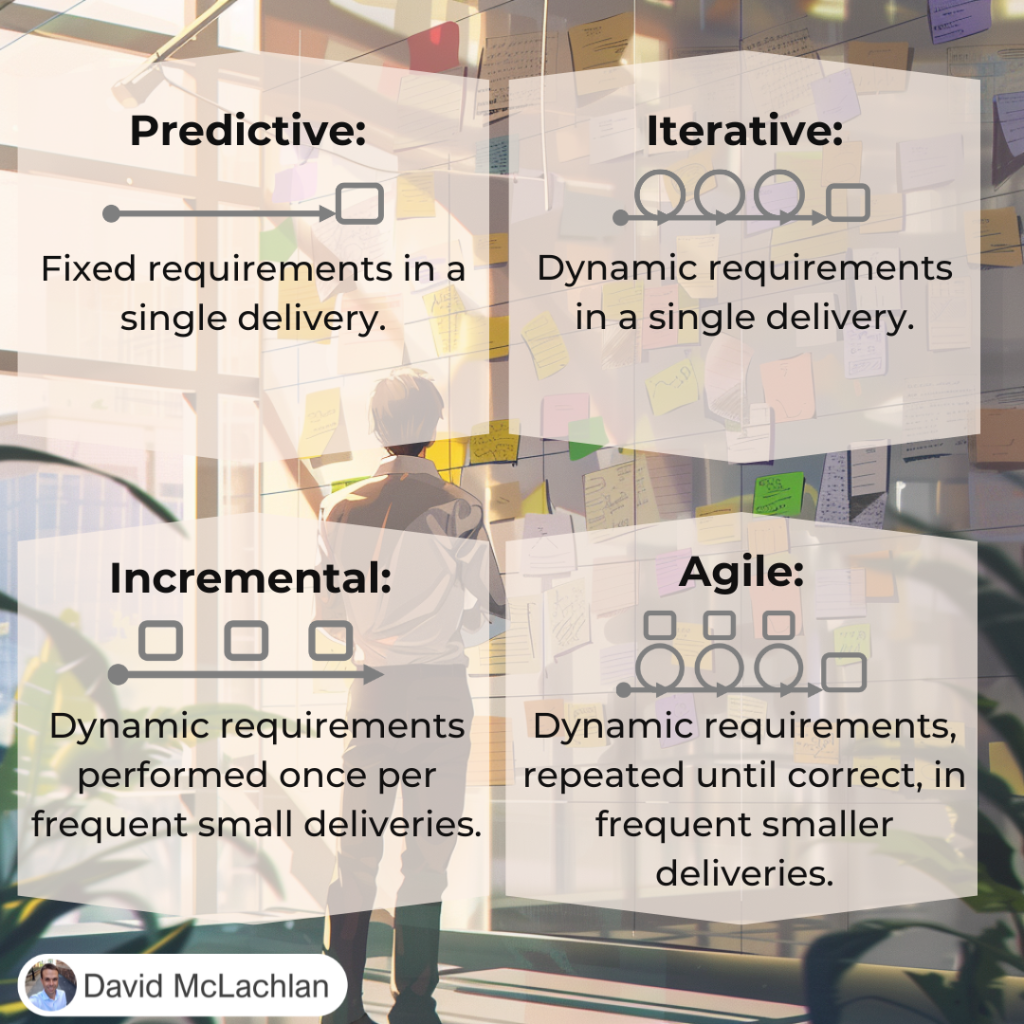
Previously we’ve looked at the different types of life cycles.  We’ve got the predictive life cycle which is your traditional waterfall approach – very step-by-step.

We’ve got an iterative approach where we’re iterating, and we’re not necessarily releasing something but we’re getting feedback on a regular basis, usually every two to four weeks.

Then we’ve got the incremental life cycle and that is where we’re actually delivering an increment to something usable that a customer can can use see feel and touch and getting that feedback as well using that approach.

Lastly the Agile approach which is both incremental and iterative so we’ve combined those two things or we’re iterating towards success building that feedback back into the product but also releasing that product on a regular basis to refine that work and to deliver frequently.

So let’s delve into the characteristics of these life cycles a little more deeply.

Continue reading When to Use Agile, Waterfall, Iterative or Incremental Project Life Cycles

Different Project Lifecycles and When to Use Them – Agile and Waterfall

– Back to the Agile Practice Guide (all) –

Project Development Lifecycles

Project Lifecycles: The Agile Practice Guide

Do you know the different types of project lifecycles you can use to manage your project, develop a product, or bring a change about in a company?

The Agile Practice Guide goes into four main project lifecycles: Waterfall, Incremental, Iterative, and Agile.  There is also “Hybrid” – a combination, which many companies end up using.

Check out the video for details on them now!

There are Many Different Project Environments

In the video, we’re looking at the different types of project life cycles and when we might need to use them.  The reason we’re doing this is because there are many different types of projects, different environments they operate in, and projects are often very different.

We might have different organizational structures – for example it might be PMO controlled or it might be functional manager controlled, it might be just within one team or within many departments.  There are different life cycles involved in how to manage those projects, there are different  management styles, different sizes, different customer needs and requirements, different products or outputs, and the list really does go on.

You might also have co-located teams or dispersed teams you might be governed by a supportive, controlling or directive project management office, or the functional manager of a team.  Your sponsor or customer might want daily reports, weekly reports, or they may just have a completely hands-off approach and want you to do the work and report in once it’s done.  You may have more than one customer group receiving the benefit of the project which can really complicate things, and of course the project may be technically simple simple or technically complex.

Now all of these things combine into what we look at as the project having easily definable work or high uncertainty work and that’s the difference where the different life cycles and the ways of managing a project comes into it.

Continue reading Different Project Lifecycles and When to Use Them – Agile and Waterfall

A Simple (Yet Powerful) Framework for Employee Engagement

It’s time to unpack Employee Engagement.

By now the benefits of having engaged employees – teams who come to work with their whole self and genuinely care about doing a good job – should be nothing new to you. But just in case they are, here’s a taste:

Highly engaged employees take 41% fewer sick days. They have 21% higher productivity, and 17% higher sales. They make 17% fewer mistakes.  This is what the actual statistics say.  Companies with the majority of highly engaged employees earn on average twice the revenue of companies whose employees drag their feet on the way to work.

And it makes sense, doesn’t it? If your team is dragging their feet on their way to work, then dragging their feet while they perform their work, they are not getting as much done as they could.  They are not happy, and that unhappiness has a big impact on your results as a leader.

But employee engagement goes deeper than that – much deeper. In fact, part of what I am about to show you is that by creating a workplace that enables a high engagement in your staff, you are actually doing something more meaningful than increasing your profit (although that is definitely nice). You’re doing a public service, and improving the community around which you work. You’re bringing happiness by reducing the effects caused by many workplaces like depression, anxiety and fatigue.  By improving your people, you’re improving the community, and by improving the community you’re improving the broader world around you.

In creating a workplace that has engaged employees, you are bringing meaning to your people’s work. Given that we spend the majority of our time at work (apart from sleeping), you are now giving meaning to their life. In giving meaning to a person’s life, you are meeting more of their basic and enhanced needs that, according to Maslow, bring happiness. In bringing happiness you are reducing things like depression. You’re reducing illness, as happy people have been proven to get sick less often (41% less often, actually).

Continue reading A Simple (Yet Powerful) Framework for Employee Engagement

21 of the Best Pieces of Research on Employee Engagement (and How To Motivate Your Team)

Employee Engagement Research & Sources

If you’ve read any form of leadership literature over the past year there’s a good chance you’ve heard about the epidemic that is sweeping the globe, and has been for some time.  No country is safe – whether it is a first world country with all the benefits a person could want, or a third world country where workers are truly exploited.

That epidemic is employee engagement.

Low engagement across the world in what should be a meaningful endeavor – work, has strangled productivity and is robbing employees around the world of their energy and happiness.  You see, it’s only in the last 100 years that work has really been separate from the management and planning.  And that separation has led to meaningless work, separated from the customers who benefit or the outcomes they produce.

Now more than 70% of employees, even in first world countries, are disengaged in their work.

I’ve put together a manifesto with a clear step-by-step guide to improving employee engagement, and below are the sources for research that all point to the same thing: We crave clarity, regular checking in from our leaders where they focus on our strengths, and continuous improvement, and despite what you may have experienced the meaning we can get from normal every day jobs runs very deep.

Let’s check it out!

  1. The State of the Global Workplace, Gallup
  2. Growth Mindset
  3. Maslow’s Hierarchy of Needs
  4. Hertzberg’s Two Factor Theory
  5. Happiness, income satiation and turning points around the world
  6. High income improves evaluation of life but not emotional well-being
  7. Eustress versus Distress
  8. Harvard Forces of Employee Engagement
  9. Self-Determination Theory and the Facilitation of Intrinsic Motivation
  10. SWOT Analysis For Management Consulting (Albert Humphrey)
  11. Do Employees Really Know What’s Expected of Them? Gallup
  12. The Million Dollar Checklist: Sustaining reductions in catheter related bloodstream infections
  13. The Person and the Situation – effects of environment on motivation
  14. Universal and Cultural Dimensions of Optimal Experiences
  15. Motivating Language Theory
  16. The Art of Motivating Employees
  17. Driving Engagement by Focusing on Strengths
  18. Inner Work Life: Understanding the Subtext of Business Performance
  19. Harvard, The Easiest Way To Change People’s Behavior
  20. Timing Matters: The Impact of Immediate and Delayed Feedback on Learning
  21. The Power of Feedback
  22. Google’s research on Clarity and Meaning

First, the statistics on the current engagement epidemic.

Continue reading 21 of the Best Pieces of Research on Employee Engagement (and How To Motivate Your Team)