All posts by David McLachlan

10 Predictive PMP and CAPM Questions and Answers (21 to 30)

Click the video above to view

Practice These Video Questions to Pass your PMP or CAPM

Here are 10 PMP and CAPM Practice Questions to help you pass your PMP exam! Watch the video and check the question summaries below:

Question 21 – How to Handle Opportunity

A project manager is developing a customer portal with a knowledge base and self-service tools. Another project manager suggests repurposing training videos as tutorials for the portal, requiring a decision on how to handle this opportunity.

Question 22 – Which Development Approach?

A project involves developing a mobile application for a retail company. Some requirements are well-defined, while others depend on user feedback during development, requiring a decision on the most suitable development approach.

Question 23 – How to Ensure Quality?

A large project is underway to develop a new customer relationship management system with strict regulatory requirements. The project manager needs to determine the best approach to ensure quality and avoid costly rework or delays.

Question 24 – What to Do with Risks

During the planning phase, the team completes qualitative and quantitative risk analysis to identify potential project risks. The next step is deciding how to document and manage these risks effectively.

Question 25 – Leadership Styles

A project manager joins a new team where the functional manager follows a transactional leadership style. The task is to understand what to expect from this leadership approach.

Question 26 – Types of Power

A senior engineer is advocating for a change in project scope. Their influence comes from the trust the team places in their experience and knowledge. What form of power are they using?

Question 27 – PMO Types

A project management office (PMO) provides project managers with templates, training, and access to historical data but does not control project execution. What type of PMO is this?

Question 28 – Behind Schedule Construction Project

A construction project in the execution phase is behind schedule. The planned progress was 50%, but only 40% is complete, and the actual cost is higher than planned. What should the project manager do next?

Question 29 – Project Design Not Complete

In a phased project (design, development, testing), the design phase is nearing completion, but a stakeholder raises concerns about missing requirements. The team is ready to move forward. What should the project manager do?

Question 30 – Which Process Group?

A construction project has just been approved. The project manager needs to finalize the scope, estimate resources, and plan execution before construction begins. What process group is the project currently in?

You Can Pass Your PMP

Every question you tackle brings you one step closer to mastering project management. Remember, managing projects isn’t just about answering exam questions – it’s about making real-world impact, driving change, and delivering value. Challenges will come, but persistence and problem-solving will set you apart.

Keep pushing forward, keep practicing, and never doubt your ability to succeed. I believe in you, and I know you’re on the right path. Stay motivated, keep learning, and make it happen. You’ve got this!

David McLachlan on LinkedIn

See more PMP Exam Practice articles: 

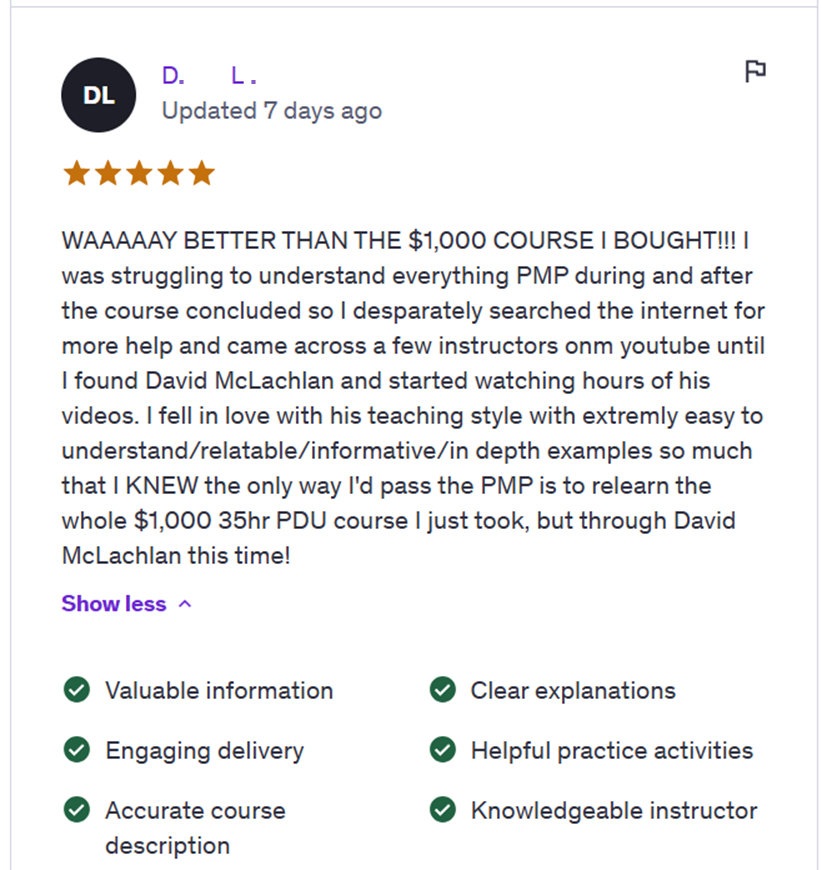
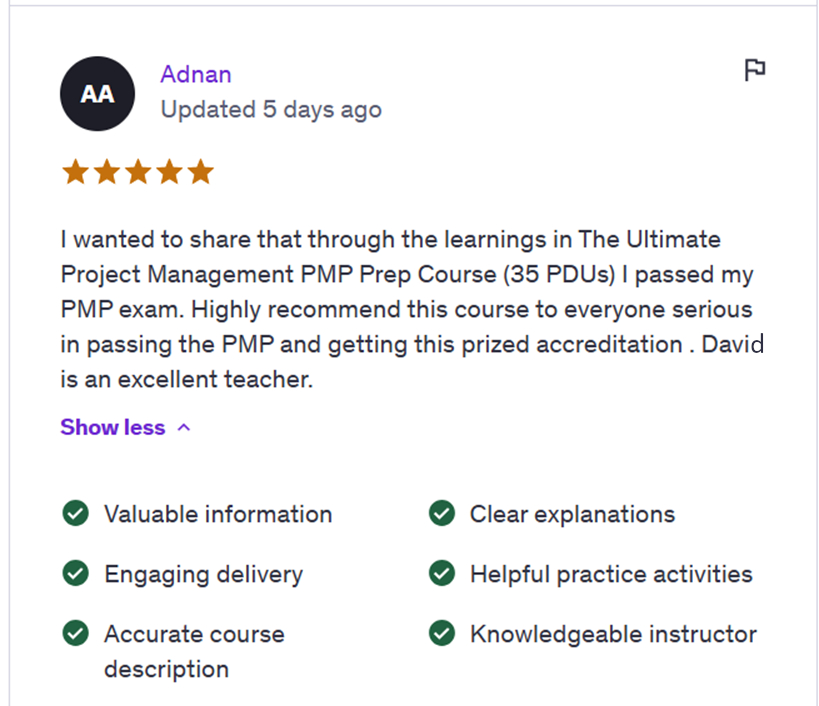
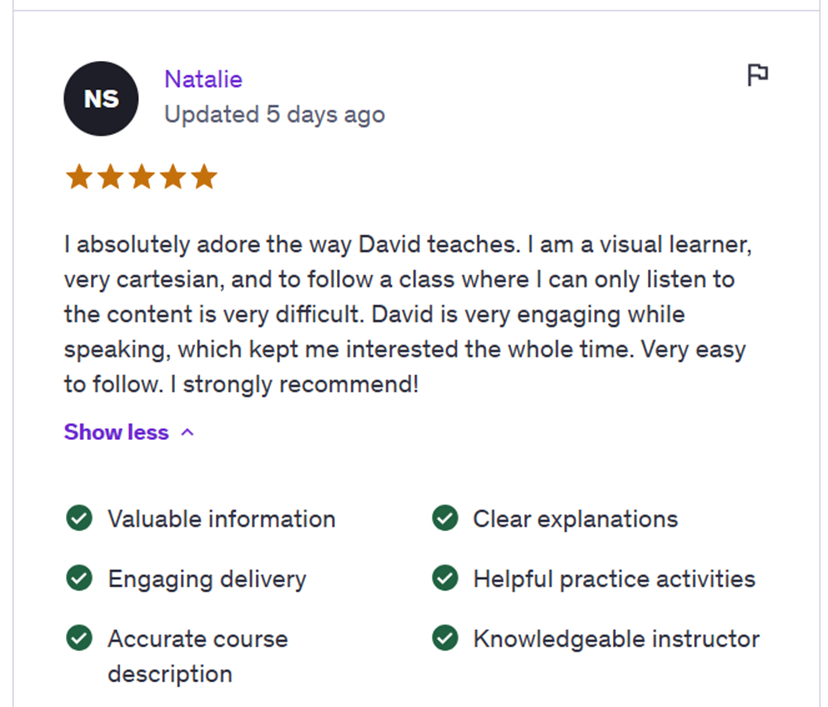
You can see what people are saying about David McLachlan here: REVIEWS

Navigate to Free Project Management and Leadership Articles through the links on the right (or at the bottom if on Mobile) 
PMI PMP 35 PDUs CourseThe Ultimate PMP Project Management Prep Course (35 PDUs)
Agile Certified Practitioner (PMI-ACP 21 PDUs)The Complete PMI-ACP Course: (28 PDUs) 
50 Project Management Templates Gantt Chart Risk Matrix and more Excel50+ Project Management Templates in Excel and PowerPoint (Gantt Chart, Risk Matrix and more!)
Project Management Plan TemplatesPre-made Project Management Plan Template: Save 100 HOURS!


10 Must-Know Project Initiation Documents

Click the video above to view

10 Must-Know Project Initiation Documents

When initiating a project, it is crucial to ensure feasibility, evaluate risks, and align stakeholders on key objectives. The PMBOK Guide outlines several key documents that help structure the project initiation phase effectively. Here are the 10 must-know project initiation documents, explained with the example of the Pet Buddy app—a mobile application aimed at connecting pet sitters with pet owners.

1. Business Case

The business case assesses whether the project is viable and worth pursuing. In our example, it includes:

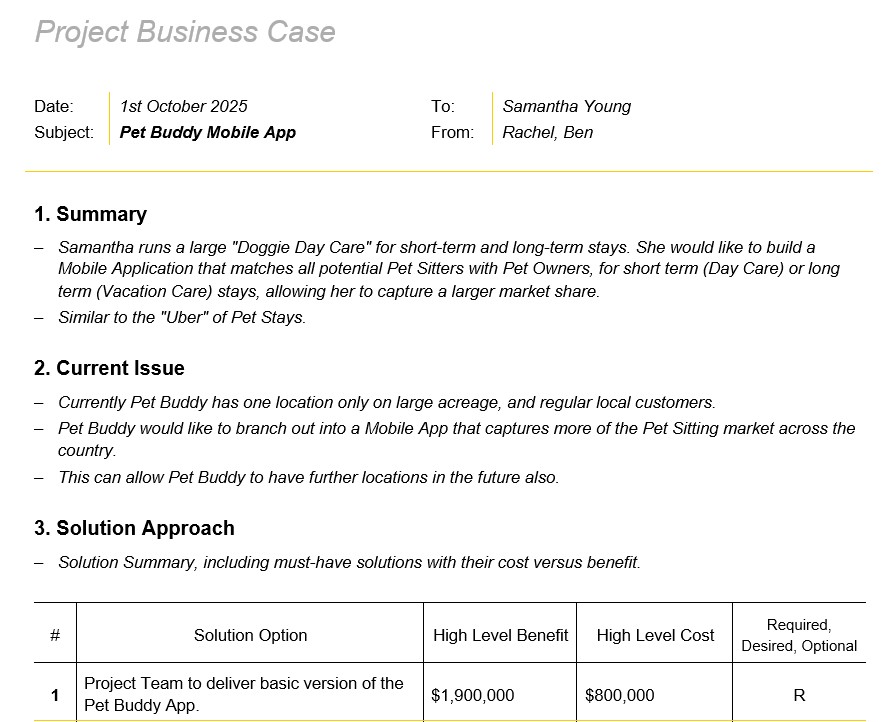
  • Summary: Pet Buddy aims to expand its current daycare service through a mobile app.
  • Current Issue: Limited to a single location, the business seeks to scale through technology.
  • Solution: Develop an app for pet sitters and pet owners.
  • High-Level Costs: $800,000 for development.
  • Projected Benefits: $3.9 million in revenue over three years.
  • Recommendation: Move forward with development.

Business Case template

2. Benchmarking

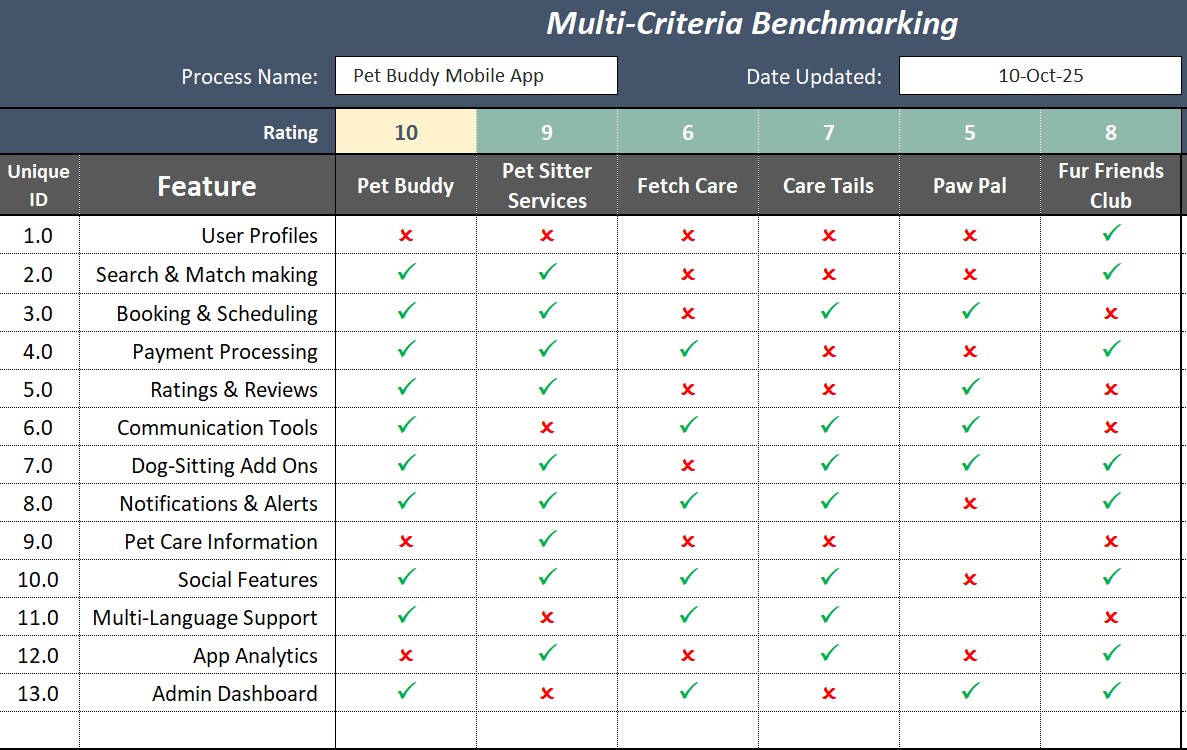
Benchmarking evaluates competitors and market trends to determine if the project offers a competitive advantage. In our example for Pet Buddy we might include:

  • Competitor Analysis: Identifies competitors lacking features like social features, detailed sitter profiles, and add-on services.
  • Feature Comparison: Helps position Pet Buddy for differentiation.
  • Market Fit Assessment: Determines key improvements needed to outperform competitors.

Benchmarking template

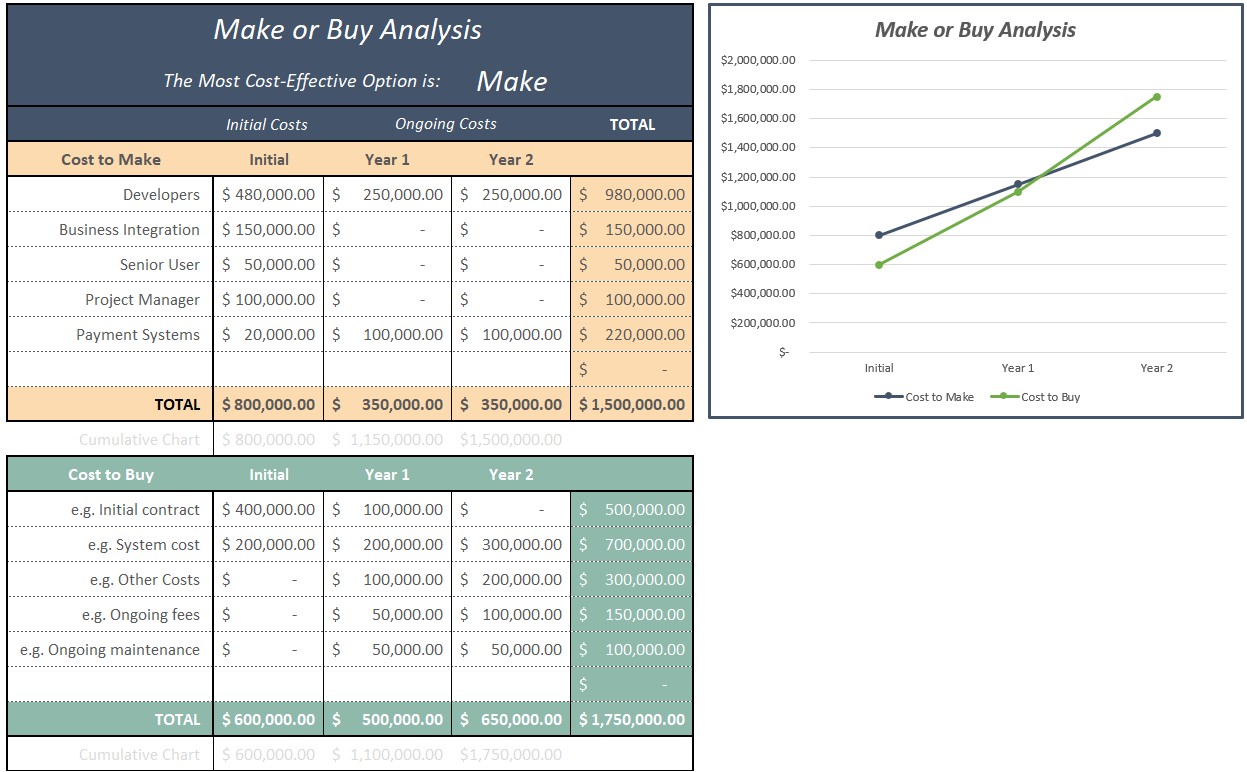
3. Make or Buy Analysis

This document assesses whether to develop the project internally or outsource it. In our example, we look at:

  • Cost to Make: $800,000 initial cost, $350,000 annual maintenance.
  • Cost to Buy: $600,000 annually for white-label solutions.

Conclusion: In this situation, in-house development becomes more cost-effective after two years.

Make or Buy Analysis Template

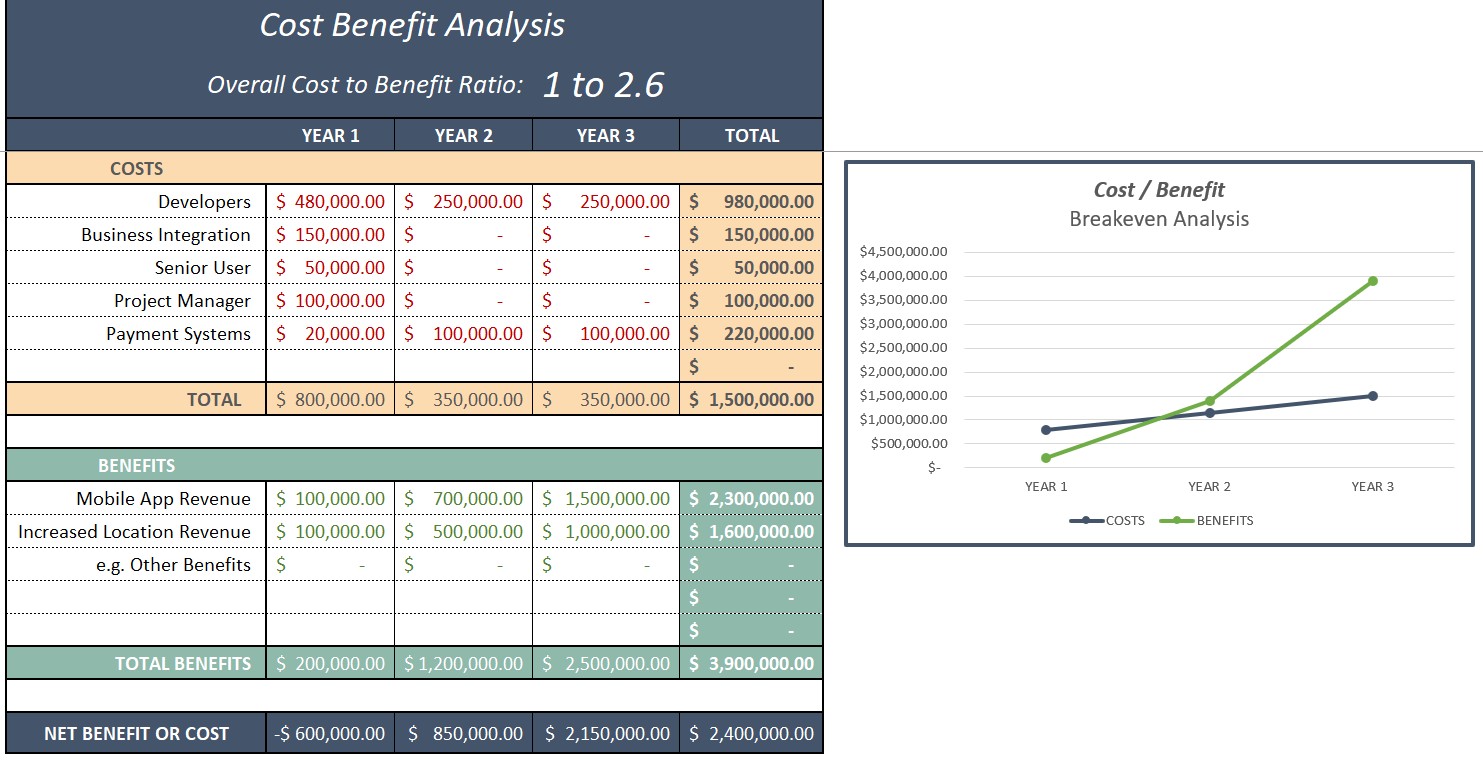
4. Cost-Benefit Analysis

Evaluates the financial viability of the project. For example:

Year 1 Costs: $800,000 (development, integration, project management).

Projected Revenue:

  • Year 1: Limited revenue.
  • Year 2: Significant growth.
  • Year 3: $3.9 million revenue.

Break-Even Point: Between years 2 and 2.5.

Benefit-to-Cost Ratio: 2.6 (favorable for investment).

Cost Benefit Analysis Template

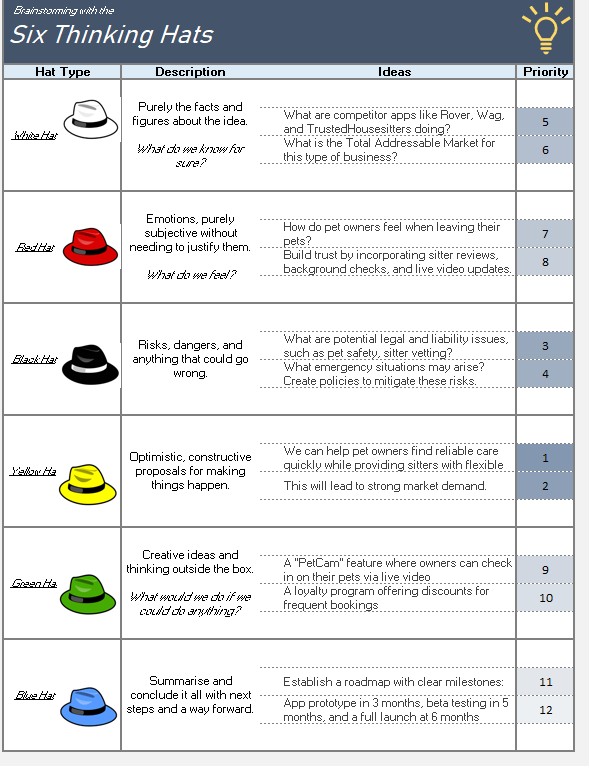
5. Six Thinking Hats

A brainstorming tool to assess different aspects of the project.

  • White Hat (Facts & Data): Market size, competitor analysis.
  • Red Hat (Emotions): Customer trust, sitter reliability.
  • Black Hat (Risks): Legal liability, emergency situations.
  • Yellow Hat (Opportunities): Increasing demand for trusted pet sitters.
  • Green Hat (Creativity): Loyalty programs, pet cameras.
  • Blue Hat (Summary & Next Steps): Action plan for moving forward.

Six Thinking Hats Template

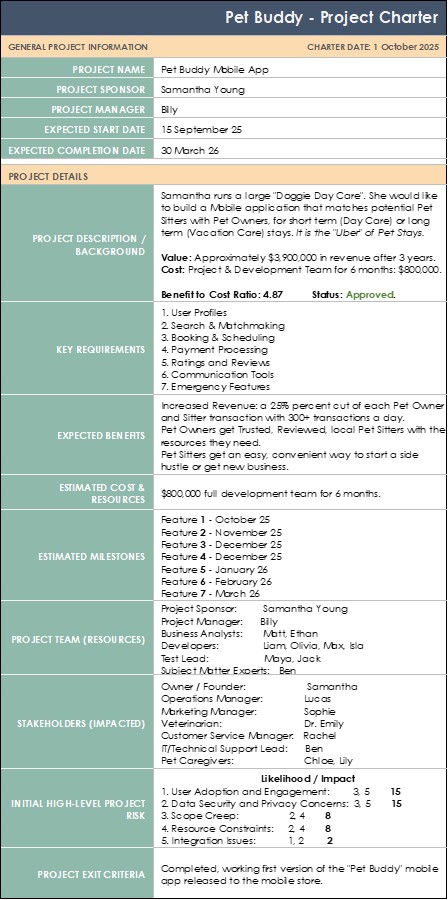
6. Project Charter

Defines the high-level scope, stakeholders, and objectives. In our example, we include things like:

  • Project Name: Pet Buddy Mobile App.
  • Project Sponsor: Samantha (Business Owner).
  • Project Manager: Billy.
  • Objective: Connect pet owners with trusted sitters.
  • Key Features: User profiles, scheduling, payments, messaging.
  • Estimated Cost: $800,000.
  • Risks Identified: Scope creep, data security, user adoption.
  • Completion Criteria: First working version launched in app stores.

Project Charter template

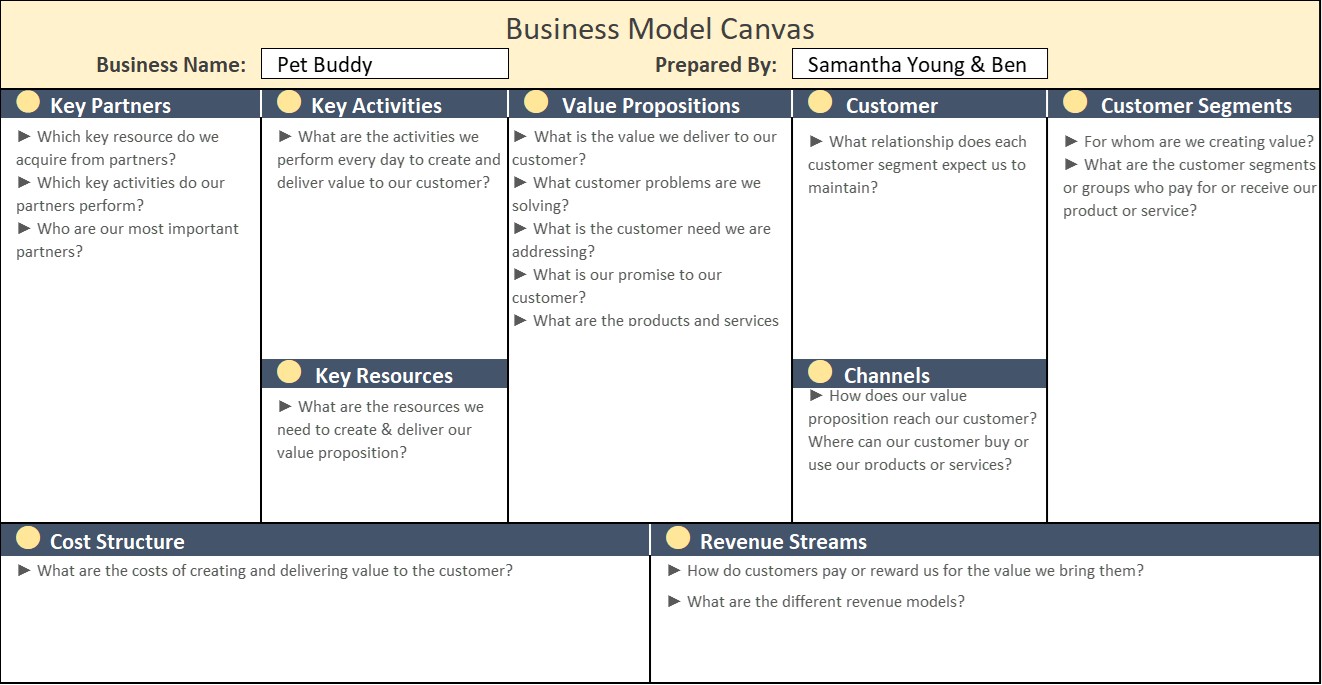
7. Business Model Canvas

A visual one-page plan to explore value creation and delivery, often used in Start-ups or for new products or features. It might include things like:

  • Customer Segments: Pet sitters, pet owners.
  • Value Proposition: Easy, trusted pet-sitting services.
  • Revenue Streams: Booking fees, subscription models.
  • Channels: Mobile app, social media marketing.
  • Key Partners: Developers, payment processors.

Business Model Canvas template

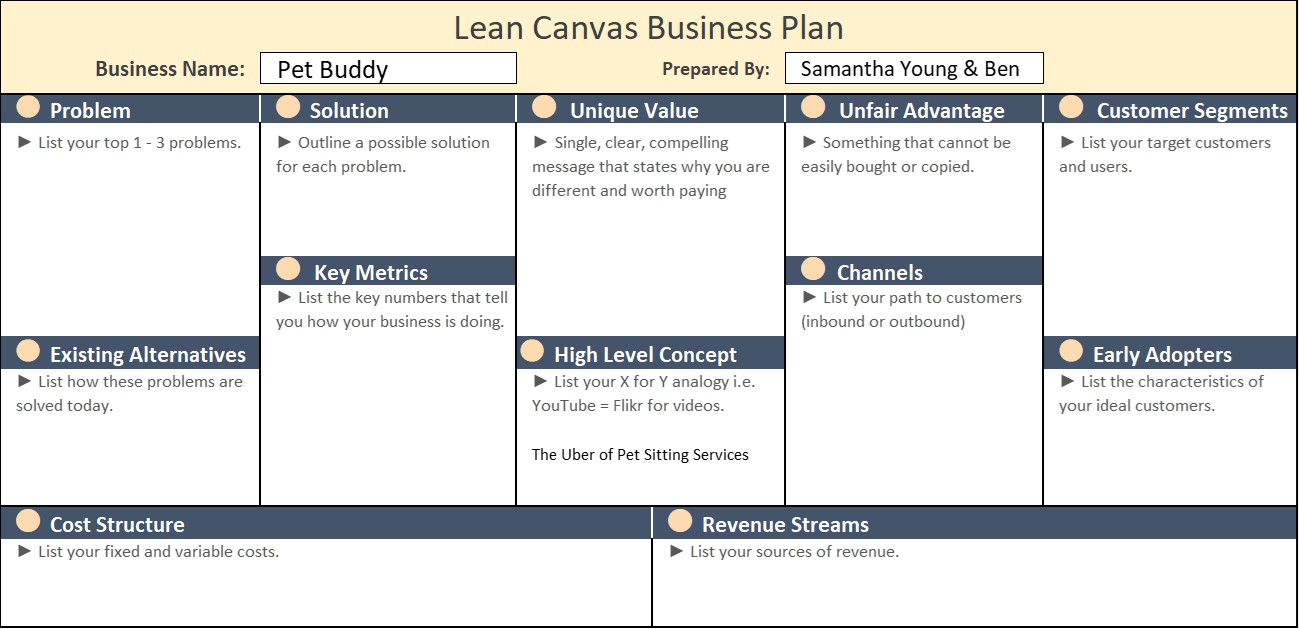
8. Lean Canvas

A startup-friendly alternative to the Business Model Canvas. In our example, we focus on things like:

  • Problem: Pet owners struggle to find reliable sitters.
  • Solution: Uber-like matching system for pet sitters.
  • Unique Value Proposition: Trusted and rated pet sitters.
  • Unfair Advantage: Built-in review system, strong brand trust.
  • Key Metrics: App downloads, engagement rate, booking conversions.

Lean Canvas

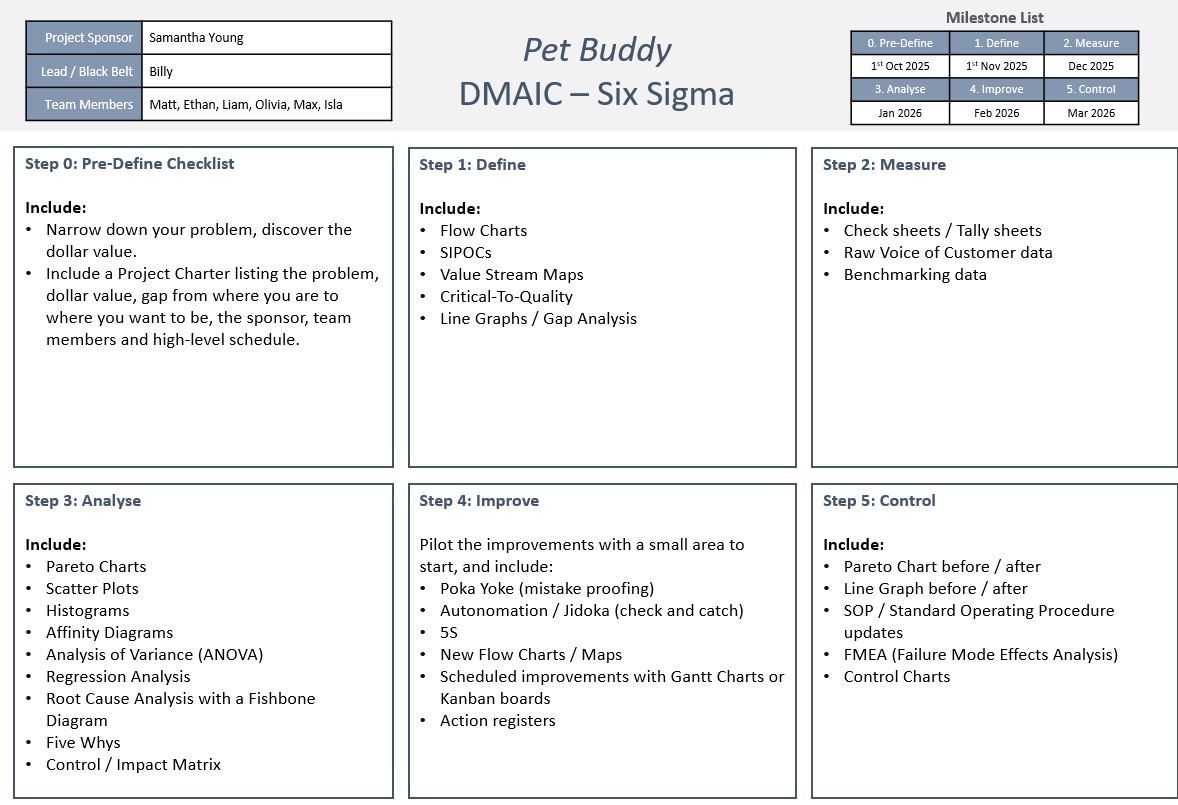
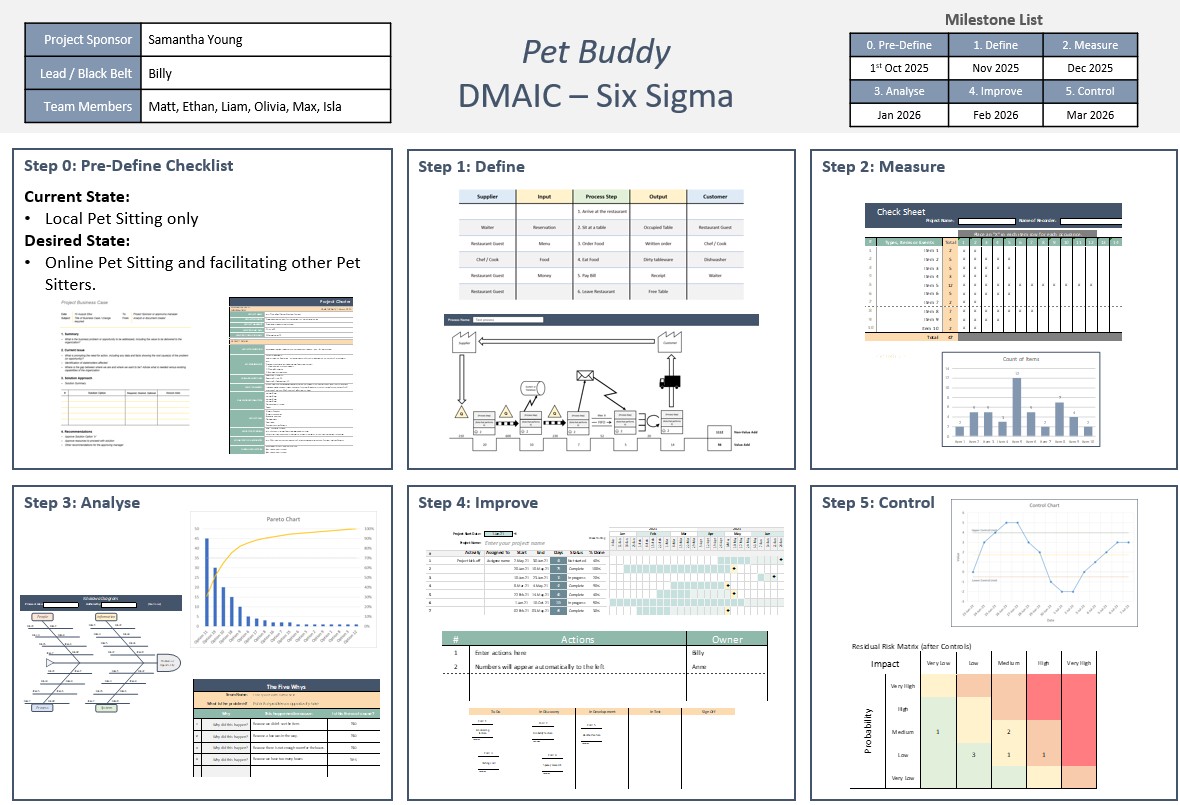
9. DMAIC (Define, Measure, Analyze, Improve, Control)

A Six Sigma approach for structuring project initiation. In our example, we go through:

  • Define: Identifying the need for a pet-sitter app.
  • Measure: Current market conditions and demand.
  • Analyze: Competitor gaps and cost-benefit results.
  • Improve: Iterative development and feature prioritization.
  • Control: Ongoing performance measurement post-launch.

09 DMAIC Six Sigma Template 0209 DMAIC Six Sigma Template 01

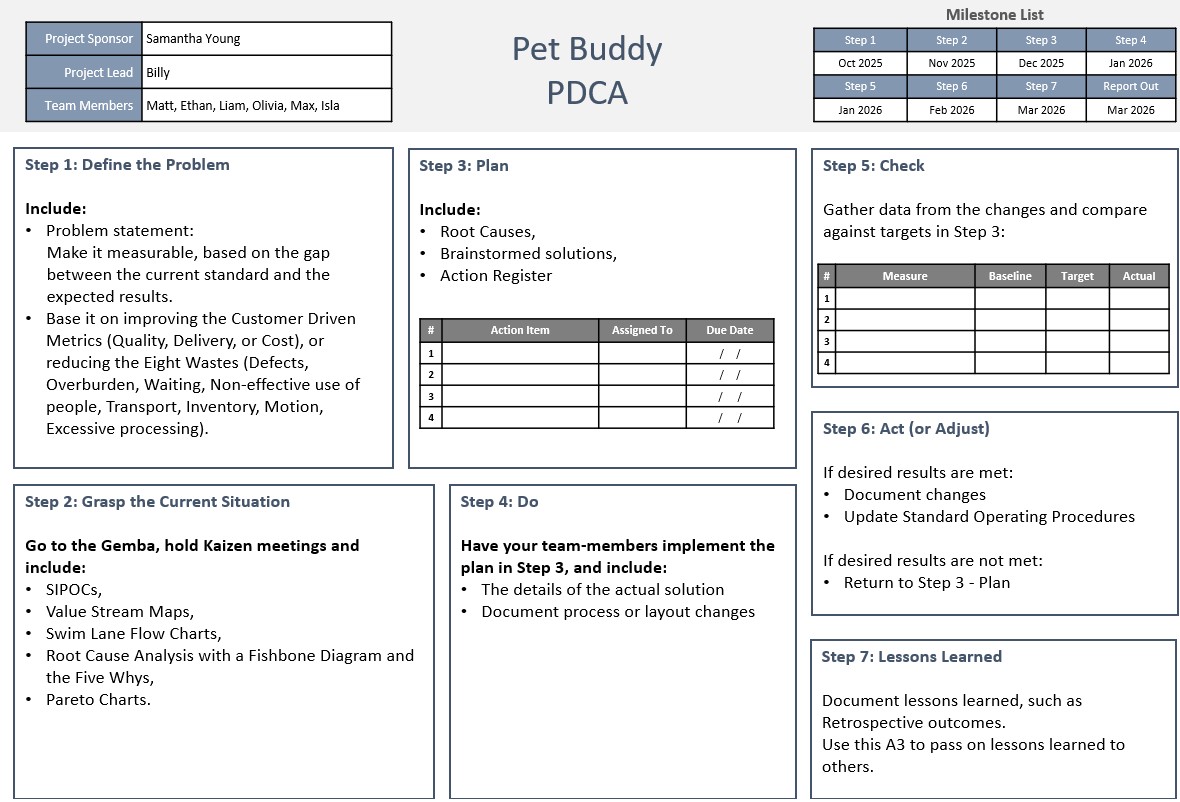
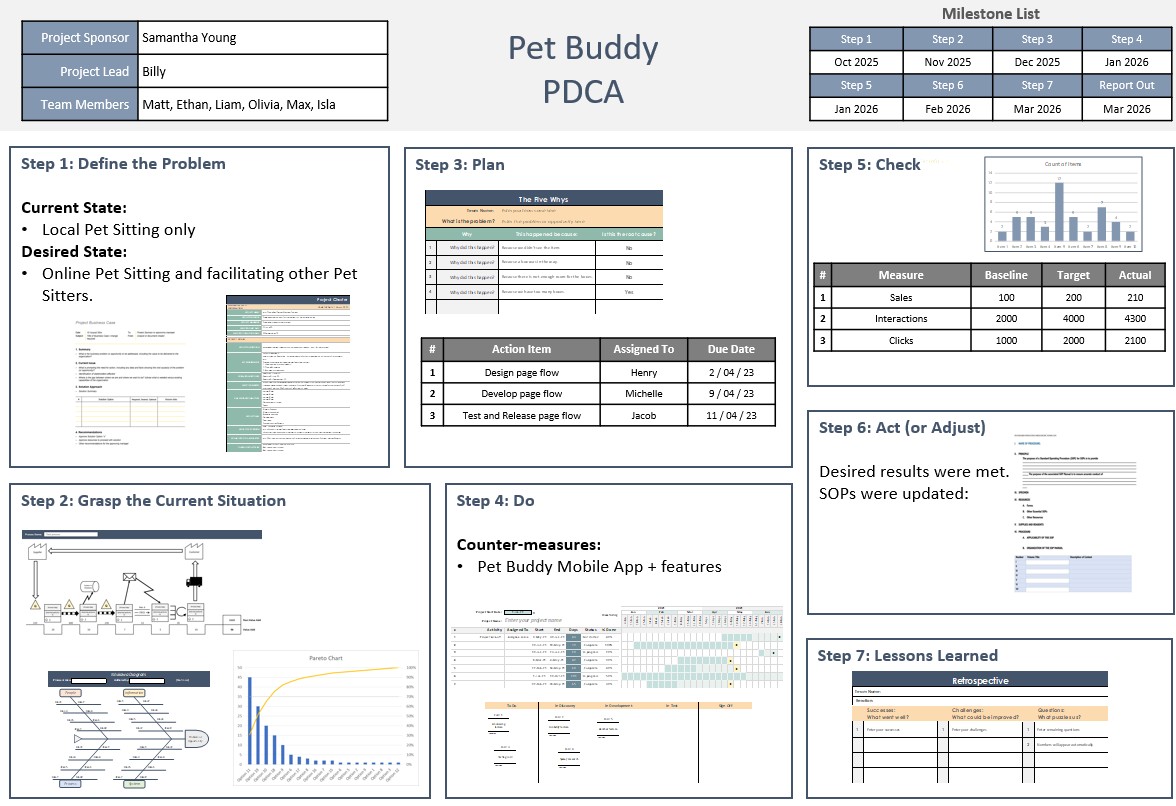
10. Plan-Do-Check-Act (PDCA) Cycle

A continuous improvement model.

  • Plan: Define project goals, features, and scope.
  • Do: Develop a minimum viable product (MVP).
  • Check: Gather user feedback and adjust.
  • Act: Implement improvements and scale operations.

10 PDCA Template 01 10 PDCA Template 02

Conclusion

These ten project initiation documents provide many ways towards a structured approach to launching a successful project. From assessing feasibility to defining the roadmap, they help ensure clarity, alignment, and risk mitigation. In the case of Pet Buddy in our example, using these documents has demonstrated a clear financial and operational advantage in moving forward with the mobile app development.

By mastering these documents, project managers can ensure a smooth and well-planned project initiation phase, setting the foundation for long-term success.

David McLachlan on LinkedIn

See more PMP articles: 

You can see what people are saying about David McLachlan here: REVIEWS

Navigate to Free Project Management and Leadership Articles through the links on the right (or at the bottom if on Mobile) 

PMI PMP 35 PDUs CourseThe Ultimate PMP Project Management Prep Course (35 PDUs)
Agile Certified Practitioner (PMI-ACP 21 PDUs)The Complete PMI-ACP Course: (28 PDUs) 
50 Project Management Templates Gantt Chart Risk Matrix and more Excel50+ Project Management Templates in Excel and PowerPoint (Gantt Chart, Risk Matrix and more!)
Project Management Plan TemplatesPre-made Project Management Plan Template: Save 100 HOURS!


What To Do If You Don’t Have A Product Owner

Click the video above to view

What Do You Do If You Don’t Have a Product Owner?

In an agile environment, the product owner plays a crucial role in prioritizing the backlog, ensuring that the most valuable features and fixes are addressed first. But what happens when there isn’t a product owner in place? This is a real-world scenario that many agile teams face, and understanding how to handle it is essential for keeping projects on track. Let’s explore how to navigate this situation effectively.

Understanding the Product Owner’s Role

The product owner is responsible for:

  • Managing and prioritizing the backlog
  • Acting as a bridge between stakeholders and the development team
  • Defining and refining requirements based on business needs
  • Ensuring that the team is working on high-value tasks

In an ideal scenario, the product owner makes prioritization decisions, ensuring alignment with business objectives. However, in some cases, teams may not have a dedicated product owner, leaving project managers or agile teams to fill in the gaps.

A Common Scenario: An Executive Stakeholder Requests a New Feature

Imagine you’re part of an agile team developing new features for an app. An executive stakeholder with significant influence approaches the team, requesting a new feature they believe is important. Typically, the product owner would determine whether to add it to the backlog and prioritize it accordingly. But if there is no product owner, how should the team respond?

Steps to Take Without a Product Owner

Assess Business Value and Impact

The first step is to determine whether the requested feature aligns with the product vision and objectives. Ask:

  • Does this feature support the overall business strategy?
  • What is the expected value versus the cost of development?
  • Will it impact other priorities already in progress?

Collaborate with the Team and Stakeholders

Without a product owner, decision-making should be collaborative. The project manager, Scrum Master, and key stakeholders can work together to discuss the feature’s feasibility and potential impact. Involve developers, designers, and other key team members in evaluating the effort required.

Use Cost-Benefit Prioritization

Prioritization in agile projects typically relies on cost-benefit analysis, considering factors like:

  • Revenue potential
  • Customer impact
  • Effort required for implementation

Alignment with current sprint goals

If the feature provides high value with minimal effort, it may be worth incorporating sooner rather than later.

Place the Feature in the Backlog

Even without a product owner, the team can place the feature request in the backlog. However, it should not be immediately prioritized over existing work without a thorough discussion. Ensure transparency by documenting the feature’s potential value and discussing it in backlog refinement meetings.

Avoid Unnecessary Work Before Prioritization

If the feature has not yet been prioritized, avoid spending time gathering detailed requirements or elaborating on it too soon. Agile follows rolling-wave planning, meaning details should only be worked out when a feature is scheduled for development.

Follow Agile Decision-Making Principles

If prioritization responsibility is unclear, establish a temporary decision-making framework. Some teams designate a lead business analyst, senior team member, or a committee to handle backlog prioritization until a product owner is assigned.

Communicate Decisions Transparently

If the team determines that the feature should not be an immediate priority, communicate this decision to the requesting stakeholder clearly. Provide reasoning based on business value, development effort, and existing priorities. If needed, offer an estimated timeframe for reconsideration.

Adapting to a Product Owner-Less Environment

While a product owner is a vital role in agile, teams can still function effectively without one by fostering collaboration, maintaining clear prioritization criteria, and ensuring transparency in decision-making. Agile is about adaptability, and by following structured prioritization methods, teams can continue delivering value even in the absence of a dedicated product owner.

If your team frequently finds itself without a product owner, consider advocating for one or assigning temporary responsibilities to an engaged business representative, to ensure that prioritization remains aligned with business needs. Until then, leveraging teamwork, structured analysis, and agile best practices will help keep projects moving forward efficiently.

David McLachlan on LinkedIn

See more PMP Exam Practice articles: 

You can see what people are saying about David McLachlan here: REVIEWS

Navigate to Free Project Management and Leadership Articles through the links on the right (or at the bottom if on Mobile) 
PMI PMP 35 PDUs CourseThe Ultimate PMP Project Management Prep Course (35 PDUs)
Agile Certified Practitioner (PMI-ACP 21 PDUs)The Complete PMI-ACP Course: (28 PDUs) 
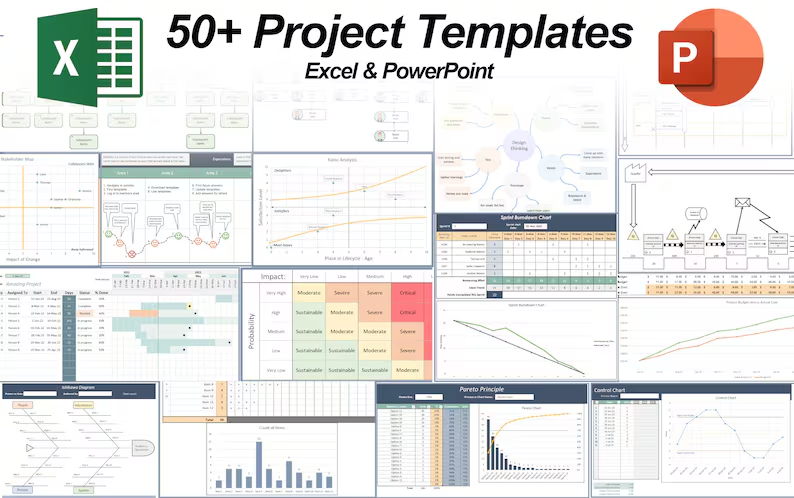
50 Project Management Templates Gantt Chart Risk Matrix and more Excel50+ Project Management Templates in Excel and PowerPoint (Gantt Chart, Risk Matrix and more!)
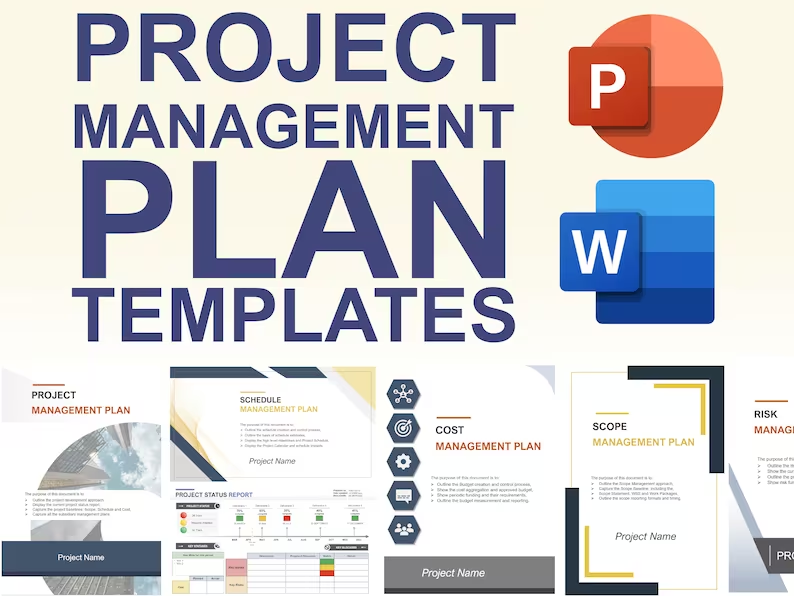
Project Management Plan TemplatesPre-made Project Management Plan Template: Save 100 HOURS!


10 Predictive PMP and CAPM Questions and Answers (11 to 20)

Click the video above to view

Practice These Video Questions to Pass your PMP or CAPM

Here are 10 PMP and CAPM Practice Questions to help you pass your PMP exam! Watch the video and check the question summaries below:

Question 11: Customer has Verified Project Completion – The project is nearing completion, testing is done, and deliverables meet specifications. The question asks what should be done next in the process before finalizing the project.

Question 12: Cost of Quality – The project sponsor emphasizes the importance of delivering a defect-free product. The question focuses on what steps should be taken to prevent defects from occurring during the project.

Question 13: Stakeholder Requests Additional Scope – A stakeholder requests a new feature, and a change request is submitted. However, the Change Control Board does not approve it. The question asks what the project manager should do next in response to the decision.

Question 14: Project is Authorized – What’s Next? – The project has received formal approval from the sponsor and is now moving forward. The question asks what the next step should be in the project lifecycle.

Question 15: How to Initiate a Project – After completing the business case, the project needs formal authorization to proceed. The question asks what step should be taken next to initiate the project officially.

Question 16: Engaging the Right Stakeholders – A project manager is developing an internal system for financial reports. Some stakeholders will rely on it but aren’t directly involved. The question asks how to ensure proper stakeholder engagement. Options include reviewing project documents, moving the team closer to stakeholders, analyzing stakeholder influence, or using a central team portal.

Question 17: More Scope on a Closed Project – A project to develop a customer support system is closed, with deliverables validated, lessons archived, and the team reassigned. The sponsor requests an additional feature outside the original scope. The question asks how to respond—whether to inform the sponsor it’s out of scope, reassign team members, use remaining funds, or propose a new business case.

Question 18: Stakeholders Blocking Access – Key stakeholders start demanding extra approval steps, blocking access to resources. The question asks how to respond—by escalating to the sponsor, reducing communication, increasing communication, or adjusting the schedule.

Question 19: Unnoticed Issue – During an IT system implementation, a team member makes an unintentional mistake that could cause a delay. The issue wasn’t reported immediately. The question asks what to do—wait to see if the client notices, transparently address it, ignore it, or log it as a risk.

Question 20: Team Member Ignoring Instructions – A senior developer with significant experience challenges the project manager’s decisions and works independently. The question asks how to respond—by mandating compliance, fostering open communication, ignoring the behavior, or fully empowering the developer.

You Can Pass Your PMP

If you’re going for your PMP this year, I know that you can do it –  especially with all of the work that you’re putting in. Keep putting in the work keep, doing the study, keep learning  and keep growing every single day and I truly believe that you can pass your PMP. It’s such a worthwhile achievement and it will definitely help your career. I know you can do this!

David McLachlan on LinkedIn

See more PMP Exam Practice articles: 

You can see what people are saying about David McLachlan here: REVIEWS

Navigate to Free Project Management and Leadership Articles through the links on the right (or at the bottom if on Mobile) 
PMI PMP 35 PDUs CourseThe Ultimate PMP Project Management Prep Course (35 PDUs)
Agile Certified Practitioner (PMI-ACP 21 PDUs)The Complete PMI-ACP Course: (28 PDUs) 
50 Project Management Templates Gantt Chart Risk Matrix and more Excel50+ Project Management Templates in Excel and PowerPoint (Gantt Chart, Risk Matrix and more!)
Project Management Plan TemplatesPre-made Project Management Plan Template: Save 100 HOURS!


Is the PMP Relevant in the Real World?

Click the video above to view

a_person_surrounded_by_many_different_certificatesIs the PMP Worth It?

There has been a lot of talk lately about whether getting a PMP (Project Management Professional) certification is really worth it, and whether it is actually relevant in the real world.

Some people think it’s overhyped, while others believe it doesn’t really help with real-world projects. So, is does the PMP help you in real-world projects and in your career? Is the PMP really that important? Let’s dive into it!

What You Learn in the PMP

The PMP certification teaches you a lot of important skills to help you manage projects. It is a broad range of project skills and tools that you can pick and choose from, depending on your project situation.

It focuses on three main areas:

  • People – This includes skills like leadership, communication, negotiation, and working with different cultures. You’ll learn how to work well with your team and manage conflicts.
  • Process – Here, you’ll learn different ways to manage projects, like the “waterfall” method (where tasks are done step by step) and “agile” (where tasks are completed in small sections over time).
  • Business Environment – You’ll learn how to make sure your project is delivering the right value for the business. This involves learning how to prioritize and make good decisions based on the needs of the business.

These are the tools you need to become a great project manager. They will help you manage both people and tasks effectively.

What You Need to Become a PMP

To get the PMP certification, it’s not just about passing a test. You need to:

  • Have 3 to 5 years of experience leading a project.
  • Take 35 hours of project management education (this could be a class or an online course).
  • Pass a tough exam that has 180 questions and lasts about 4 hours.

It’s not easy, but it’s a great way to prove that you know how to manage projects well.

Comparing PMP to Other Certifications

There are other certifications like Six Sigma Black Belt, Prince2, and Certified Scrum Master (CSM), but each one teaches different things.

  • Six Sigma Black Belt is more focused on math and statistics along with the project and improvement tools, and it requires a lot of work. You need to complete two black-belt projects to prove your knowledge, and the exam is also around 4 hours long with 180 questions.
  • Certified Scrum Master (CSM) is easier to get. It requires just a two-day course and a short exam, but it only focuses on the Scrum method, which is just one way to manage projects.
  • Prince2 is another certification that focuses on following strict steps in project management. It is more useful in controlled environments, where everyone is following the PRINCE2 process. While it’s useful, it doesn’t give you as broad of a skill set as the PMP does. You don’t need any  pre-requisites to sit for the PRINCE2 Foundation exam.

Why PMP is Still Relevant

The PMP stands out because in getting it, you have to learn everything you need to know to handle many different types of projects. It gives you broad knowledge, while other certifications focus on one specific part of project management. The PMP also helps you learn how to handle real-world problems in project management, from dealing with people to making tough decisions.

Final Thoughts

The PMP is not easy, but if you stick with it, you can do it! It will help you manage projects more effectively and give you the skills to deliver great results. Plus, many employers value the PMP certification because it shows you have the knowledge and experience to be a strong leader in project management.

If you’re thinking about getting your PMP, remember that with hard work and dedication, you can succeed. Keep studying and practicing every day, and you’ll be on your way to becoming a certified project management professional!

David McLachlan on LinkedIn

See more PMP articles: 

You can see what people are saying about David McLachlan here: REVIEWS

Navigate to Free Project Management and Leadership Articles through the links on the right (or at the bottom if on Mobile) 
PMI PMP 35 PDUs CourseThe Ultimate PMP Project Management Prep Course (35 PDUs)
Agile Certified Practitioner (PMI-ACP 21 PDUs)The Complete PMI-ACP Course: (28 PDUs) 
50 Project Management Templates Gantt Chart Risk Matrix and more Excel50+ Project Management Templates in Excel and PowerPoint (Gantt Chart, Risk Matrix and more!)
Project Management Plan TemplatesPre-made Project Management Plan Template: Save 100 HOURS!


Get David McLachlan’s Udemy Courses for $15.99 During February 2025

Get my courses for $15.99 during February!

Discount codes below, and see what others have to say:

PMP Exam Prep (35 PDUs) – Use code: FEB2025PMP Link: https://www.udemy.com/course/ultimate-project-management-pmp-35-pdus/?couponCode=FEB2025PMP

ACP Exam Prep (28 PDUs) Use code: FEB2025ACP Link: https://www.udemy.com/course/the-greatest-agile-course-ever-pmi-acp/?couponCode=FEB2025ACP

Keep growing, keep learning, and keep improving every day. You can do it!

David McLachlan PMP Review 03 David McLachlan PMP Review 01 David McLachlan PMP Review 02

The PMBOK Guide 8th Edition Draft – My Feedback

Click the video above to view

a_person_reading_a_draft_of_a_large_bookA Look at the New Project Management Guide (PMBOK 8th Edition Draft)

Recently, the Project Management Institute released a draft version of their new guide for managing projects called the PMBOK Guide (Project Management Body of Knowledge). It’s slated for release in the last quarter of 2025 (around October), and this version will be the 8th Edition.

Over the past year, I’ve taught more than 30,000 students project management and helped them get their PMP (Project Management Professional) certification. I want to share with you how this new guide compares to the older editions, what has changed, and what my feedback is.

A Little History of the PMBOK Guide

The PMBOK Guide helps project managers learn the steps and skills needed to lead projects successfully. It has changed a lot over the years, with each new version seeing changes to reflect the changing nature of how projects are managed.

The 6th edition, which was released in 2017, is still my favorite! It gave clear steps for running a project from start to finish. The guide was divided into 49 processes that showed how to organize, plan, and control projects. It also covered things like how to use agile methods for each process, and how to manage project Quality, Procurement and Risks.

In 2021, the 7th edition was released, and it changed a lot. Instead of focusing on specific steps, it looked at how to improve the overall performance of a project. It also included tools and methods like models for leadership, organizational change and complexity, which helped project managers handle tough or ambiguous situations. This edition introduced principles like focusing on value, managing risk, and creating a strong project team. These principles were meant to guide project managers in every part of their work.

What’s New in the PMBOK 8th Edition Draft?

Now, let’s talk about the new PMBOK Guide 8th Edition. This edition is still in draft form, which means it’s open to feedback, but it’s already looking like it’s going to be very useful.

It takes out Quality as a process, and puts Procurement in the Appendix instead of the process groups. It also puts “Validating Deliverables or Scope” in the Executing group, instead of nearer to the end, before closing a project.

Other big changes in the 8th Edition’s draft so far are:

Fewer Principles

The 8th edition has reduced the number of principles from 12 to just 6. These principles focus on being a good leader, focusing on value, and making sure the project is sustainable and of good quality.

Project Foundations

The guide has brought back some important basics from the 6th edition, such as explaining what a project is, the environment in which a project happens, and what the project manager does. This helps new project managers understand the very basics before diving into the details.

Process Simplification

While the 6th edition had 49 processes, the 8th edition has shortened these into fewer, more streamlined steps. This could make the guide easier to follow, as it still includes key ideas about tailoring processes for different kinds of projects and handling the interactions between different areas of the project.

Sustainability

A new addition to the 8th edition is a focus on sustainability. This means project managers need to think about the environment and long-term impacts of their projects, something that wasn’t as emphasized in previous editions.

Artificial Intelligence (AI)

The 8th edition also talks about the role of AI in project management. AI can help project managers with planning, risk management, and decision-making, and the new guide explores how to use it in projects.

Tools and Techniques

One thing I really like is how the tools and techniques are organized in the back of the book. Instead of being scattered throughout, they are grouped together for easy reference. This makes it easier for project managers to find the information they need when they need it.

Feedback and Suggestions

I think the new PMBOK Guide 8th Edition can work, but there are still a few things I would change. For example:

Quality Management

In previous editions, quality management was a key part of the process. It was often its own section, and I think it should be kept as its own topic in the 8th edition, especially since quality teams are so important in large projects.

Agile Methods

Agile is a very popular way of managing projects now, so I think it should be included more in each of the processes. The 6th edition did a good job of including agile, and I’d like to see more of that in the 8th edition as well.

Procurement

In the 8th edition, procurement (the process of getting things for your project, like materials or services) has been moved to the back of the guide. I think it should be included in the main processes since it’s so important to project management.

Validating Deliverables

I would have the Sponsor (or accepting, paying customer) validate and accept the Deliverables before closing the project or phase, instead of having this during project Execution.

Other Recommendations

I would also recommend including the great models from the 7th Edition, such as the Complexity Models around VUCA and Cynefin and Stacey, Organizational Change models like ADKAR and PROSCI and the Bridges model, and Leadership models too.

Why This Guide Matters

No matter which edition of the PMBOK Guide you’re using, the goal is the same: to help project managers lead successful projects. I know from my own experience that learning the steps in these guides can make a huge difference. In fact, when I started using the 6th edition, my team’s project success rate went up dramatically. We went from delivering almost nothing to delivering features that saw a huge customer benefit to the company from 25% uptake to 75% uptake, because we followed the processes in the guide.

If you’re studying for the PMP exam or just learning about project management, keep going! It’s a challenging journey, but with hard work and the right resources like the PMBOK Guide, you can succeed.

I hope you found this overview helpful. Whether you’re learning about project management or already working as a project manager, remember that with the right skills and knowledge, you can lead any project to success!

Good luck, and I believe in you!

David McLachlan on LinkedIn

See more PMP articles: 

You can see what people are saying about David McLachlan here: REVIEWS

Navigate to Free Project Management and Leadership Articles through the links on the right (or at the bottom if on Mobile) 
PMI PMP 35 PDUs CourseThe Ultimate PMP Project Management Prep Course (35 PDUs)
Agile Certified Practitioner (PMI-ACP 21 PDUs)The Complete PMI-ACP Course: (28 PDUs) 
50 Project Management Templates Gantt Chart Risk Matrix and more Excel50+ Project Management Templates in Excel and PowerPoint (Gantt Chart, Risk Matrix and more!)
Project Management Plan TemplatesPre-made Project Management Plan Template: Save 100 HOURS!


10 Predictive PMP and CAPM Questions and Answers (1 to 10)

Click the video above to view

Practice These Video Questions to Pass your PMP or CAPM

Here are 10 PMP and CAPM Practice Questions to help you pass your PMP exam! Watch the video and check the question summaries below:

Question 1: Project Approach: For a construction project with clear scope and set requirements, which approach should you use?

Question 2: Change Control: After a change request is approved, what’s the next step?

Question 3: Scope Process: After creating the project scope statement, what’s the next step in preparation for execution?

Question 4: Using Reserves: If a new feature request exceeds the budget, what reserve can you use to cover the costs?

Question 5: Schedule Variance: If earned value is $200K and planned value is $220K, what does this indicate about the project’s schedule?

Question 6: Schedule Management: If a project is behind schedule but under budget, what should you do to get it back on track?

Question 7: Cost Performance: If earned value is $500K and actual cost is $400K, what does this tell you about the project’s cost performance?

Question 8: Scope Process: After defining deliverables in the WBS, what should you do next?

Question 9: Critical Path: What is the definition of the critical path in a project?

Question 10: Bring Schedule Back on Track: How can you bring a project back on track without additional budget?


David McLachlan on LinkedIn

See more PMP Exam Practice articles: 

You can see what people are saying about David McLachlan here: REVIEWS

Navigate to Free Project Management and Leadership Articles through the links on the right (or at the bottom if on Mobile) 
PMI PMP 35 PDUs CourseThe Ultimate PMP Project Management Prep Course (35 PDUs)
Agile Certified Practitioner (PMI-ACP 21 PDUs)The Complete PMI-ACP Course: (28 PDUs) 
50 Project Management Templates Gantt Chart Risk Matrix and more Excel50+ Project Management Templates in Excel and PowerPoint (Gantt Chart, Risk Matrix and more!)
Project Management Plan TemplatesPre-made Project Management Plan Template: Save 100 HOURS!


Never Escalate, Never Close – Bad Advice for your PMP Exam

Click the video above to view

a_project_manager_escalating_an_issueWhy “Never Escalate” is Terrible Advice for the PMP Exam

When studying for the PMP exam, you may hear advice like, “Never escalate,” or “Never close the project.” While it might sound like good advice at first, it can actually be harmful. The truth is, in some situations, you should escalate issues or even close a project to stay on track.

Let’s break down why these “rules” are not always the right choice.

Escalation is Sometimes Necessary

You might have heard that you should avoid escalating problems to the project sponsor or outside of your team. But sometimes, you really need to. Here’s an example:

Imagine you’re managing a project that was stopped a few years ago and is now being restarted. There are major changes to the project’s scope, and most of the budget has already been spent. Even worse, the Schedule Performance Index (SPI) is 0.3, and the Cost Performance Index (CPI) is 0.2 – both of which mean the project is way behind schedule and over budget.

What do you do in this situation? The correct answer is not to just keep going and hope for the best. Instead, you should escalate to the project sponsor and consider closing the project. In this extreme case, it’s almost like starting a new project, and it’s better to begin fresh with a new plan than continue with a failing one.

Another Extreme Example: Security Concerns

Here’s another example of why escalation might be necessary. Let’s say you’re working on a critical defense project. One of your stakeholders informs you that a team member has faked their security clearance to join the team. You confirm this is true. This is a serious issue!

In this case, the right answer is not to provide training or adjust the project schedule. The extreme risk posed by this team member means you must remove them from the project immediately. The situation calls for a direct and immediate response to avoid more significant problems.

Tailor Your Approach

The key takeaway from both of these examples is to tailor your approach to the situation. If you’re dealing with a normal project situation, where things are going according to plan, then yes, you can be collaborative, update plans, and train your team. But when things go wrong, such as with major delays or security risks, you must be willing to escalate or even close the project if necessary.

In extreme cases, like the ones above, acting quickly and decisively is crucial to deliver value and avoid bigger problems down the road.

Final Thoughts

Never saying “never” is important when it comes to the PMP exam. Sometimes escalating issues or closing a project is the right choice, especially in extreme situations. By tailoring your approach based on the situation, you’ll be better prepared to pass your PMP exam and manage projects effectively.

Good luck with your studies – I believe in you!

David McLachlan on LinkedIn

See more PMP articles: 

You can see what people are saying about David McLachlan here: REVIEWS

Navigate to Free Project Management and Leadership Articles through the links on the right (or at the bottom if on Mobile) 
PMI PMP 35 PDUs CourseThe Ultimate PMP Project Management Prep Course (35 PDUs)
Agile Certified Practitioner (PMI-ACP 21 PDUs)The Complete PMI-ACP Course: (28 PDUs) 
50 Project Management Templates Gantt Chart Risk Matrix and more Excel50+ Project Management Templates in Excel and PowerPoint (Gantt Chart, Risk Matrix and more!)
Project Management Plan TemplatesPre-made Project Management Plan Template: Save 100 HOURS!


The PMP Cheat Sheet – Are You Ready for the Exam?

Click the video above to view

pmp cheat sheetAre You Ready for the PMP Exam? Here’s a Simple Cheat Sheet to Find Out!

If you’re wondering whether you’re ready to take the PMP exam, you’re not alone. Many people ask the same question. The PMP exam is tough because it tests your knowledge of project management, which can be challenging. But don’t worry! There’s a way to figure out if you’re ready, and I’m here to help.

Over the past year, I’ve spent a lot of time learning from practice questions and teaching thousands of students to pass the PMP exam. I’ve created a cheat sheet to help you prepare. Let’s break it down into three simple sections: People, Process, and Business Environment.

1. People: Understanding the Team

The first area is all about the people involved in the project. This is the largest part of the exam, making up 42%. Here’s what you need to know about the people you’ll work with:

Roles and Responsibilities: Understand the roles of the project sponsor, project manager, team members, and others involved.

Conflict Management: Learn five ways to solve problems and when to use each technique.

Negotiation: Know how to negotiate for resources and get things done.

Leadership: Learn about leadership styles, like servant leadership, which is most important for the PMP exam.

Team Communication: Understand how to communicate clearly with your team and stakeholders, and use tools like the basic communication model.

Emotional Intelligence: Be aware of your own feelings and how to manage them to work better with others.

This part also includes other things like stakeholder analysis and managing the team’s progress. If you’re familiar with these ideas, you’re on the right track!

2. Process: Managing the Project

The second section, which makes up 50% of the exam, focuses on project management processes. These processes are divided into Predictive and Agile methods.

Predictive Process:

Planning: You’ll need to understand how to develop a project plan, define the project scope, schedule, and budget.

Scheduling: Know how to use tools like critical path method, precedence diagrams, and float/slack to keep your project on track.

Risk Management: Understand how to identify risks, create a risk register, and come up with responses.

Monitoring: You’ll need to know how to check your project’s progress and handle any changes.

Closing: Finally, you’ll need to know how to properly close a project and deliver it to the customer.

Agile Process:

In Agile, projects are managed differently, often in short bursts called Sprints. You’ll need to know:

Product Backlog: This is where work is stored. Learn how the product owner prioritizes the tasks.

Sprints: A team works on tasks during a Sprint. Afterward, they review their work with the customer and make improvements for the next Sprint.

Ceremonies: These are meetings like daily stand-ups and Sprint reviews that help the team communicate and solve problems.

Both of these processes are important to understand because they make up a huge portion of the PMP exam. If you know how these work, you’re in a good spot!

3. Business Environment: Delivering Value

The last part of the exam focuses on delivering value, which makes up 8% of the exam. As a project manager, you must be able to:

Understand Business Needs: Know how to create a business case to explain why a project is needed and how it will deliver value.

Measure Value: Use tools like cost-benefit analysis, net present value, and return on investment to measure the project’s success.

Align with Organizational Goals: Your project should support the bigger goals of the organization.

Even though this section is smaller, it’s still important to know how projects create value for the company or customer.

Are You Ready?

Now that we’ve covered the three main areas of the PMP exam—People, Process, and Business Environment—take a moment to think about what you know. Do you feel confident in these areas? If not, it’s okay! You can always go back and study the areas where you feel less prepared.

Remember, studying for the PMP exam takes time, but with effort and focus, you can do it. Stay positive, keep learning, and you’ll be ready to pass the PMP exam. I believe in you!

Good luck, and keep up the great work!

David McLachlan on LinkedIn

See more PMP articles: 

You can see what people are saying about David McLachlan here: REVIEWS

Navigate to Free Project Management and Leadership Articles through the links on the right (or at the bottom if on Mobile) 
PMI PMP 35 PDUs CourseThe Ultimate PMP Project Management Prep Course (35 PDUs)
Agile Certified Practitioner (PMI-ACP 21 PDUs)The Complete PMI-ACP Course: (28 PDUs) 
50 Project Management Templates Gantt Chart Risk Matrix and more Excel50+ Project Management Templates in Excel and PowerPoint (Gantt Chart, Risk Matrix and more!)
Project Management Plan TemplatesPre-made Project Management Plan Template: Save 100 HOURS!