Tag Archives: David McLachlan

CAPM versus PMP – What Are They and Which Should You Choose?

Note: Click on the video above to watch.

CAPM versus PMP: Different Certificates for Different Times

If you’ve been considering diving into project management certifications, you’ve probably heard about the CAPM (Certified Associate in Project Management) and the PMP (Project Management Professional) from PMI (Project Management Institute). Both certifications can boost your career, but they cater to different needs and levels of experience. Let’s break down the key differences between them to help you figure out which one might be right for you.

Which Certification is Right for You?

CAPM:

If you’re new to project management or looking to switch careers, the CAPM is a great starting point. It’s designed for those who might not have a lot of project management experience but want to demonstrate their understanding of the basics. You don’t need years of experience to qualify for the CAPM, but you do need education and a willingness to learn.

PMP:

On the other hand, the PMP is for seasoned professionals who want to showcase their project management expertise. It’s ideal if you’ve already been leading projects and want to prove your advanced skills and experience. The PMP is recognized globally and can be a powerful credential if you’re aiming to advance in your career or work internationally.

Requirements to Apply

CAPM:

To apply for the CAPM, you need a secondary degree (like a high school diploma or GED) and 23 hours of project management education. The CAPM doesn’t require project management experience, making it accessible for those just starting out.

PMP:

For the PMP, you need more than just education. You need either a secondary degree or GED plus 5 years of professional project management experience, or 3 years of experience leading projects if you have a four-year degree. Additionally, you’ll need 35 contact hours of project management education. If you already hold a CAPM, those education hours count completely towards your PMP application instead.

Exam Differences

CAPM:

The CAPM exam consists of 150 questions to be completed in 3 hours. Of these, 135 are scored, and 15 are “seeded” questions used to test future exam content. The CAPM exam covers project management fundamentals, predictive methodologies (waterfall), Agile frameworks, and business analysis. The breakdown is roughly 36% fundamentals, 17% predictive, 20% Agile, and 27% business analysis in the CAPM Exam Content Outline.

PMP:

The PMP exam is a bit more involved, with 180 questions to be answered in 3 hours and 50 minutes (230 minutes). Out of these, 175 are scored, and 5 are seeded. The PMP exam focuses on people and soft skills (42%), project management processes (50%), and the business environment (8%). This reflects the advanced nature of the PMP and the comprehensive knowledge required.

What to Study for CAPM versus the PMP

CAPM:

To prepare for the CAPM, focus on the exam content outline, the PMBOK (Project Management Body of Knowledge) Guide, and PMI’s guides on process groups and Agile practices. The CAPM requires a solid understanding of project management fundamentals and methodologies.

PMP:

For the PMP, you’ll want to study the same resources as for the CAPM but in greater depth. The PMP also includes additional recommended readings and a more detailed examination of project management processes, leadership skills, and business environment. The PMBOK 7th Edition and the Agile Practice Guide are essential resources for this.

Final Thoughts

Both the CAPM and PMP certifications offer significant value depending on where you are in your project management career. The CAPM is a fantastic entry-level certification that can open doors to new opportunities, while the PMP is a prestigious credential for those with substantial project management experience looking to advance their careers.

Whichever certification you choose, both will enhance your project management skills and add value to your career. With dedication and the right preparation, you can successfully achieve either certification and stand out in the ever-evolving field of project management.

See more PMP Articles and Tips for Passing your Exam: 

You can see what people are saying about David McLachlan here: REVIEWS

Navigate to Free Project Management and Leadership Articles through the links on the right (or at the bottom if on Mobile) 
PMI PMP 35 PDUs CourseThe Ultimate PMP Project Management Prep Course (35 PDUs)
Agile Certified Practitioner (PMI-ACP 21 PDUs)The Complete Agile Course: PMI-ACP (21 PDUs), Coaching, Jira and MORE! 
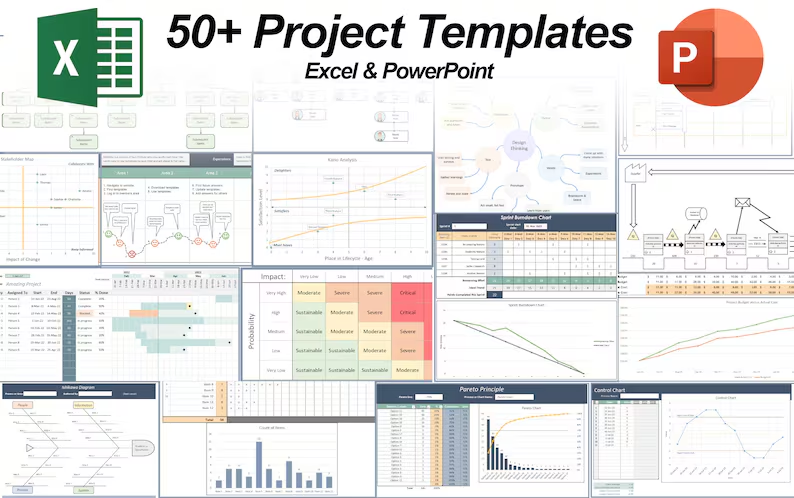
50 Project Management Templates Gantt Chart Risk Matrix and more Excel50+ Project Management Templates in Excel and PowerPoint (Gantt Chart, Risk Matrix and more!)
Project Management Plan TemplatesPre-made Project Management Plan Template: Save 100 HOURS!


David McLachlan Review – “I just passed my PMP exam having AT on all three parts.”

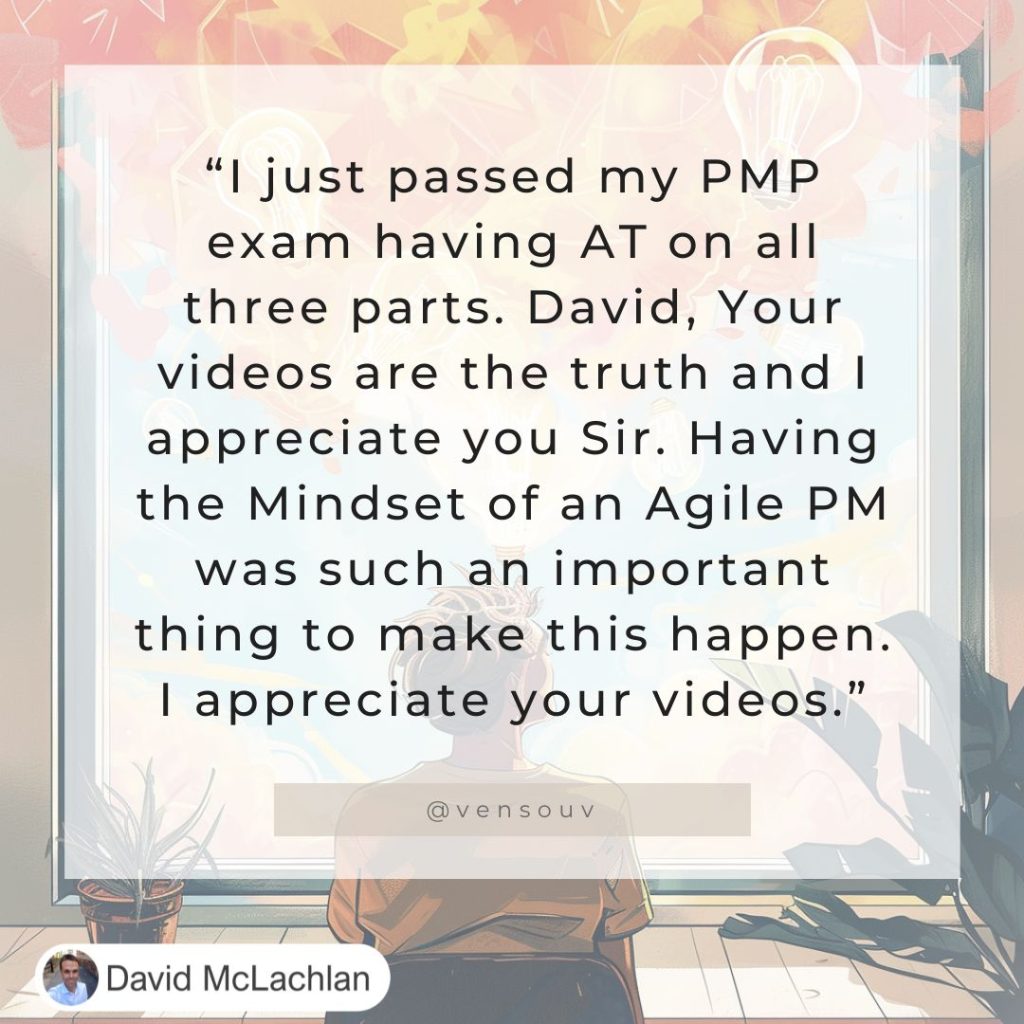
“I just passed my PMP exam having AT on all three parts. David, your videos are the truth and I appreciate you Sir. Having the mindset of an Agile PM was such as important thing to make this happen. I appreciate your videos.” – Vensouv

This is yet another person working hard and passing their PMP with Above Target results. Getting these results are not easy, but they are worth it. If you’re working on your Project Management skills this year, you can do it. I believe in you.

See live comments and reviews on David McLachlan on YouTube, Udemy and Etsy.

See what people are raving about! Get the Project Plans, Project Tools in Excel, Udemy PMP Course or Udemy Agile course here:

PMI PMP 35 PDUs CourseThe Ultimate PMP Project Management Prep Course (35 PDUs)
Agile Certified Practitioner (PMI-ACP 21 PDUs)The Complete Agile Course: PMI-ACP (21 PDUs), Coaching, Jira and MORE! 
50 Project Management Templates Gantt Chart Risk Matrix and more Excel50+ Project Management Templates in Excel and PowerPoint (Gantt Chart, Risk Matrix and more!)
Project Management Plan TemplatesPre-made Project Management PLAN Template: Save 100 HOURS!


What Is A WBS Dictionary?

Breaking Down The Work

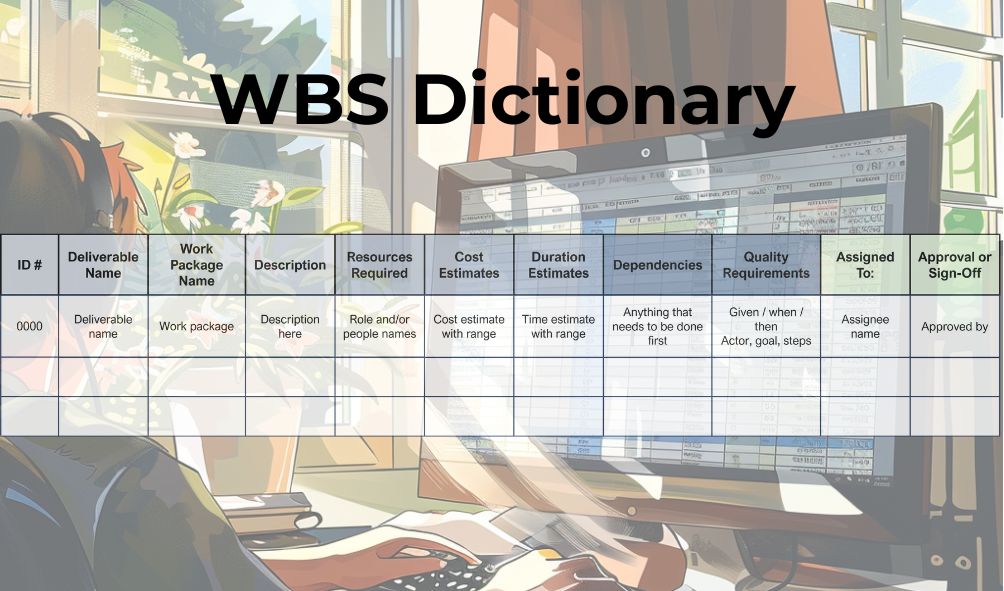
A typical Work Breakdown Structure “decomposes” items, or breaks them down from a high level feature or deliverable, into smaller Work Packages or User Stories that a person can work on.

But once you’ve decomposed those deliverables, you need to add information to them to make them meaningful. And you do that with a WBS Dictionary.

What Goes In A WBS Dictionary?

A WBS Dictionary lists our deliverables, the work packages in those deliverables, and then any additional project information we need. It will usually include:

  • A Unique ID
  • Deliverable Name
  • Work Package Name
  • Description

And then Project attributes, such as:

  • Resources Required
  • Cost Estimates
  • Duration Estimates
  • Dependencies (what needs to be completed first)
  • Quality Requirements (tasks or acceptance criteria)

And lastly, the people involved, such as:

  • Who the item is assigned to
  • Who approved or signed off on the item.

Having all this information at a glance makes it easier to understand your project and see what is needed.

See more Project Management Picture Concepts: 

You can see what people are saying about David McLachlan here: REVIEWS

Navigate to Free Project Management and Leadership Articles through the links on the right (or at the bottom if on Mobile) 
PMI PMP 35 PDUs CourseThe Ultimate PMP Project Management Prep Course (35 PDUs)
Agile Certified Practitioner (PMI-ACP 21 PDUs)The Complete Agile Course: PMI-ACP (21 PDUs), Coaching, Jira and MORE! 
50 Project Management Templates Gantt Chart Risk Matrix and more Excel50+ Project Management Templates in Excel and PowerPoint (Gantt Chart, Risk Matrix and more!)
Project Management Plan TemplatesPre-made Project Management Plan Template: Save 100 HOURS!


David McLachlan Review – “I aced the PMP on my first attempt with AT across all 3 domains.”

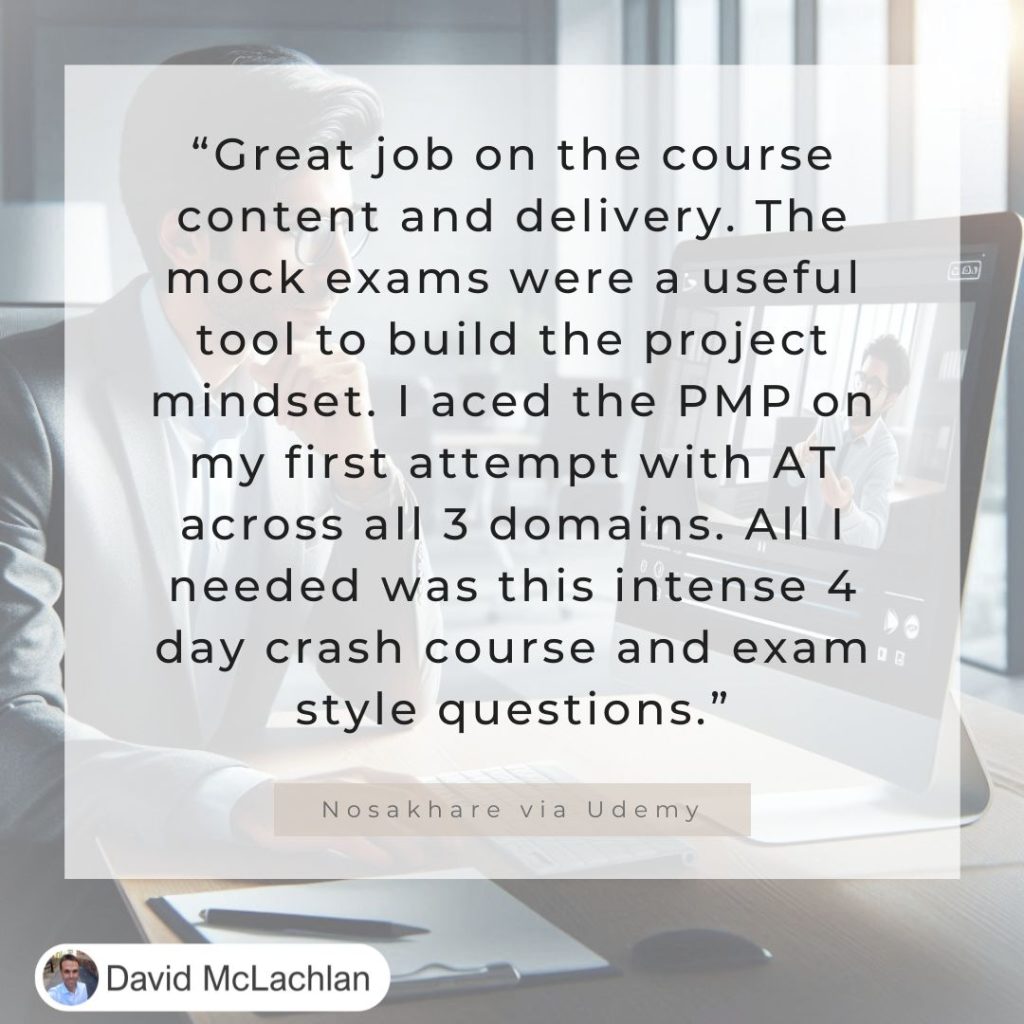
“Great job on the course content and delivery. The mock exams were useful to build the project mindset. I aces the PMP on my first attempt with AT across all domains. All I needed was this intense 4 day crash course and exam style questions.” – Nosakhare – PMP Course on Udemy.

No matter where you’re starting from, you can improve your life.

No matter how small it starts, each small improvement you make will build on the previous one, getting bigger and bigger like a snowball rolling down a hill. Make the right choices.

Choose the study instead of television. Choose your family instead of social media. Learn something new every day. This is another person passing their PMP – it is wonderful to hear 😊 And YOU can do it too!

See live comments and reviews on David McLachlan on YouTube, Udemy and Etsy.

See what people are raving about! Get the Project Plans, Project Tools in Excel, Udemy PMP Course or Udemy Agile course here:

PMI PMP 35 PDUs CourseThe Ultimate PMP Project Management Prep Course (35 PDUs)
Agile Certified Practitioner (PMI-ACP 21 PDUs)The Complete Agile Course: PMI-ACP (21 PDUs), Coaching, Jira and MORE! 
50 Project Management Templates Gantt Chart Risk Matrix and more Excel50+ Project Management Templates in Excel and PowerPoint (Gantt Chart, Risk Matrix and more!)
Project Management Plan TemplatesPre-made Project Management PLAN Template: Save 100 HOURS!


Crowdstrike and Quality Management on a Project

Why is Quality important in your project?

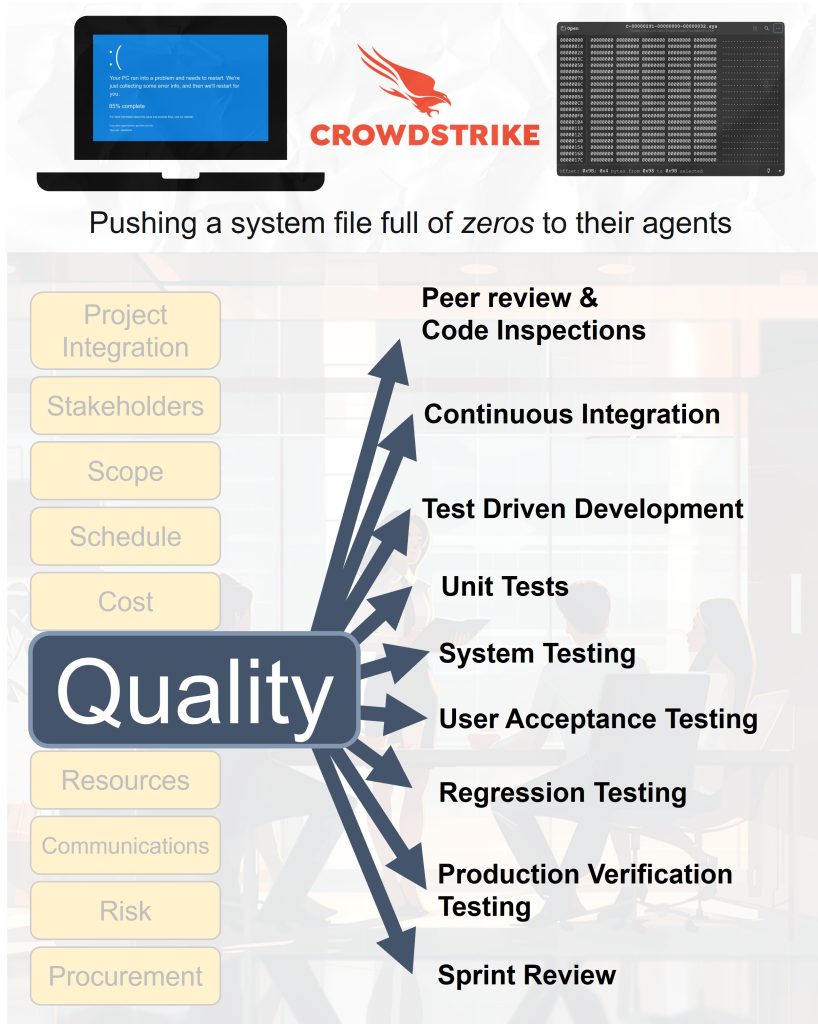
You probably heard about the Crowdstrike outage on the weekend of July 2024 that disrupted airports, banks and stores all around the world. It was caused by Crowdstrike pushing a system file full of zeros to production.

How can we avoid this sort of disaster as we manage our own Projects? There are many ways:

➡️ Peer review & Code Inspections: Checking the requirements with a user or reviewing the code with another Developer.

➡️ Continuous Integration: Merging changes into the main test system (often daily) with automatic tests.

➡️ Test Driven Development: Tests are written first, failed, then run again and passed after the solution is coded.

➡️ Unit Tests: Testing each small piece or User Story.

➡️ System Testing: Testing the integrated system as a whole.

➡️ User Acceptance Testing: Testing the system from the User’s point of view.

➡️ Regression Testing: Testing the existing system with the changes to see if they’ve impacted normal operations.

➡️ Production Verification Testing: Testing the change in the live environment after go-live then rolling the change back if it goes wrong.

➡️ Sprint Review: Demonstrating the actual change to the customer or senior users before release.

Quality is one of the 10 Project Management Knowledge Areas for a reason.

⭐ What are some of the ways you manage Quality on your own projects? ⭐

See more Project Management Picture Concepts: 

You can see what people are saying about David McLachlan here: REVIEWS

Navigate to Free Project Management and Leadership Articles through the links on the right (or at the bottom if on Mobile) 
PMI PMP 35 PDUs CourseThe Ultimate PMP Project Management Prep Course (35 PDUs)
Agile Certified Practitioner (PMI-ACP 21 PDUs)The Complete Agile Course: PMI-ACP (21 PDUs), Coaching, Jira and MORE! 
50 Project Management Templates Gantt Chart Risk Matrix and more Excel50+ Project Management Templates in Excel and PowerPoint (Gantt Chart, Risk Matrix and more!)
Project Management Plan TemplatesPre-made Project Management Plan Template: Save 100 HOURS!


The Change Control Process in Project Management

Change Happens When Delivering a Project

There are many competing factors when delivering change with a Project. Not only do you have many competing stakeholders with their different needs, biases, history in the organization and more, but you have competing constraints too.

The triple constraint of Scope, Schedule and Cost is impacted frequently on a project. If scope changes a little, it might impact how long it takes to deliver it. And that might cost more. Balancing these is an essential part of being a good Project Manager.

Use Change Requests to Keep Change under Control

If you’re studying or working in Project Management this year, know the broad Change Control process.

So, so many project managers never even outline their Change Control approach – or worse – they confuse it with modern Organizational Change Management (transitioning a product to operations or BAU).

The good part is, you get to decide (with your stakeholders) your project’s Change Control approach and you outline this in your Change Management Plan.

YES this works for Agile too, but it’s usually just a single line as the Product Owner decides on Scope Changes with the Product Backlog, and they understand and absorb the impact to their Schedule (Cost is often fixed).

Make sure you know it. Make sure you write it down.

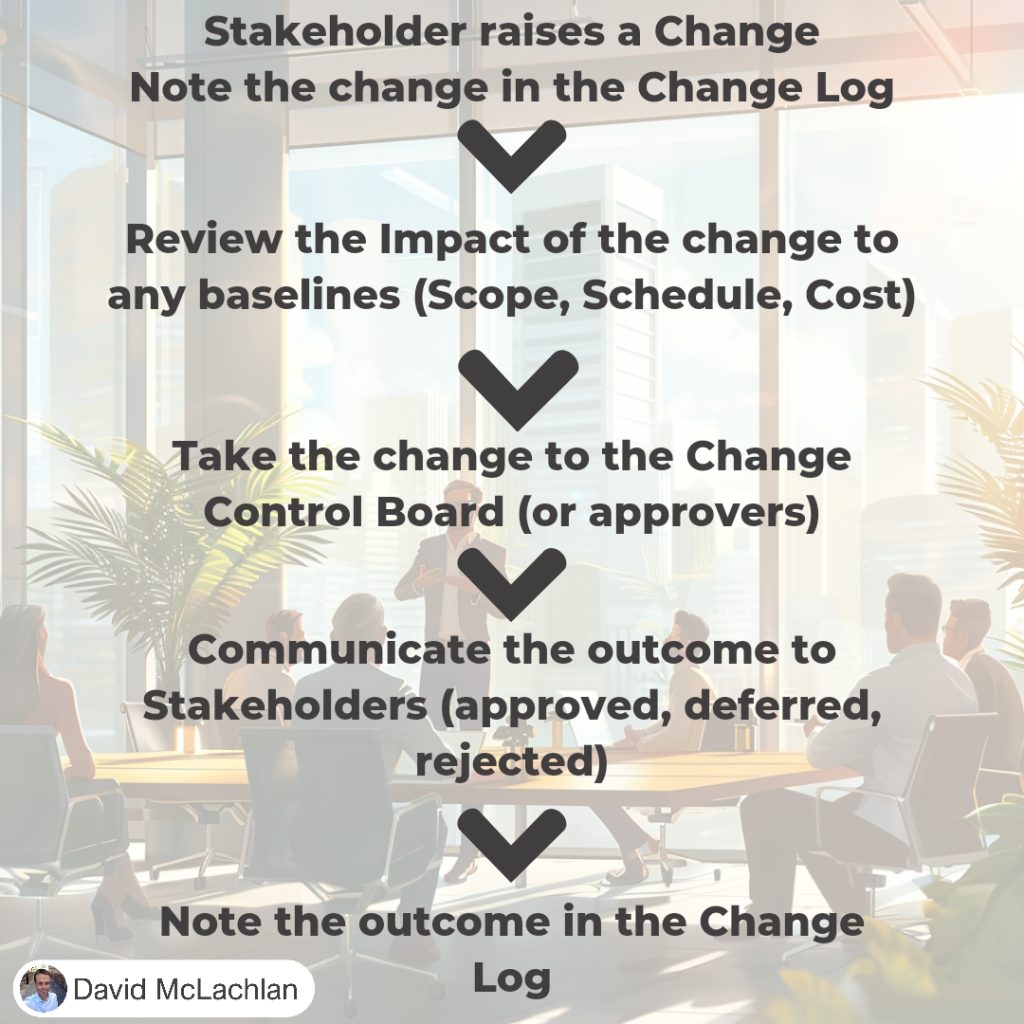
Then deliver value and win. The typical Change approach might be:

  1. A Stakeholder raises a change to the Scope, Schedule, Cost, Resources (or any other baselined part of the project).
  2. We note that proposed change in the Change Log.
  3. We analyze the impact of the change to our project Cost, Schedule, Scope, and any other necessary impact.
  4. We take this information to the Change Control Board, or the approver. This might be multiple people or just one person (i.e. a Project Sponsor or Product Owner).
  5. We communicate the outcome of the change to the necessary stakeholders (Approved, Deferred, Rejected).
  6. We update the Change Log with the outcome and take the necessary change action.

See more Project Management Picture Concepts:

You can see what people are saying about David McLachlan here: REVIEWS

Navigate to Free Project Management and Leadership Articles through the links on the right (or at the bottom if on Mobile) 
PMI PMP 35 PDUs CourseThe Ultimate PMP Project Management Prep Course (35 PDUs)
Agile Certified Practitioner (PMI-ACP 21 PDUs)The Complete Agile Course: PMI-ACP (21 PDUs), Coaching, Jira and MORE! 
50 Project Management Templates Gantt Chart Risk Matrix and more Excel50+ Project Management Templates in Excel and PowerPoint (Gantt Chart, Risk Matrix and more!)
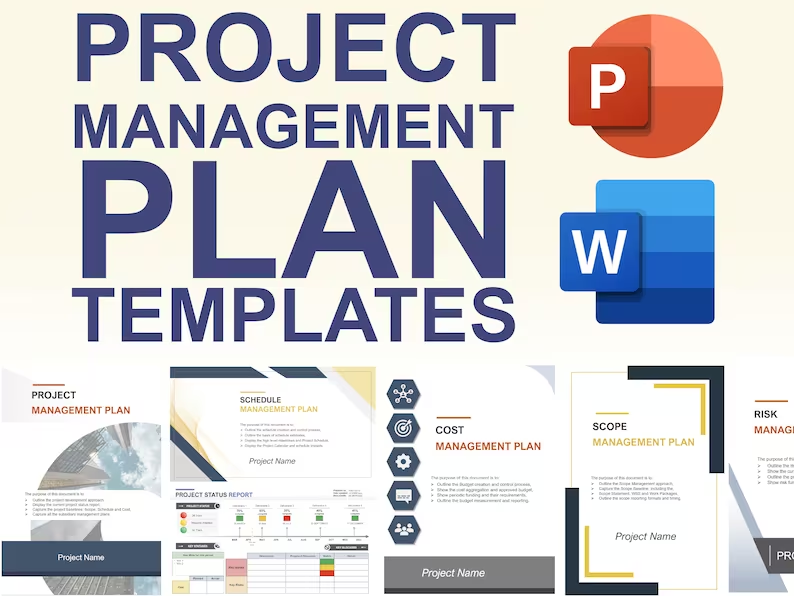
Project Management Plan TemplatesPre-made Project Management PLAN Template: Save 100 HOURS!


Prototypes in a Waterfall or Agile Project

Prototype First, Then Build With Less Risk

If you’re working in or studying Project Management, it is essential to know about Prototyping and the different types of prototypes you might use.

A Prototype is a small, low cost version of the real thing, so we can see if it works and whether we really want it.

The idea of Prototyping works in any form of project. We might build a house or a bridge using a sequential, step-by-step approach (such as Waterfall). The prototypes we’ll use on these projects might include architectural designs, blueprints, or 3D models created by a draftsman or engineer to help us see if the design will work.

In a software environment, it is common to create a storyboard or wireframe of the new system, so we can see if it flows well when we “use” it, and we can see if the design works for any customers that trial it.

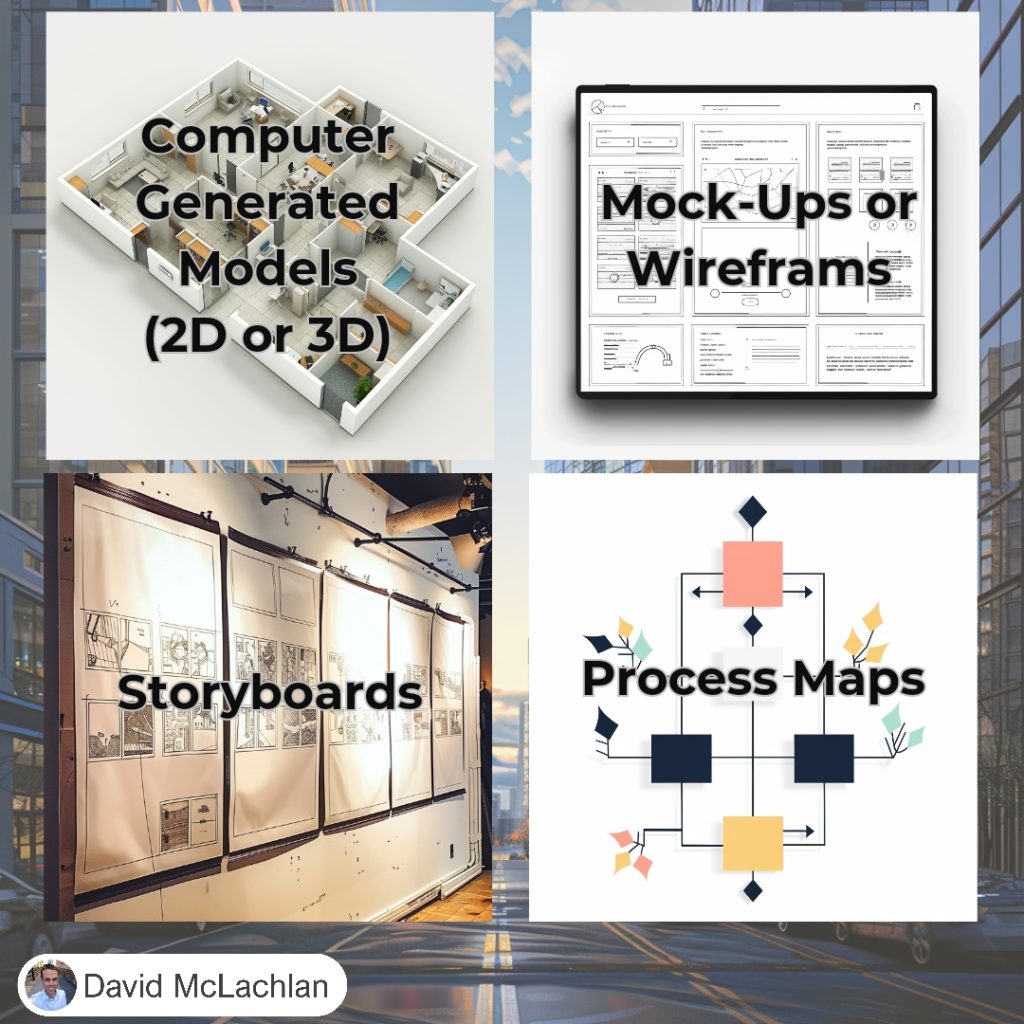
These are the most popular Prototypes you’ll come across:

  • ✅ Mock-ups or Wireframes: A simple drawing or design of the new idea.
  • ✅ Process Maps: Connecting process steps with boxes so you can see how a new process will flow.
  • ✅ Storyboards: Connect your designs together to link as they would in the real item, as you navigate a new design.
  • ✅ Computer generated models (2D or 3D): Using Blender or CAD, or cardboard and glue, you can see it in more depth and make corrections early.

➡️ What are some other Prototyping methods you use in your projects?

See more Project Management Picture Concepts:

You can see what people are saying about David McLachlan here: REVIEWS

Navigate to Free Project Management and Leadership Articles through the links on the right (or at the bottom if on Mobile) 
PMI PMP 35 PDUs CourseThe Ultimate PMP Project Management Prep Course (35 PDUs)
Agile Certified Practitioner (PMI-ACP 21 PDUs)The Complete Agile Course: PMI-ACP (21 PDUs), Coaching, Jira and MORE! 
50 Project Management Templates Gantt Chart Risk Matrix and more Excel50+ Project Management Templates in Excel and PowerPoint (Gantt Chart, Risk Matrix and more!)
Project Management Plan TemplatesPre-made Project Management PLAN Template: Save 100 HOURS!


Project Management Key Concepts (in Pictures)

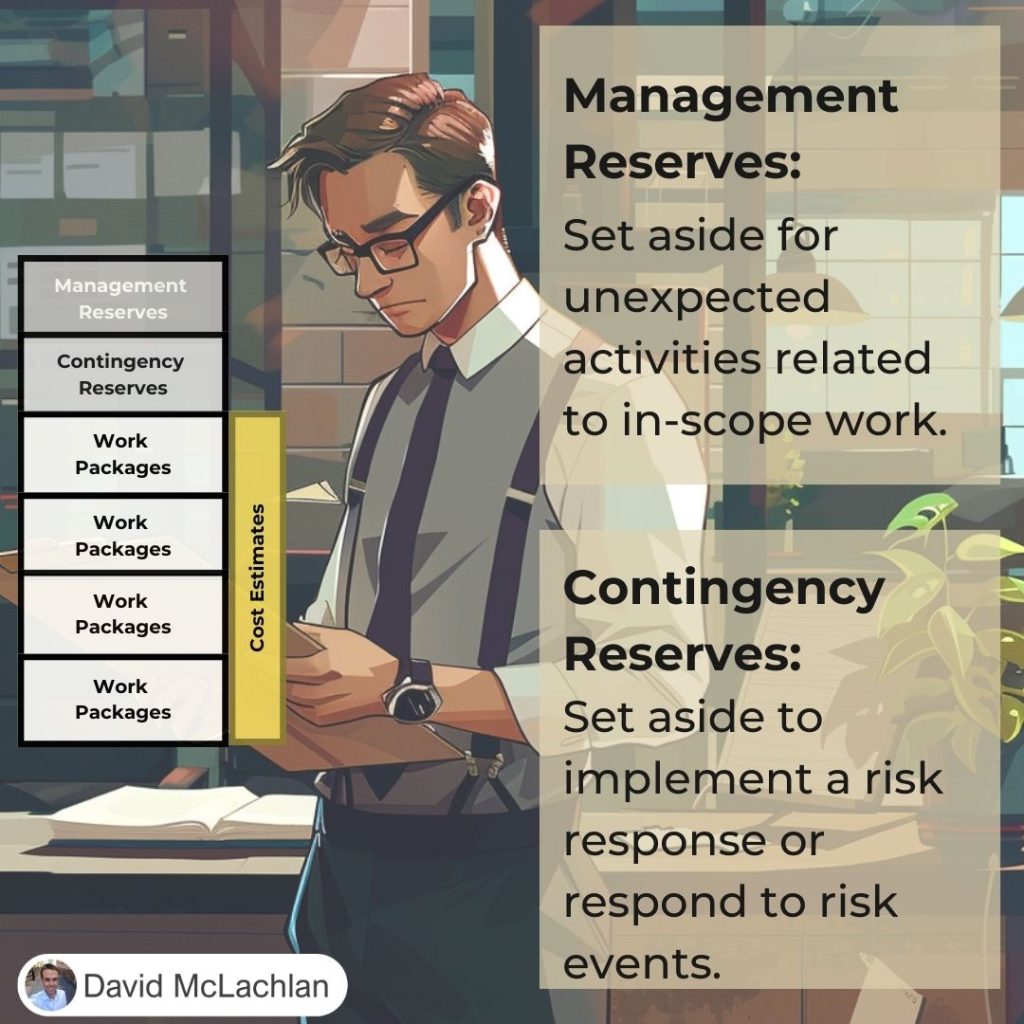
Cost Reserves (Contingency, Management):

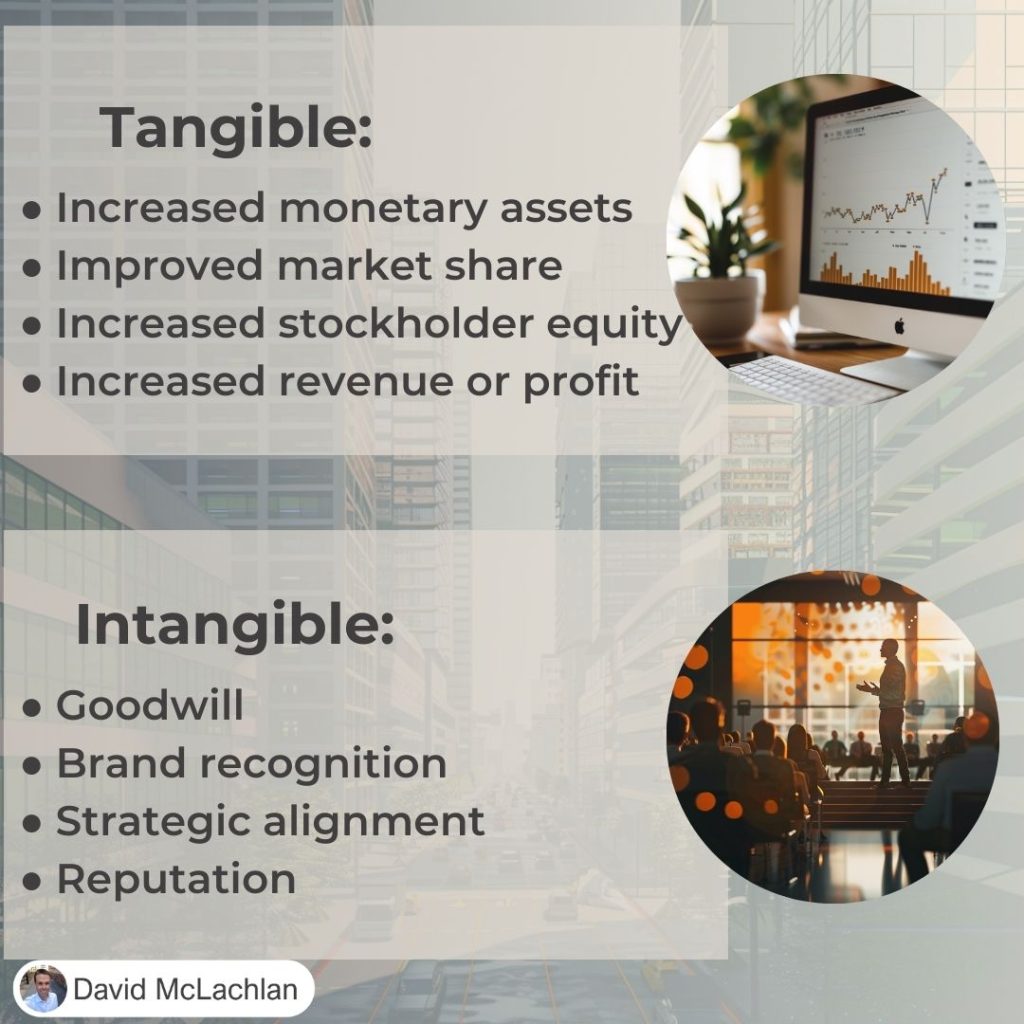
Types of Project Benefits (Tangible, Intangible):

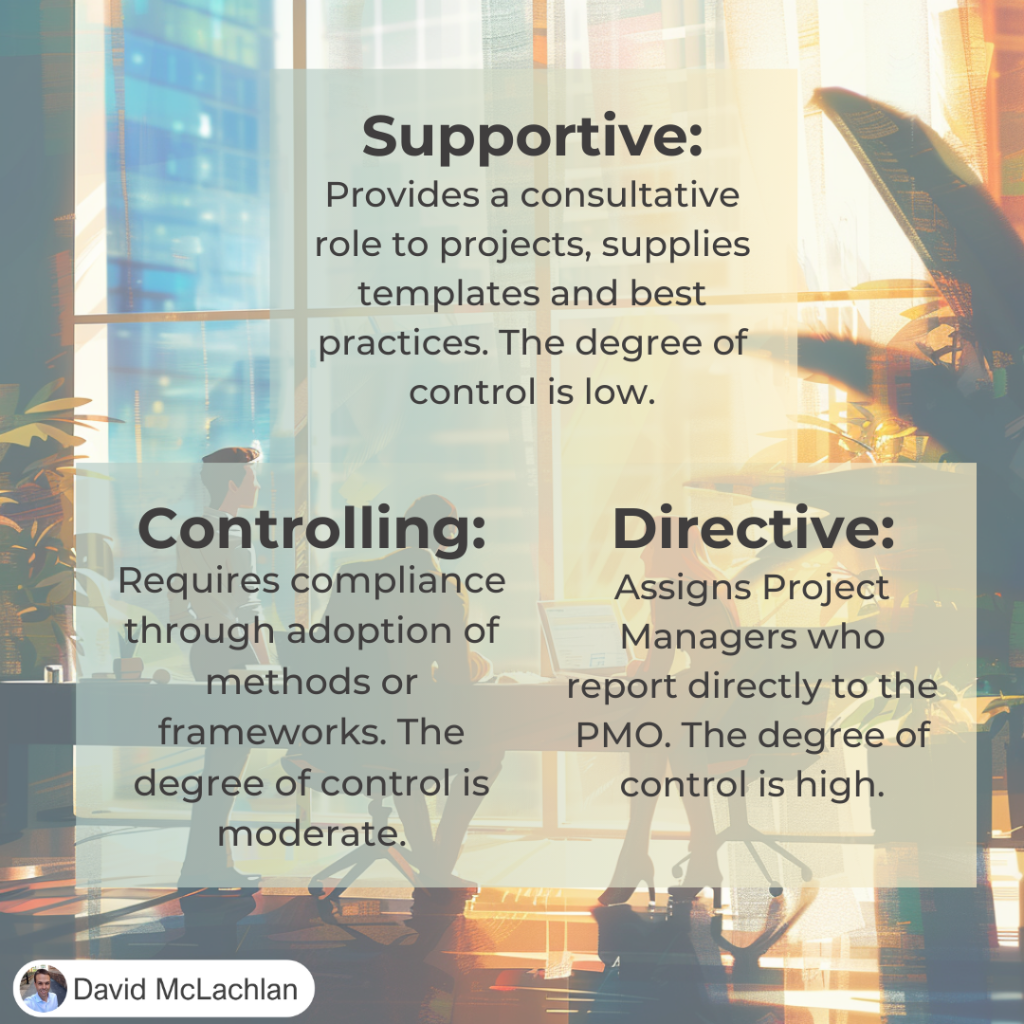
Three Types of PMO (Supportive, Controlling, Directive):

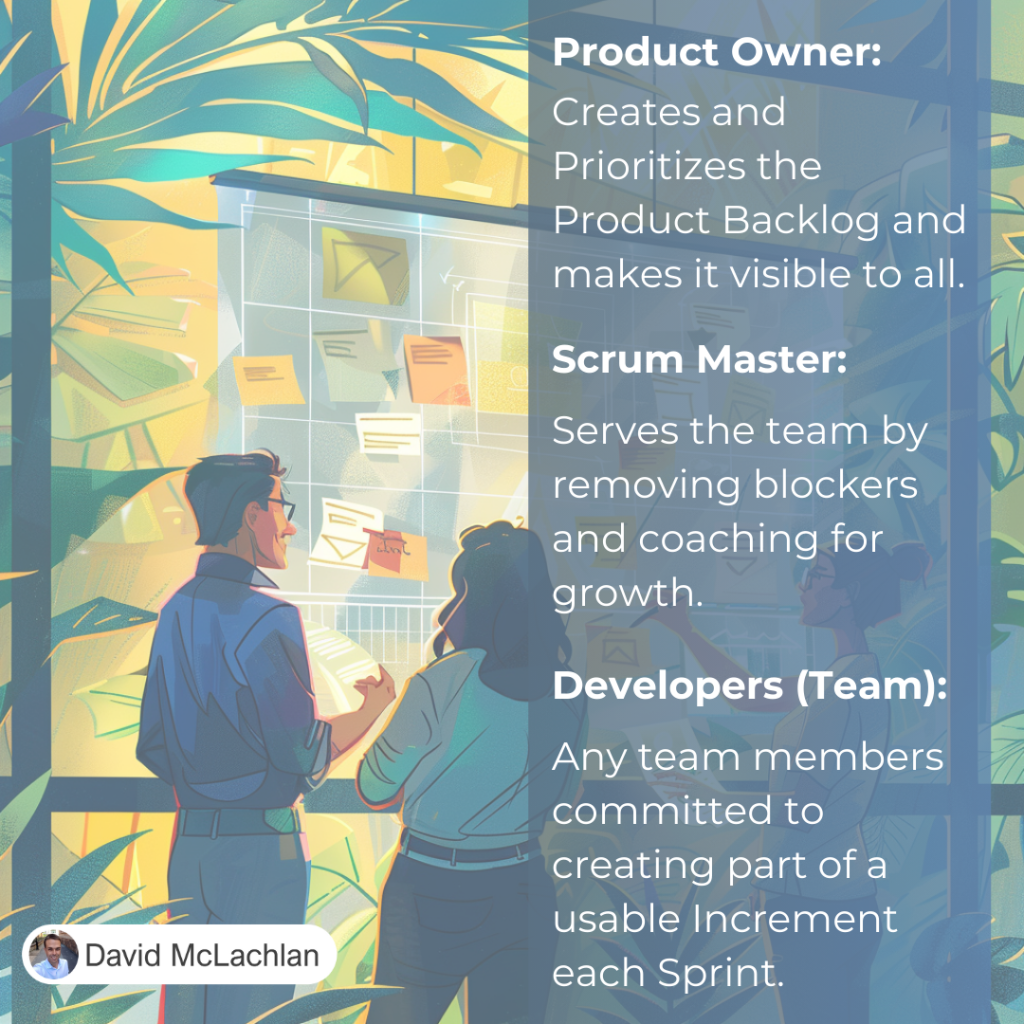
Roles on a Scrum Team:

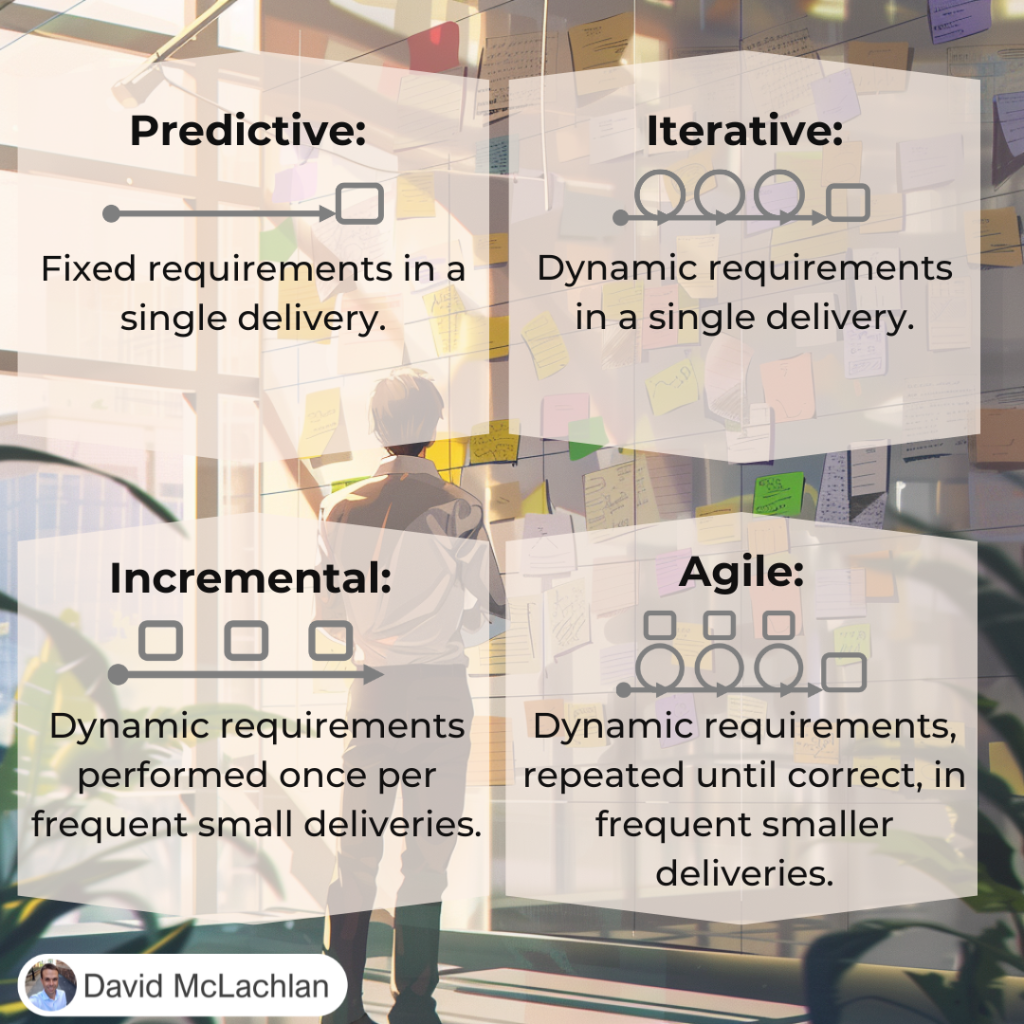
Project Development Lifecycles:

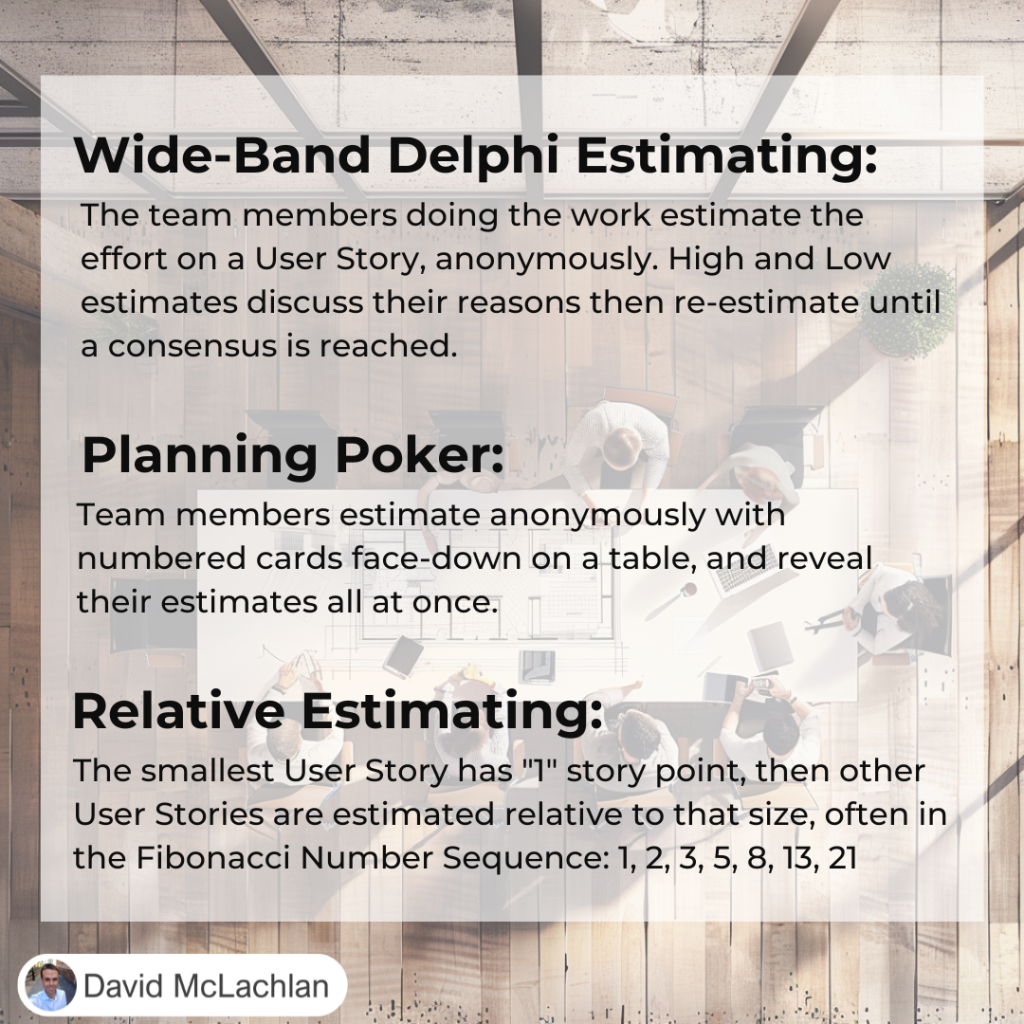
Agile Estimating:

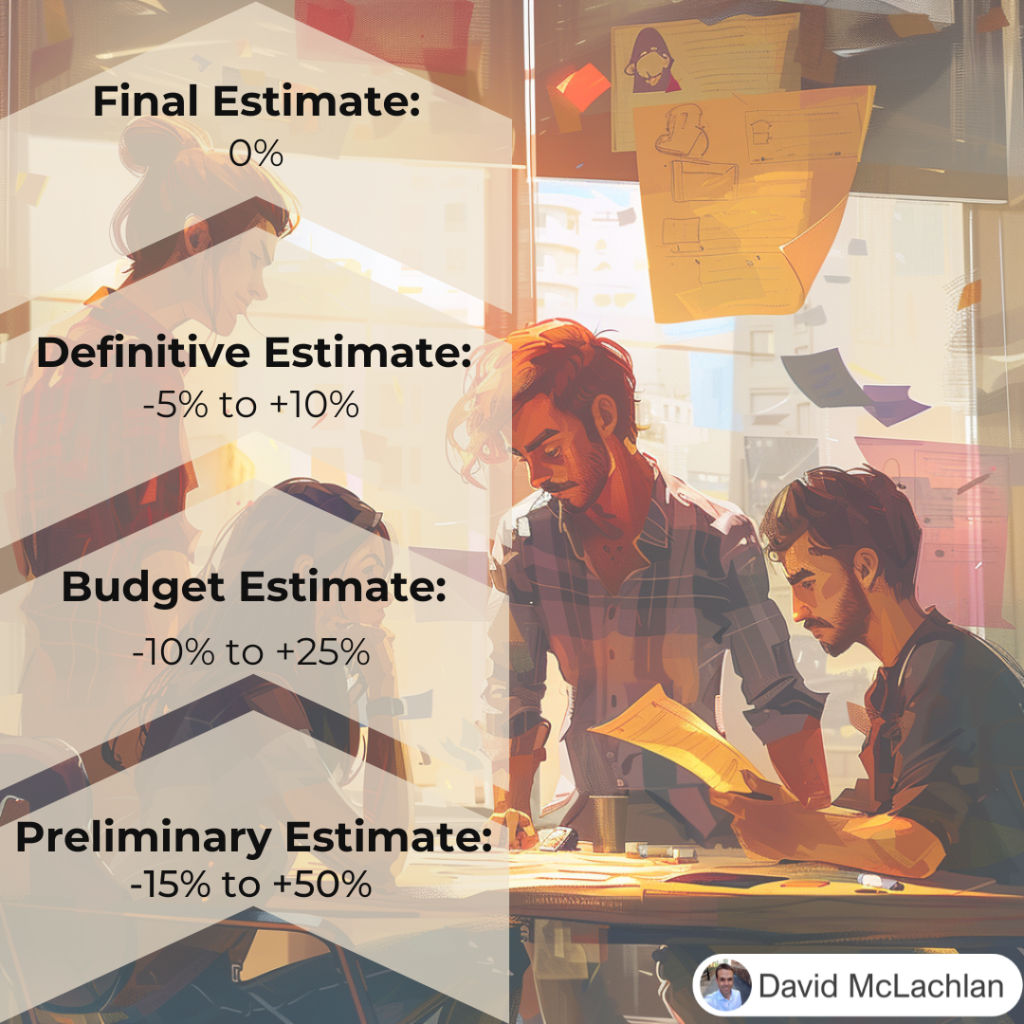
Estimating Types and Ranges:

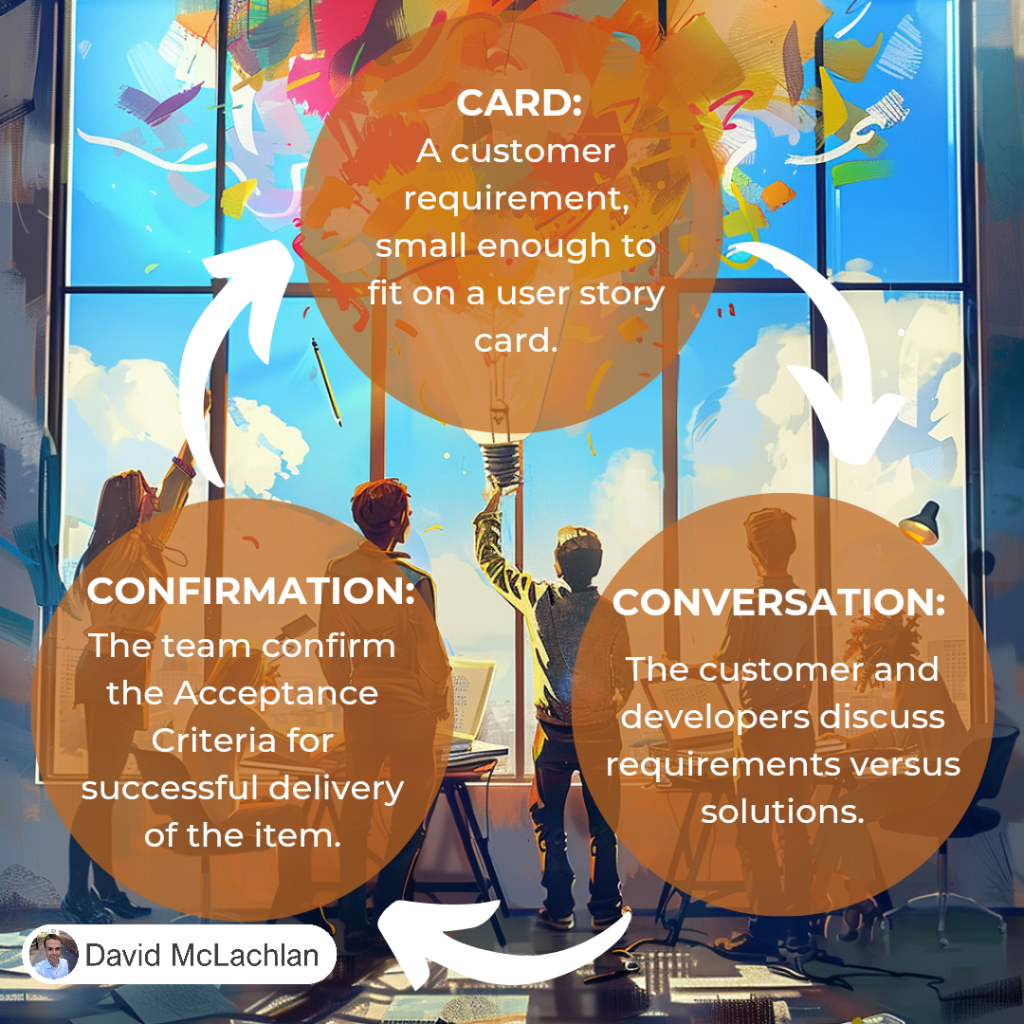
The Three Cs for creating User Stories:

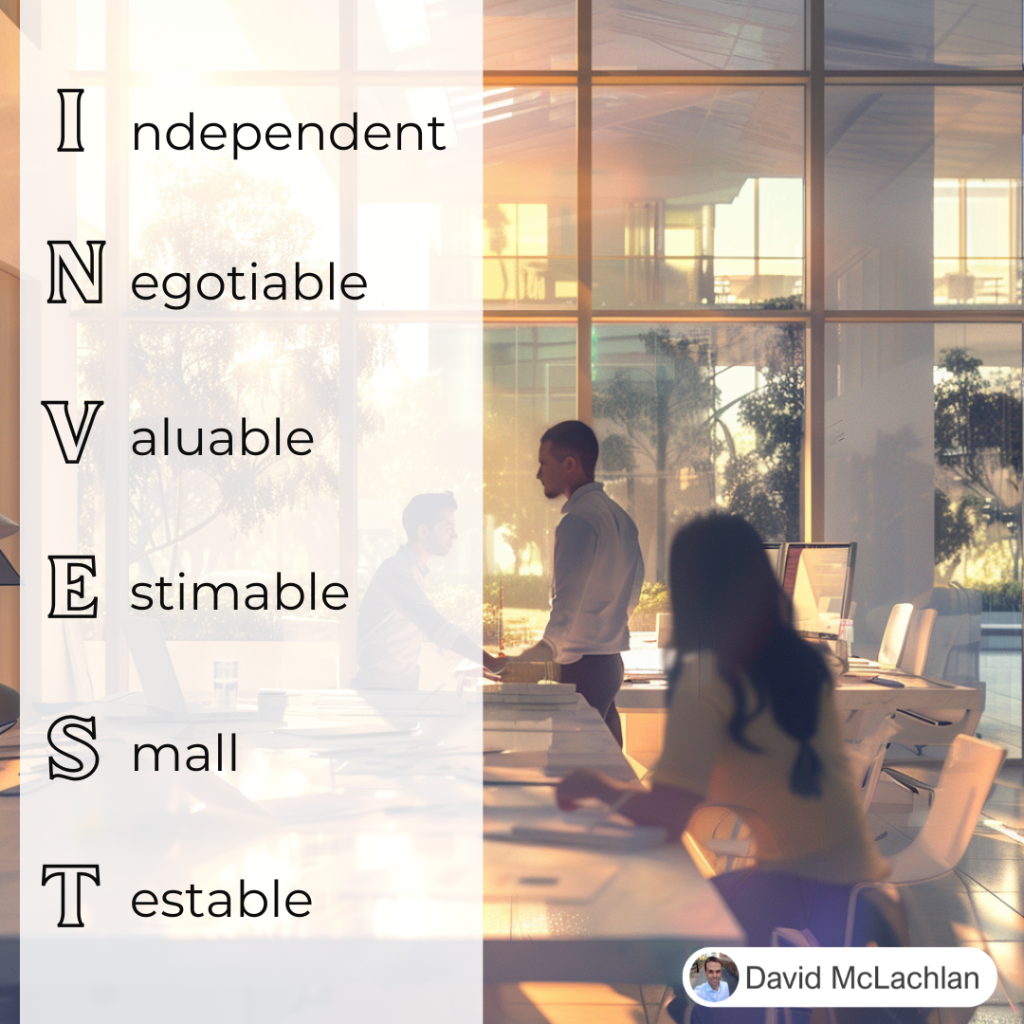
INVEST for creating User Stories:

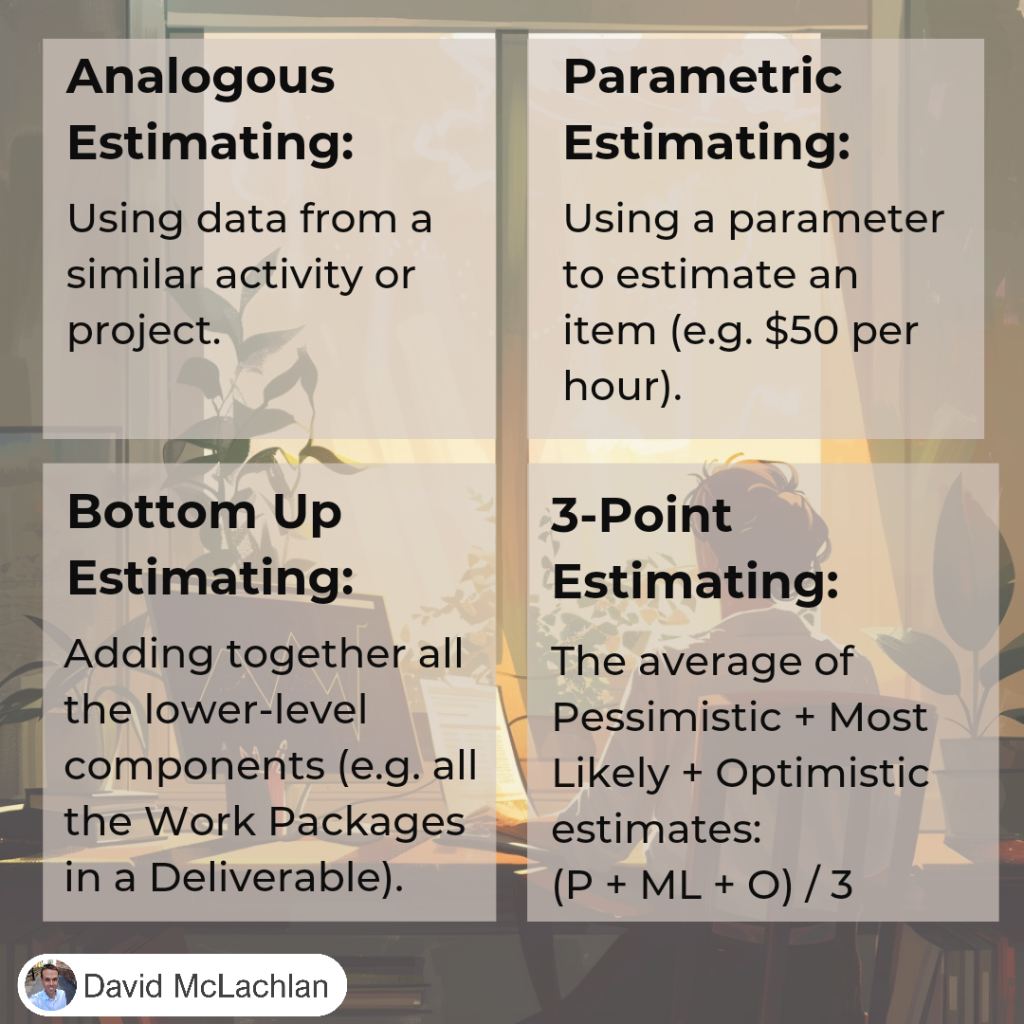
Types of Estimating (Analogous, Parametric, 3-point, etc.)

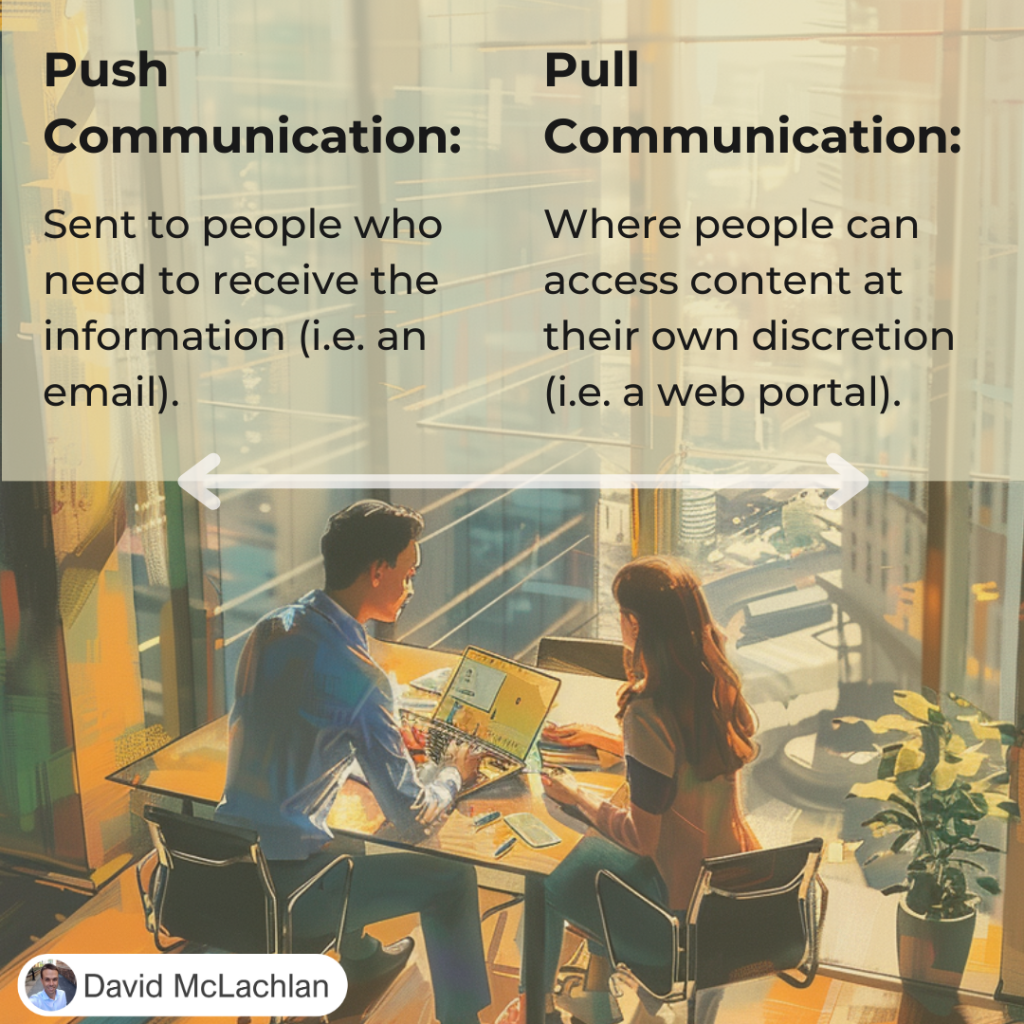
Push Communication and Pull Communication:

The Five Cs of Communication

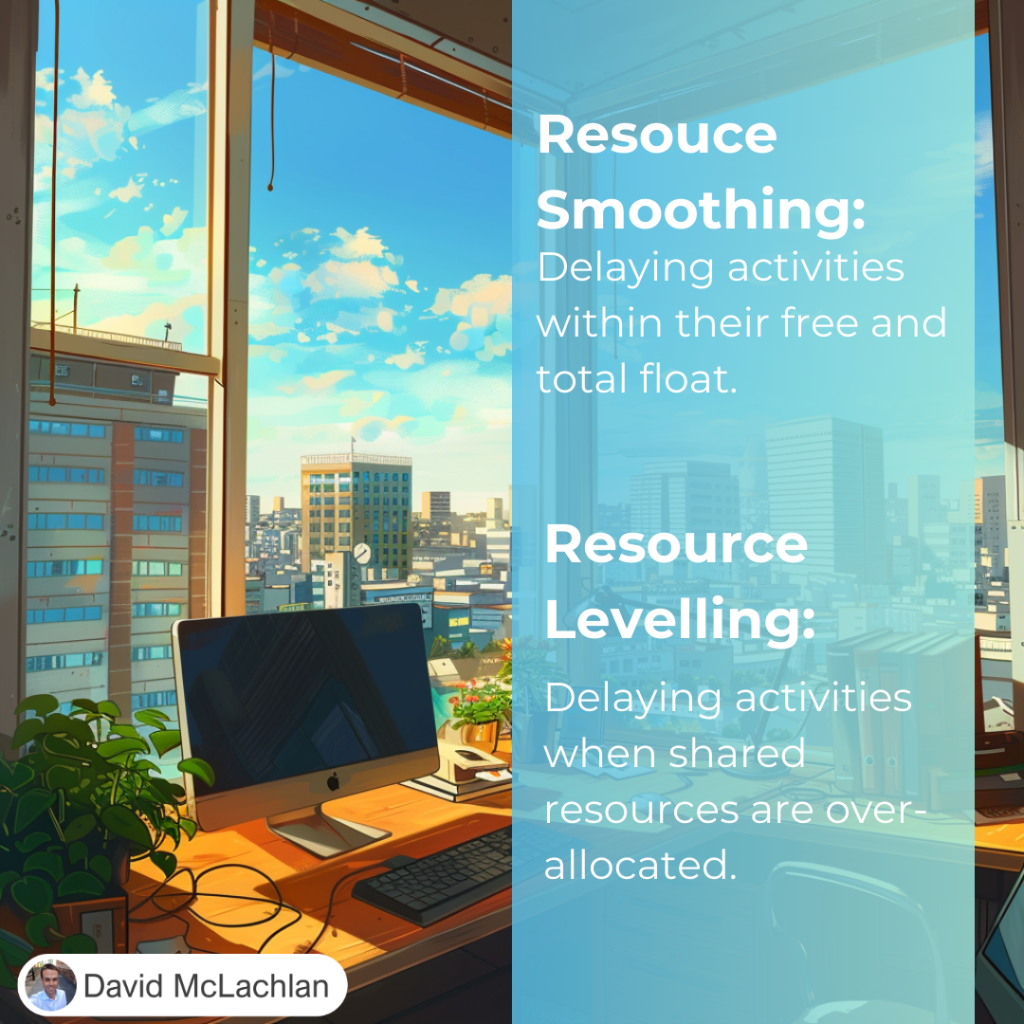
Resource Smoothing and Resource Levelling:

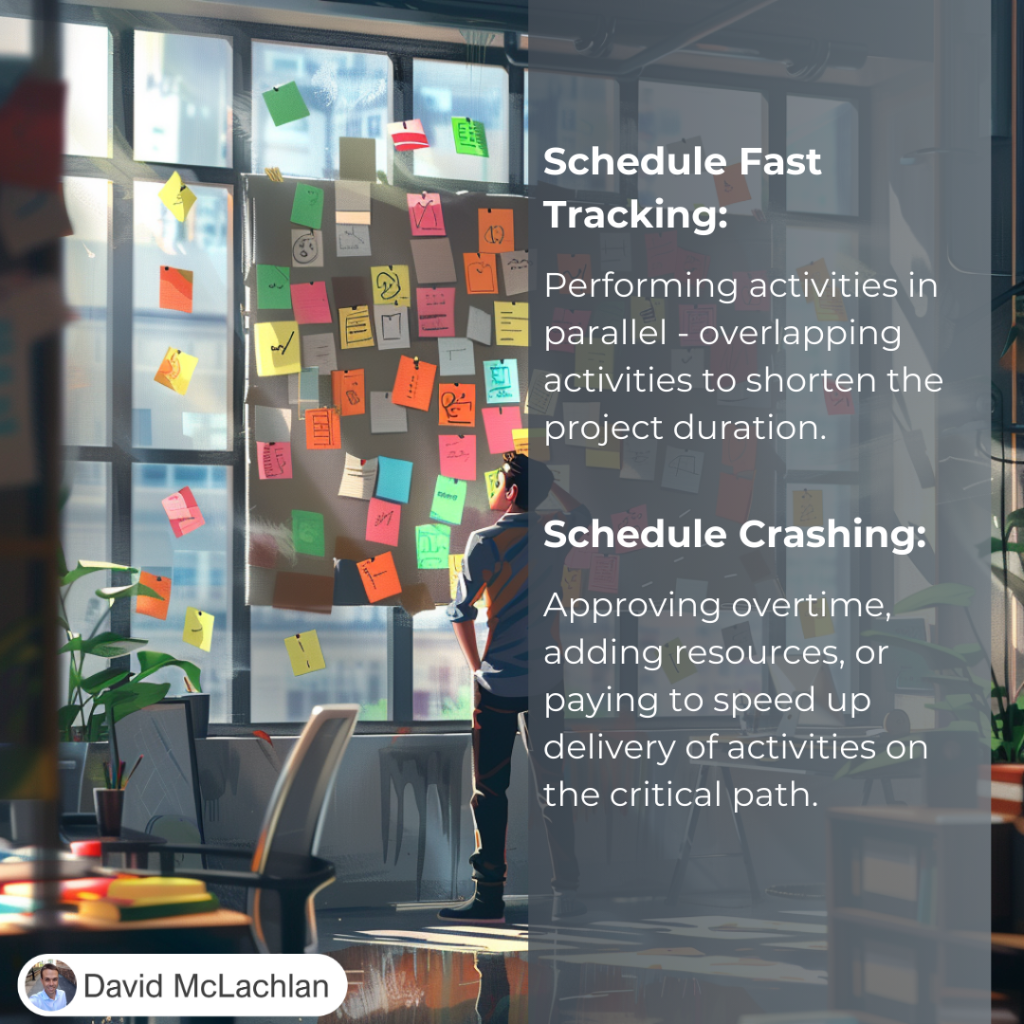
Schedule Fast Tracking and Schedule Crashing:

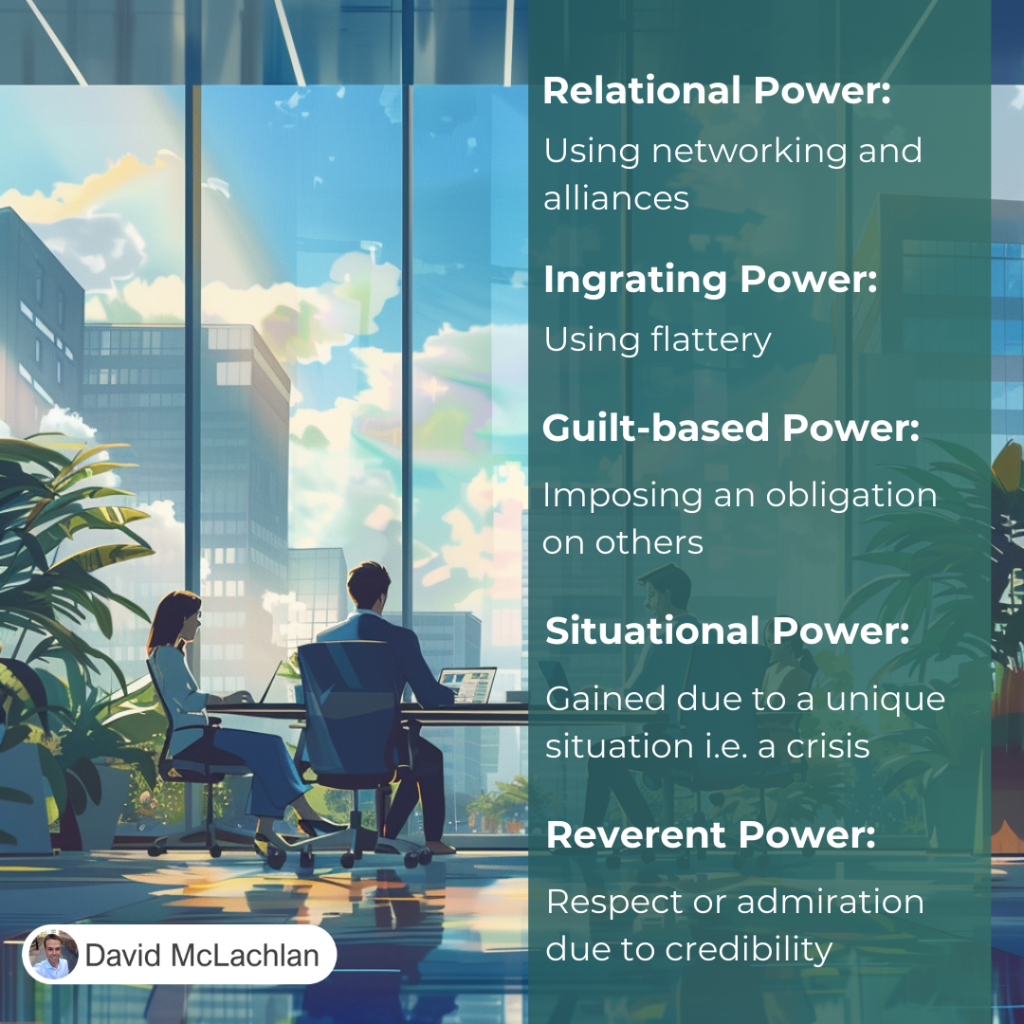
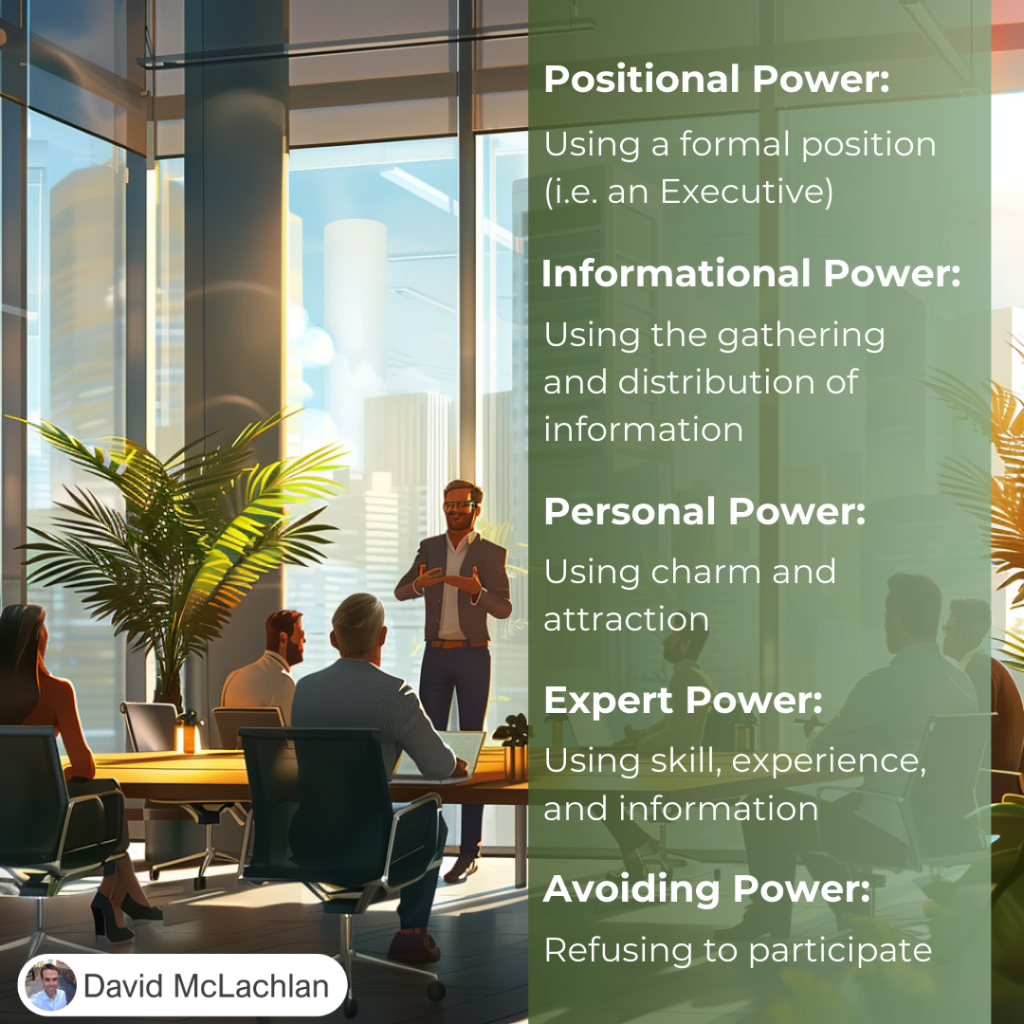
Types of Power:

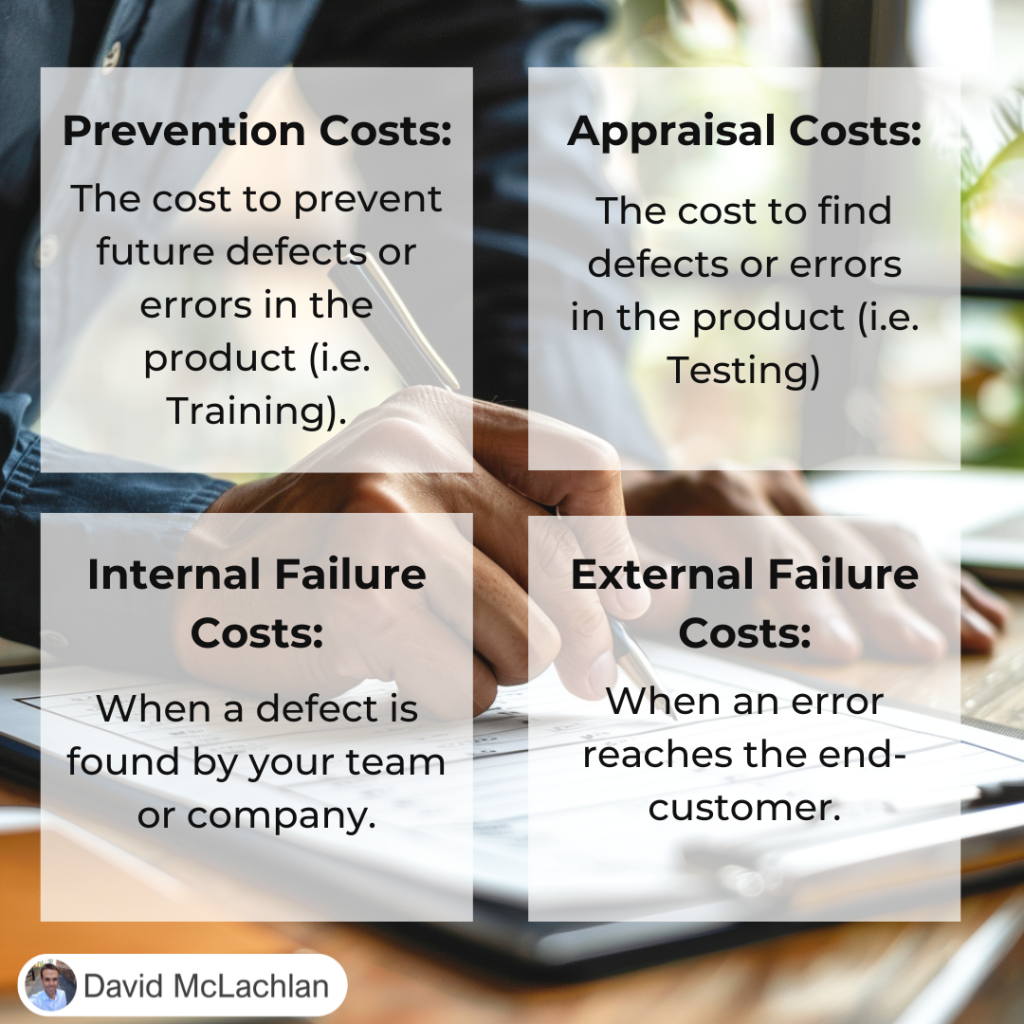
The Cost of Quality:

Cost of Quality

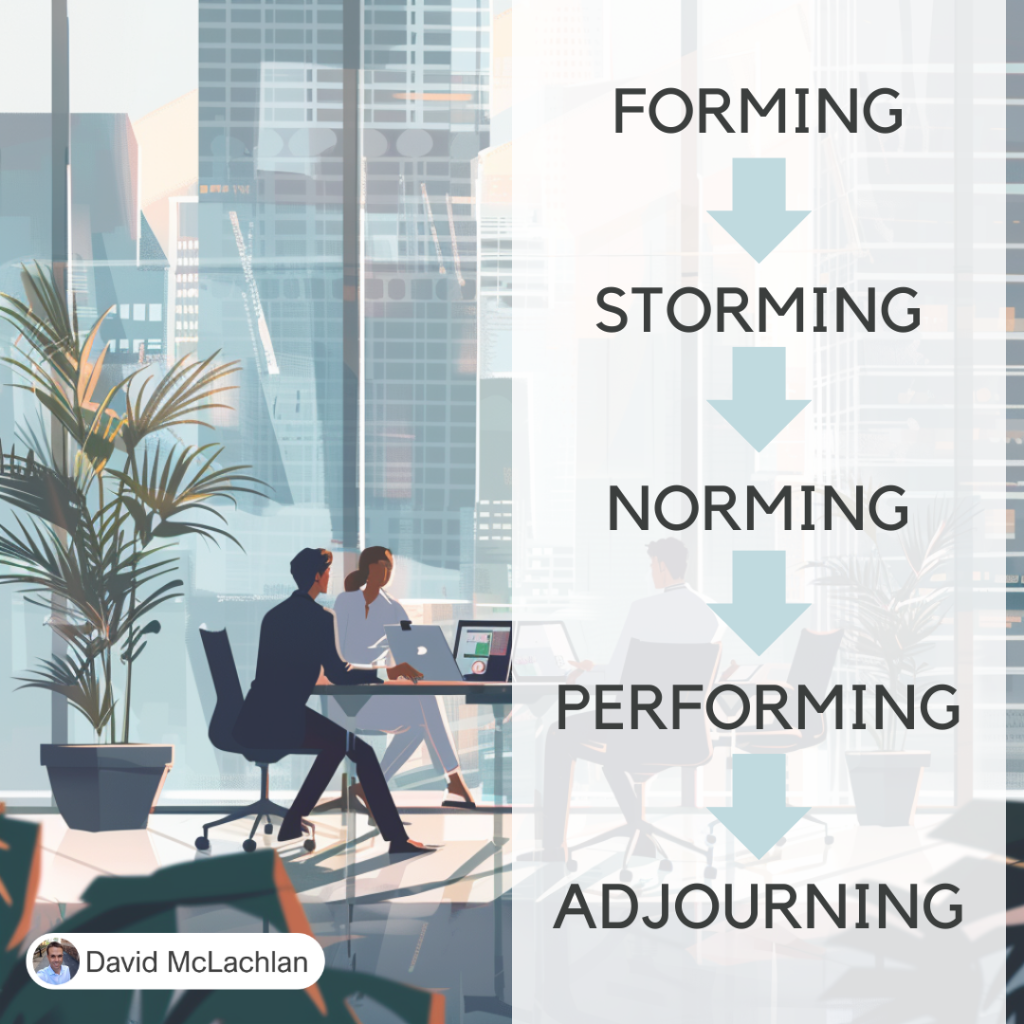
Tuckman’s Ladder (the Tuckman Model for Team Development):

Tuckmans Ladder

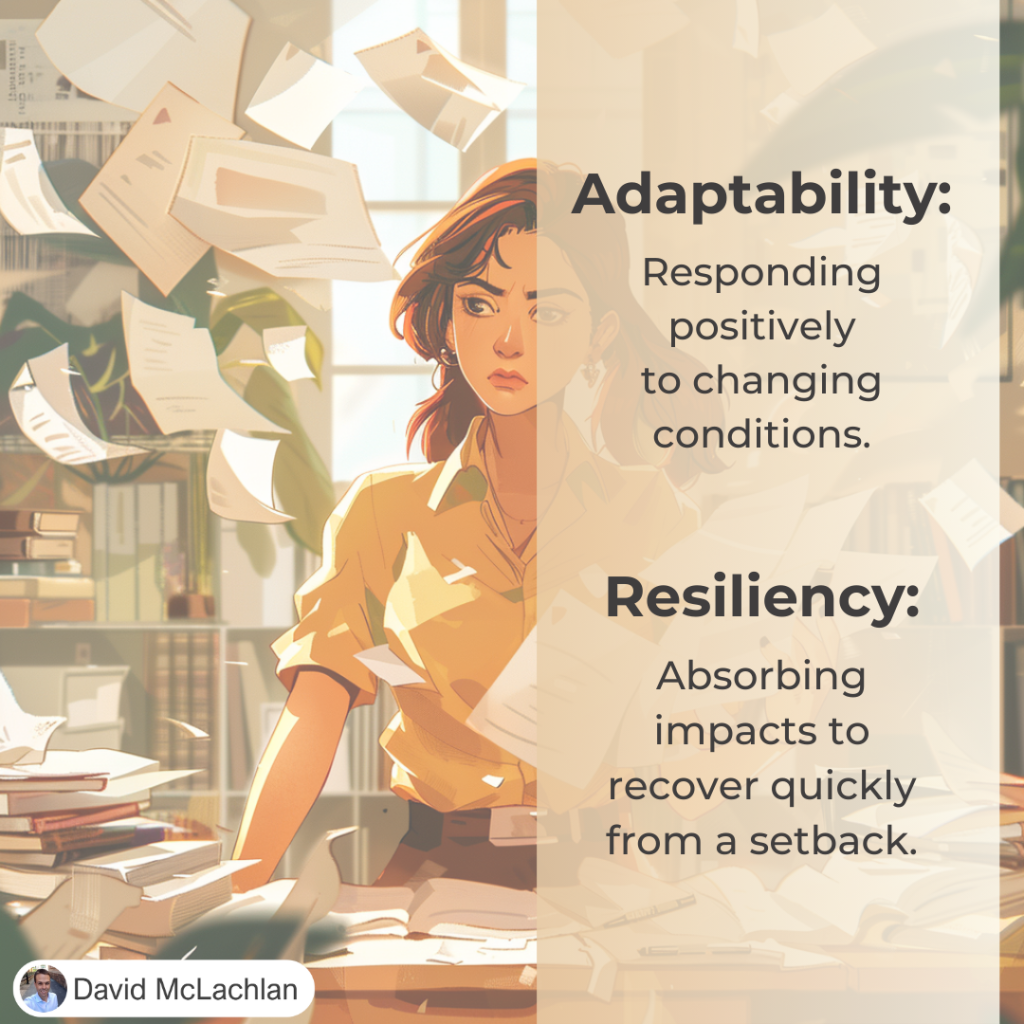
Adaptability and Resiliency:

Adaptability and Resiliency

Adaptability and Resiliency

Adaptability and Resiliency

Projects are hard. But they can be easier when you and your team are Adaptable and Resilient.

The good news? You can improve both of these things.

Adaptability is responding positively to changing conditions.

Resiliency is absorbing impacts to recover quickly from a setback.

Having a solid foundation (like an emergency fund in your home Budget, or a career skill that is in high demand) will help you with both.


– David McLachlan

See more Project Management Picture Concepts:

David McLachlan – What People Are Saying

See live comments and reviews on David McLachlan on YouTube, Udemy and Etsy.

Here is what people have to say about David McLachlan:

“THE best instructor I have seen so far for the PMP, he not only gives you the information, but he TRAINS you to get into the mindset required to pass the PMP exam, and also to effectively manage your own project. Amazing course, amazing instructor, I believe in you, and so does David McLachlan.” – Xavier

David McLachlan review

“David McLachlan is one of the most sincere and personable teachers I’ve ever studied under. His positivity is genuinely infectious. It’s clear to me that what he teaches comes from a place of wanting his students to succeed, not just in the exam, but also in the corporate environment.” – Manunath

David McLachlan review

“Passed my PMP first try. In the 3rd section of the exam when I could feel myself getting tired, I imagined how you would read the question and break it down, and I heard your voice and your accent when reading the questions. I can’t recommend this (David McLachlan course) enough.” – John
David McLachlan review

“I have to say how amazing your (David McLachlan’s) video series is. Both my wife and I took the exam and we both passed AT in all areas. When I first saw your revies, I assumed they were fake because of how glowing they were. If anything, they under-report the true value you provide.” – Eric
David McLachlan Review

“Hi David McLachlan, I passed PMP this week with 3 ATs. Thanks a lot for the humongous effort that you have put in to make things clear for us. You made me understand the concept so well. Thanks again David.” – Rekha

David McLachlan Review

“Fabulous Project Management Plans (by David McLachlan) for any Project Management Professional (PMP). Saves you several hundred hours of work, prevents mistakes, and makes you look like a very experienced professional.” – Linda

David McLachlan Project Plans Review

“I took my PMP exam today, and could practically hear (David McLachlan) your enthusiastic, encouraging words as I made my way through the test. “How did you go?” “I KNOW you can do it.” “I believe in you.” I can’t thank you enough for your encouragement!” – Burt

David McLachlan review

“Highly recommend this (David McLachlan) course! The clear communication, efficient content, and handy review materials not only made learning enjoyable but also led to my successful exam outcome. Kudos to David for creating an exceptional learning experience!” – Said K.

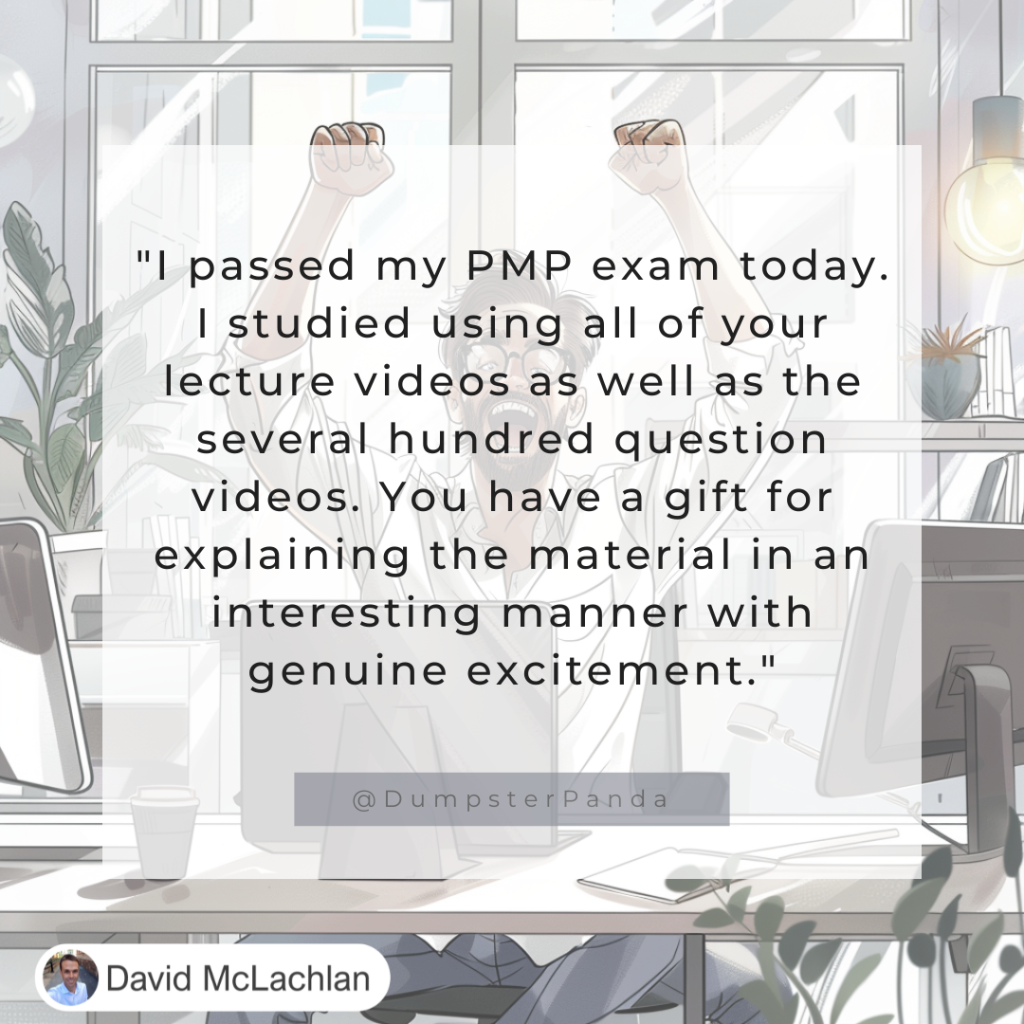
“I passed my PMP exam today. I studied using all of your (David McLachlan) lecture videos as well as the several hundred question videos. You have a gift for explaining the material in an interesting manner with genuine excitement.” – DP

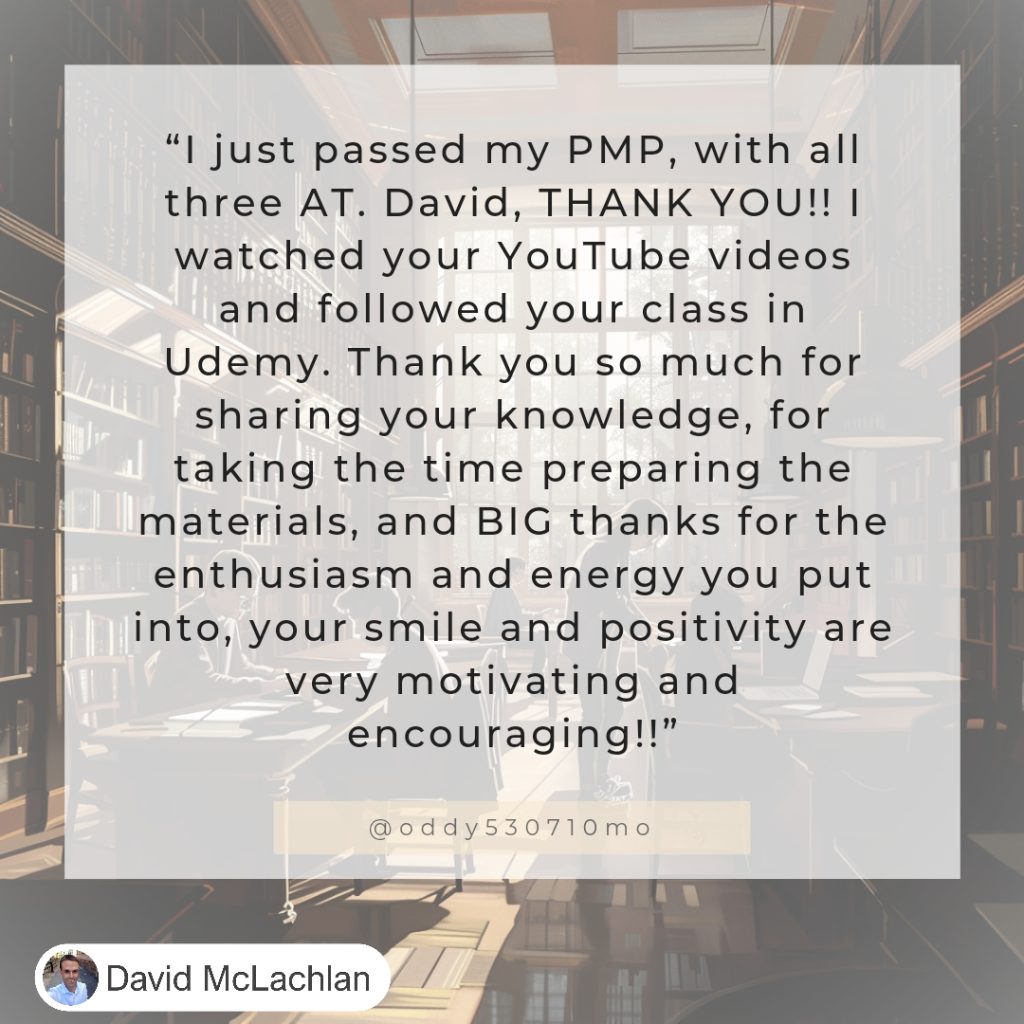
“I just passed my PMP, with all three Above Target. David McLachlan, THANK YOU!! I watched your YouTube videos and followed your class in Udemy. Thank you so much for sharing your knowledge, for taking the time preparing the materials, and BIG thanks for the enthusiasm and energy you put into, your smile and positivity are very motivating and encouraging!!” – Oddy

“I got my PMP certification two days back and wanted to express by sincere gratitude for your videos David McLachlan. What I liked the most is the way you have recorded them, the acknowledgement for the efforts and positive nudge was very effective. Thank you so much!” – Apurva

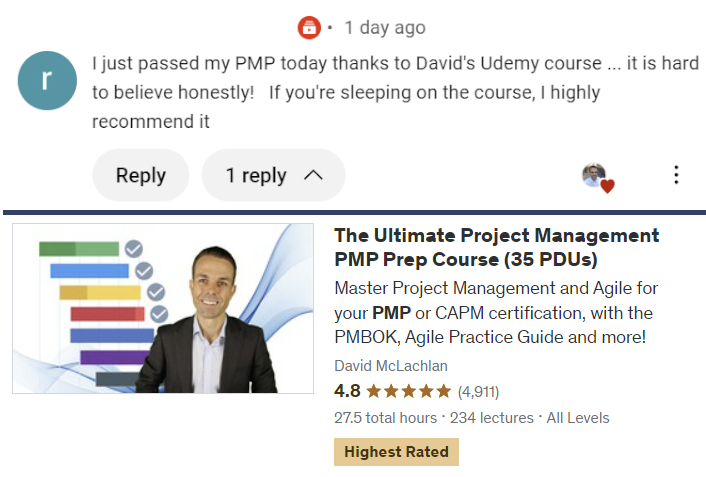
“I just passed my PMP today thanks to David’s Udemy course … it is hard to believe honestly! If you’re sleeping on the course, I highly recommend it.”

David McLachlan’s PMP Udemy Course is currently the highest rated PMP Course on Udemy.

David McLachlan PMP Udemy Review

See what people are raving about! Get the Project Plans, Project Tools in Excel, Udemy PMP Course or Udemy Agile course here:

PMI PMP 35 PDUs CourseThe Ultimate PMP Project Management Prep Course (35 PDUs)
Agile Certified Practitioner (PMI-ACP 21 PDUs)The Complete Agile Course: PMI-ACP (21 PDUs), Coaching, Jira and MORE! 
50 Project Management Templates Gantt Chart Risk Matrix and more Excel50+ Project Management Templates in Excel and PowerPoint (Gantt Chart, Risk Matrix and more!)
Project Management Plan TemplatesPre-made Project Management PLAN Template: Save 100 HOURS!