Tag Archives: David McLachlan

Leadership Card 11 – Clarity and Empathy and Employee Engagement

See The Leadership Card Deck Here

Design For Ease of Use with Lean CX – Leadership Card 11

Lean CX Ease of Use Leadership Card - Engagement Model 3

Leadership CardsView All The Leadership Cards (48)

- or - Have the Leadership Cards delivered for your next meeting

Clarity and Empathy – Two Major Keys To Employee Engagement

Straight out of Harvard comes a story and research showing a simple way to improve employee engagement and your productivity, profit and happiness.  It’s called caring.  Actually caring what your customers are trying to solve, actually caring what your team is trying to solve, and providing clarity on the path to solve that problem.

Sounds simple, doesn’t it?

Yet almost no one does this.  Most people are too busy either putting out fires in their own business, or creating fuzzy, vague outcomes and mission statements that when it comes down to it mean absolutely nothing.

To Be Clear Is To Be Unkind

Something financial guru and  entrepreneur Dave Ramsey says is “To be unclear is to be unkind”.  And that kinda makes sense, doesn’t it?  It happens so often not just in business but also in relationships – when you have an expectation that something will happen but you haven’t actually made that clear.  You haven’t told the person what you would like!  And since they can’t read minds, there is a good chance they won’t actually do the thing you secretly wanted them to do.

So make it clear.

Make it clear by understanding what your customer wants.  Make it clear in a standard, repeatable process that shapes the path for your team.  Make it clear when you check in regularly to see if everything is on track.

When you’ve made it clear, another thing can happen.  It might be clear that the process is actually pretty hard.  Maybe it’s an emotional time or area for a customer, maybe it’s a long and boring process.  Nothing is perfect.  So this is where the second part of our equation comes in:

Care.

Care about your team, sympathize with their troubles.  Yes, problem solve with them using Lean CX when you can, but also just listen.  Sometimes people need to vent, and need to be heard that they are going through something tough.  Acknowledge that it is, and don’t minimize it.

Empathy and Clarity.  They both make a difference to your team’s engagement, and if you use both I absolutely guarantee you will see some astounding results.

Chat soon – David Mclachlan

Leadership CardsView All The Leadership Cards (48)

- or - Have the Leadership Cards delivered for your next meeting

Leadership Card 8 – 50% of Employees Don’t Know What is Expected

See The Leadership Card Deck Here

Design For Ease of Use with Lean CX – Leadership Card 8

Lean CX Leadership Card- Employees dont know what is expected

Leadership CardsView All The Leadership Cards (48)

- or - Have the Leadership Cards delivered for your next meeting

If You Don’t Know What’s Expected, What Are You To Do?

Imagine this: in a high performing company there are two teams.  One team is given a clear objective and is clear on their path to get there.  The other team is given no direction at all – in fact some of them are not even sure why they turn up each day.

Which one do you think will do a better job?  And if you’re a business owner, which team do you think will be worth the wage you’re paying them?

When we put it like this, it seems obvious, doesn’t it?  The team with the clear direction, objective and path will certainly outperform.  Yet recent research shows that around 50% of employees in work today are not clear on what is expected of them at work.

And when they’re not clear, as we found above, they’re probably not going to be doing a great job for you or your customers.  Here’s the thing about people who aren’t clear on what their objective is – they perform 35% worse and are 34% more likely to be disengaged in their work.

So set clear outcomes.  Better yet, do it collaboratively with your team.  You will be pleasantly surprised by the results and the improvement to your revenue and profit.

Chat soon – David McLachlan

Leadership CardsView All The Leadership Cards (48)

- or - Have the Leadership Cards delivered for your next meeting

Leadership Card 7 – The Benefits Of Clear Outcomes

See The Leadership Card Deck Here

Design Your Work For Ease of Use with Lean CX – Leadership Card 7

Lean CX Ease of Use Leadership Card - 35pc gap in what was achieved

Leadership CardsView All The Leadership Cards (48)

- or - Have the Leadership Cards delivered for your next meeting

Having Something To Aim For Makes A Difference

Have you ever tried crumpling up a piece of paper, taking aim at the nearest waste basket, doing your favorite basketballer impression and shooting a three pointer while an imaginary crown goes wild?

Well, maybe your version wasn’t that elaborate (or maybe it was), but being able to see the waste paper basket – knowing it is there and having something to aim for makes a big difference in whether you get it in or have to take another try.

Can you imagine walking, blindfolded, into a room while holding the same crumpled up piece of paper, and throwing it in any random direction with the hope that it somehow makes it into a waste paper basket?

Well that’s exactly what the majority of businesses, startups, and teams within those businesses are doing today.  They’re going into business without a clear idea of what to aim for.  They’re delving into their work without clear outcomes.

Clear outcomes mean you have a clear objective – a goal, an aim, a target – and have taken the time to outline clear steps to get there.  Are the steps going to be right every time?  Of course not.  Despite what some people will tell you, no one can see the future.  But having something to start with and get you on your way certainly helps.

Now a few business disciplines have been misinterpreted and been taken completely the other way.  Agile, iterative planning, continuous development, the Lean Startup and Minimum Viable Products can (and have) been used as an excuse by lazy managers not to do any planning or set any clear outcomes at all.  Those managers say they will test and learn, and they don’t know what they don’t know.  And those managers are missing the point.  “Iterating” towards something still means you have to have a clear objective to iterate towards in the first place.  And having clear steps to start with is like having a flight plan that you can take off with, and adjust it as you go.

Apart from all that, the research actually backs up the approach of setting clear outcomes in a big way.  Teams and companies who set clear outcomes outperformed those who didn’t by 35% in their results, according to this Stanford University study, and found no less by the man who invented SWOT analysis (an acronym for Strengths, Weaknesses, Opportunities, and Threats, well known by your typical MBA graduate).

So set clear outcomes with your team, do it collaboratively, and you will see a big improvement in your results.

Chat soon – David McLachlan

Leadership CardsView All The Leadership Cards (48)

- or - Have the Leadership Cards delivered for your next meeting

Leadership Card 6 – Employee Engagement and Defects, Theft and Safety

See All The Cards Here

Design Your Work For Ease of Use Using Lean CX – Leadership Card 6

Lean CX Ease of Use Leadership Card - Theft and Defects

Leadership CardsView All The Leadership Cards (48)

- or - Have the Leadership Cards delivered for your next meeting

Have You Ever Been Happy?

Silly question, I know.  But… have you?  Really, truly happy?  Do you remember what it’s like?  Maybe it was this morning, maybe it was yesterday, maybe it was last week or maybe it was last year.  But the thing about happy people – people who are fulfilled, at peace with their place in life, and satisfied with what they have, is that they are nicer people to have around for a variety of reasons.

Sure, they are happier, they don’t grumble as much, and are generally more fun to be around.  But the statistics also take it a step further, because people who are happy, find meaning from and are completely engaged in their work actually make fewer mistakes, have fewer safety incidents, and steal less.

Employee engagement is so important when it comes to safety incidents, in fact, that one CEO I recently worked with used to have a rule: “Don’t tell me the engagement score, just tell me how many safety incidents and absentees your team has had.”  That was all the information he needed to know to get a gauge on whether or not the team would be working well or far off track.

Chat soon – David McLachlan

Leadership CardsView All The Leadership Cards (48)

- or - Have the Leadership Cards delivered for your next meeting
Leadership Card 5 – Absenteeism and Turnover

See All The Cards Here

Design Your Work For Ease Of Use – Card 5

Leadership Card 5 - absenteeism and turnover

Leadership CardsView All The Leadership Cards (48)

- or - Have the Leadership Cards delivered for your next meeting
People Leave Leaders, Not companies

Your experience of a company, now matter how large or small, is only as good as the leader you are working for.  Have a good leader who engages her staff, checks in regularly, focuses on strengths, ties outcomes to meaning and more, and you will likely have a good experience and want to do great work.

Have a bad leader, however, who micromanages, is never around when you need them, doesn’t seem to care about the work or your development and only looks out for themselves, and there’s a good chance you’ll be left with a bitter taste in your mouth when thinking about that company.

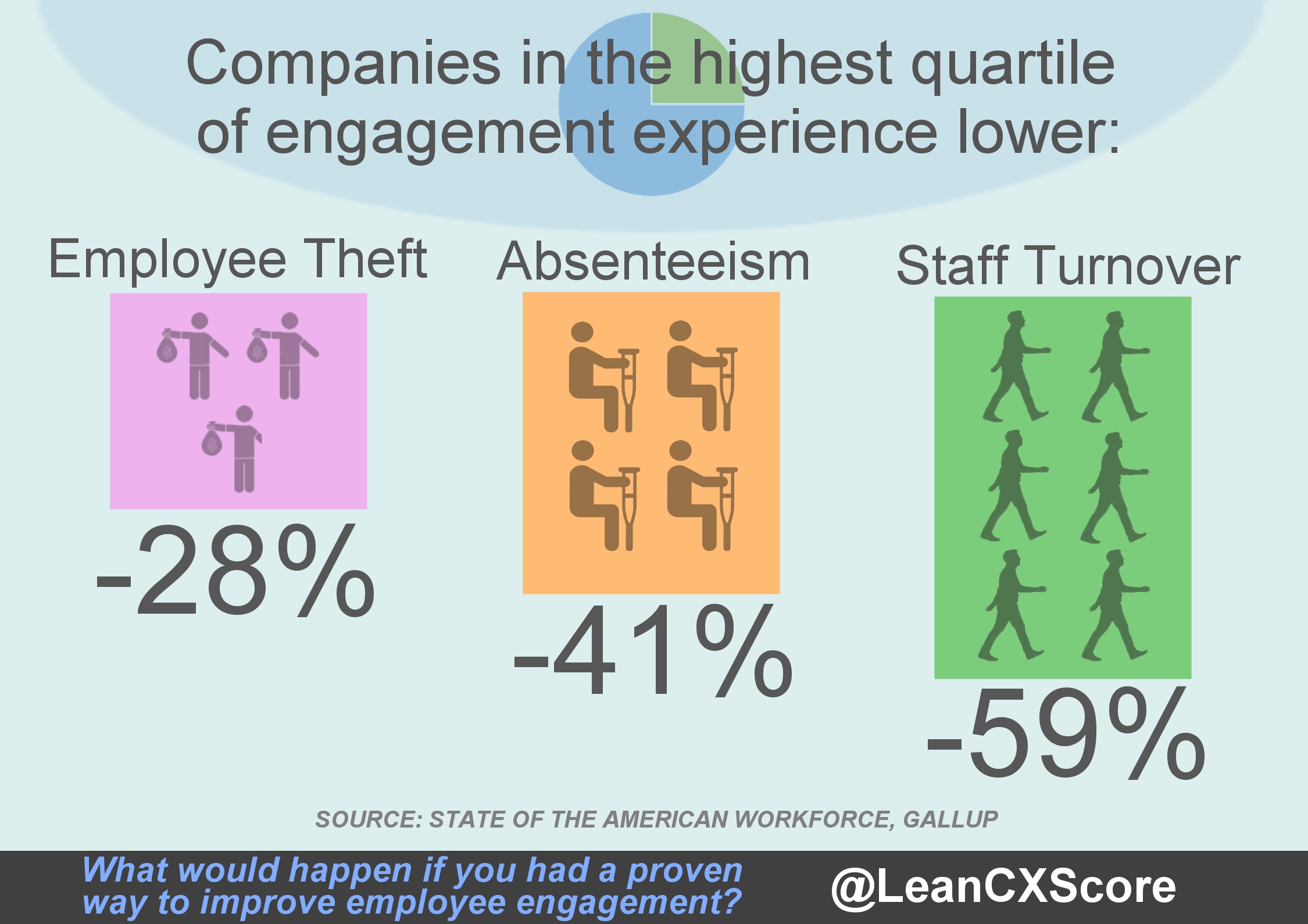
It’s no surprise, then, that teams in the lowest quartile for engagement experience 41% more absenteeism – people with sick days or any other reason to get away and have a day off.  They also experience 59% higher turnover.  When you combine these two things as a business, not only is less getting done, but the cost of replacing staff – from advertising, to hiring, and training someone new, is absolutely huge.

Design Your Work For Ease Of Use, and Employee Engagement

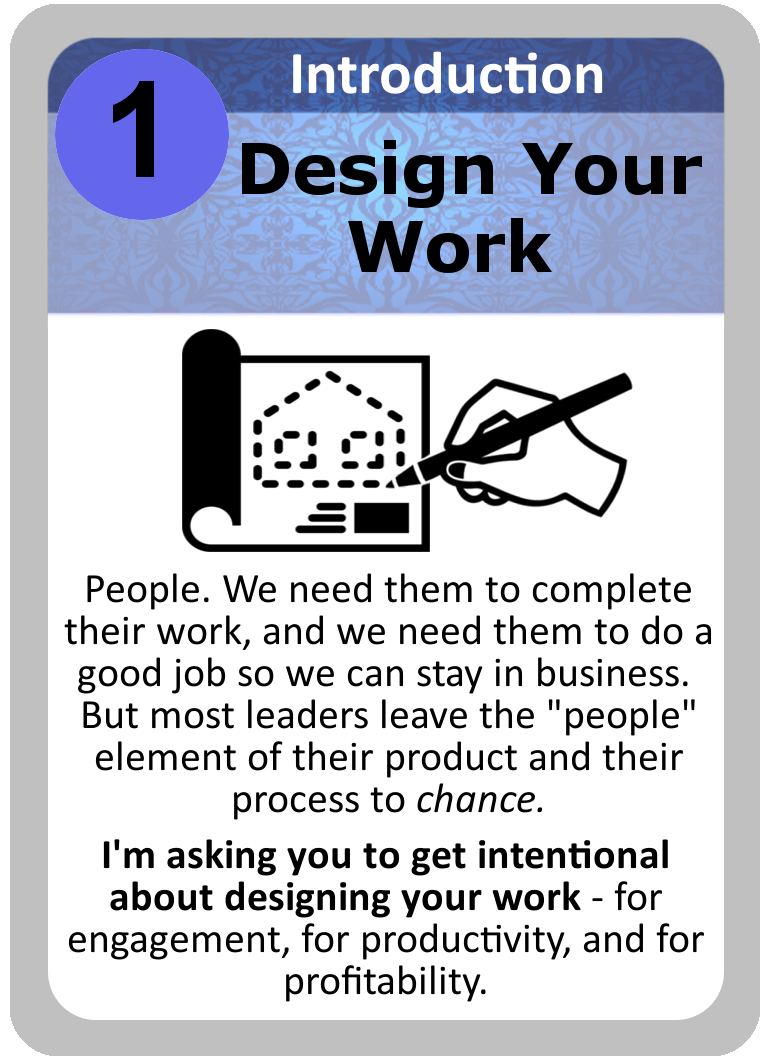
Getting intentional about designing your work means designing it in a way that engages your staff.

At its very core, the framework described in the book The Lean CX Score advocates things like checking in regularly, removing frustrating rework, gaining clarity through a standard process and much more.  It’s the little things, the mundane things, but these things make a huge difference.

Chat soon – David McLachlan

Leadership CardsView All The Leadership Cards (48)

- or - Have the Leadership Cards delivered for your next meeting
Leadership Card 4 – Productivity and Profit

See All The Cards Here

Design Your Work For Ease Of Use – Leader Card 4

Leadership Card 4 - productivity and profit

Leadership CardsView All The Leadership Cards (48)

- or - Have the Leadership Cards delivered for your next meeting

Employee Engagement Affects Productivity and Profit

Most everyday leaders battling in the trenches are not aware of a thing called “Systems thinking”.  It’s a way of thinking, taught to most MBAs or business school graduates that asks you to think of the bigger picture, and then the bigger picture again, and to how each tiny action will affect the whole.

The perfect example of this is how employee engagement – where your employees enjoy and are empowered to do their work – affects not only your team’s happiness but the productivity of your team and the profit of your company.

If you are a small business or a startup this is absolutely critical, because eventually you will be needing to hire your initial team of people to run things when you’re not around.  Trusting those first few people with your fledgling business can be very difficult, but it is made infinitely easier with the trust that comes from highly engaged, high productivity and high output team mates.

Design Your Work for Ease of Use

The good news is there is a proven framework that shows you, step up step, how to design your work in a way that increases engagement and reduces the friction you feel when your work isn’t quite right.

It’s called the Ease of Use framework, and it was first outlined in the book “The Lean CX Score”.  It takes the absolute best methods from the most customer and culture-centric business improvement method of the last century, and makes them usable in a white collar world.

Chat soon – David McLachlan

See All The Cards Here

Lean CX ScoreGet "The Lean CX Score" now, and start creating disruptors in your industry that completely annihilate your competition.

Oh and good news!  You'll be improving the speed, morale and engagement of your teams at the same time.  Get the Lean CX Score now.

Lean CX Infographic – More Incredible Benefits Of Employee Engagement

Lean CX Infographic Employee Engagement Benefits

Get all the infographics here

Employee Engagement It’s Official: It Matters

Which would you rather, having a team full of people dragging their feet, complaining, making excessive mistakes and who hate coming to work?

Or a team full of highly engaged, happy, motivated people who can’t do enough for you?

Yep, I thought so.  Employee engagement matters, and having a team who is in the top quartile for employee engagement makes a huge difference, not just to your happiness but to your bottom line as well.

These top companies and teams see 28% less theft.  41% less absenteeism, meaning more and more staff turn up to do their work because they enjoy it.  And a whopping 59% lower staff turnover.

And do you think these things affect your profit and cost as a company?  You bet.  How much does it cost to advertise, interview, hire, train, and level up a new person to replace someone previously?  And how much do staff accidents and even a little bit of theft here or there really cost?  It’s more than you think.  And it can be avoided by focusing on engaging your employees.

What Engagement Doesn’t Mean

Now I’m not talking about the latest rah-rah retreat, where everybody gathers around, drinks smoothies (or cocktails) and whiteboards a bunch of baloney that will never get done.

No. Freaking. Way.

I’m talking about culture.  But not “Culture” as a broad, flimsy, consultant-type term.  Oh no.  I’m talking about culture where I can give you specific steps that anyone (and everyone) can perform every week to create a culture of high engagement and problem solving.

It’s called Designing your work for Ease of Use.

Designing Your Work for Ease of Use

Designing your work for Ease of Use is one of the easiest, fastest, and cost effective ways to improve the engagement of your team and the profit of your company.

The Ease of Use framework may seem simple, but its methods are based on research such as that above, where we are looking to improve the engagement of your teams and make the people you work with happier (and more productive) as a result.

Having a standard, repeatable process with clear outcomes may seem boring or simple, but did you know that 50% of American workers don’t know what is expected of them at work?

Making things visual so you know what to do first time without having to ask may seem mundane, but did you know that every time you have to redo something you’re not sure of, you are effectively doubling, tripling, quadrupling your cost for the same outcome?

Checking in regularly may seem unnecessary to some, but did you know that leaders who check in at least once a week with their team mates and focus on their strengths see a 27% increase in engagement?

Designing your work for ease of use matters.  It makes a difference.  And as it improves the ease of the work your team performs, it reduces their frustrations and improves their happiness too.

Chat soon – David McLachlan

Get all the infographics here

Lean CX ScoreGet "The Lean CX Score" now, and start creating disruptors in your industry that completely annihilate your competition.

Oh and good news!  You'll be improving the speed, morale and engagement of your teams at the same time.  Get the Lean CX Score now.

Leadership Card 2 – Levels Of Engagement

See All The Cards Here

Design Your Work For Ease of Use, Leadership Card 2

Ease of use leadership card 2 Levels of engagement

Leadership CardsView All The Leadership Cards (48)

- or - Have the Leadership Cards delivered for your next meeting

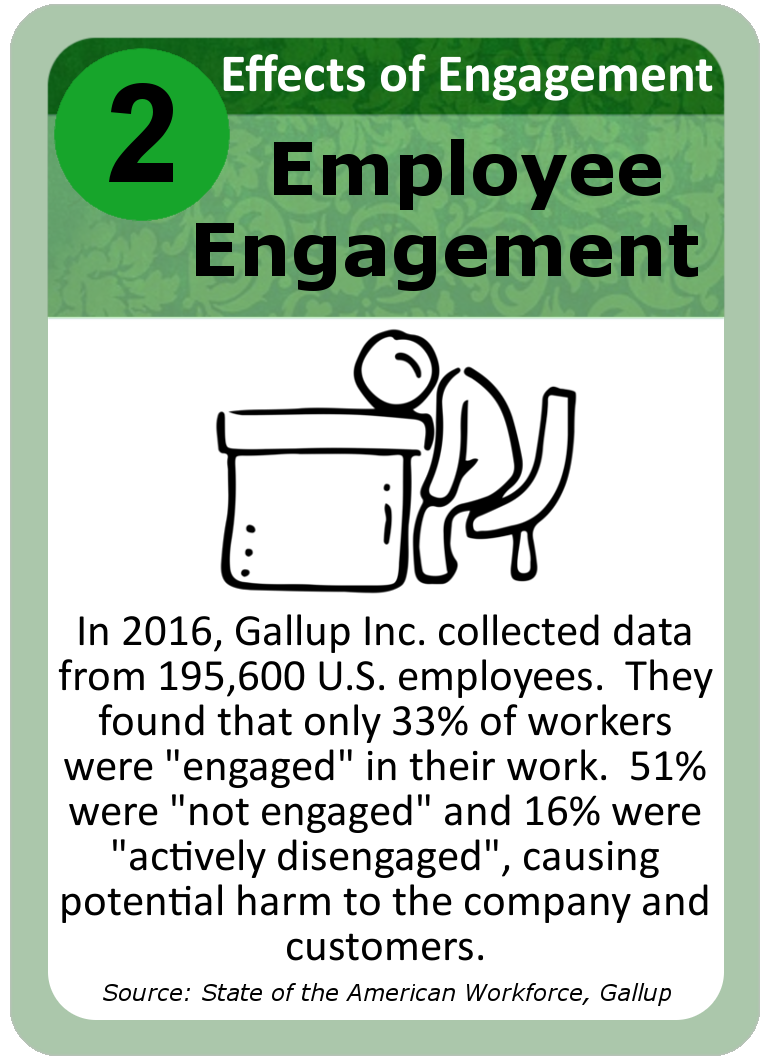
Recent research has found that the majority of workers are not “engaged” in their work.  By engagement we mean they know what is expected of them, have the tools to do their work and enjoy their work.

The effects of low engagement can be huge on a company.  As you will soon see in future Leadership Cards, sales are lower, productivity is lower, and absenteeism is higher.  It’s a hidden cost that leaders may believe they have no control over, however by being intentional about designing your work for ease of use, using the ease of use framework, you can significantly improve the engagement of your teams.

Chat soon – David McLachlan

Leadership CardsView All The Leadership Cards (48)

- or - Have the Leadership Cards delivered for your next meeting

Leadership Card 1 – Introduction

See All The Cards Here

Welcome to the first Leadership Card by David McLachlan.

So many studies have shown the benefits of intentionally designing your work, designing your customer experiences, and designing your products for Ease of Use.  Huge benefits, like outperforming other companies in the stock market by 76% on average over five years (during market crises too), enabling customers to stay for six years on average (instead of just one), and much much more.

The Leadership Cards will bring you research and frameworks, packaged in a neat card for you to collect each week as you improve your business, your leadership, and your life.

Please enjoy!

Leadership Card Deck 001 Introduction - Lean CX Ease of Use

Leadership CardsView All The Leadership Cards (48)

- or - Have the Leadership Cards delivered for your next meeting

Chat soon – David McLachlan, author of the Lean CX Score