Tag Archives: PMBOK 8

The 8 Risks of A.I. in Project Management (PMP 2026)

If you are taking your PMP exam after July 2026, artificial intelligence questions will likely appear. Understanding these ethical considerations is essential, and here are the key concerns you’ll need to know.

Bias in Data

AI models trained on only certain data sets will produce biased data, and will replicate and amplify that bias in their outputs. This has been shown recently in AI Hiring Decisions, where bias was shown against different groups of people that didn’t necessarily have anything to do with their skill or will to perform the work. Project managers must be aware that AI decisions may favor certain outcomes unfairly.

Privacy

Protecting customer data and sensitive project information is critical. AI systems that process this data must have adequate privacy safeguards in place. This often comes from paid models or enterprise models that allow a certain level of privacy, and stops the model being trained on your project’s information.

Transparency

AI decisions are often difficult to explain or understand. Project managers will often need to know why the system recommended a particular course of action before approving it, in case someone questions that decision later on.

Accountability

When something goes wrong, who is responsible? Accountability structures must be clear before deploying AI in project decision-making.

Copyright Concerns

AI tools trained on copyrighted material raise legal and ethical questions about ownership and attribution of generated outputs.

Reliability

AI can produce confident but incorrect answers, a phenomenon known as hallucination. Project managers must verify outputs before acting on them.

Sustainability

Generating AI outputs requires significant computational resources and energy consumption. The environmental impact should be considered.

These ethical considerations are worth knowing for the 2026 PMP exam and for managing AI responsibly in real projects.

– David McLachlan

You can see what people are saying about David McLachlan here: REVIEWS

Navigate to Free Project Management and Leadership Articles through the links on the right (or at the bottom if on Mobile) 
PMI PMP 35 PDUs CourseThe Ultimate PMP Project Management Prep Course (35 PDUs)
Agile Certified Practitioner (PMI-ACP 28 PDUs)The Complete PMI-ACP Course: (28 PDUs) 
PgMP Program Management CourseLearn Program Management – the PgMP Prep Course
Full PMP Exams to Pass on the First TryFour Full PMP Practice Exams (180 Qs each) to pass your PMP on the First Try!
PMP Cram Course – FULL PMP Course Condensed to just 8 hours!
Scrum Master Course PSMScrum Master Course (PSM)
Product Owner Course PSPOProduct Owner Course (PSPO)
Business Analyst CourseBusiness Analyst Course

Also available are my Project Management Templates – they’re a great way to save 100s of hours when you’re first starting out:

50 Project Management Templates Gantt Chart Risk Matrix and more Excel50+ Project Management Templates in Excel and PowerPoint (Gantt Chart, Risk Matrix and more!)
Project Management Plan TemplatesPre-made Project Management Plan Templates: Save 100 HOURS!


Artificial Intelligence As Explained in the PMBOK Guide 8th Edition

The PMBOK Guide 8th edition defines artificial intelligence in layers, each building on the previous one, with Machine Learning, Deep Learning and Generative Pre-trained Transformers. Artificial Intelligence is being used widely in modern projects – from using it to gauge stakeholder sentiment and assign actions to people at the end of meetings, to helping us reschedule tasks with the least downtime or impact on our resources. Know this for your exam!

Artificial Intelligence

At the broadest level, AI refers to systems that can reason and learn independently without explicit programming for every scenario.

Machine Learning (Layer 1)

Machine learning trains mathematical models using historical data to predict outcomes. Common techniques include linear regression and K-nearest neighbors. The model learns patterns from labelled datasets.

Deep Learning (Layer 2)

Deep learning is an advanced machine learning method using multi-layered neural networks. Unlike machine learning, it can automatically learn features from large unstructured datasets such as images or text without manual labelling.

Deep learning requires more complex mathematics including linear algebra, tensors, matrices and multivariate calculus. Success depends on managing bias, weighting options appropriately and adjusting layer depth. It also demands significant computing power and large volumes of data.

Generative AI (Layer 3)

Generative pre-trained transformers (GPTs) like ChatGPT combine all previous layers to generate new content, answers and ideas based on patterns learned from vast amounts of training data. It also uses NLP (Natural Language Processing) to create a natural user interface, where people can ask questions and get answers in a more conversational style.

Understanding these layers helps project managers recognize where AI can add value in their projects.

– David McLachlan

You can see what people are saying about David McLachlan here: REVIEWS

Navigate to Free Project Management and Leadership Articles through the links on the right (or at the bottom if on Mobile) 

PMI PMP 35 PDUs CourseThe Ultimate PMP Project Management Prep Course (35 PDUs)
Agile Certified Practitioner (PMI-ACP 28 PDUs)The Complete PMI-ACP Course: (28 PDUs) 
PgMP Program Management CourseLearn Program Management – the PgMP Prep Course
Full PMP Exams to Pass on the First TryFour Full PMP Practice Exams (180 Qs each) to pass your PMP on the First Try!
PMP Cram Course – FULL PMP Course Condensed to just 8 hours!
Scrum Master Course PSMScrum Master Course (PSM)
Product Owner Course PSPOProduct Owner Course (PSPO)
Business Analyst CourseBusiness Analyst Course

Also available are my Project Management Templates – they’re a great way to save 100s of hours when you’re first starting out:

50 Project Management Templates Gantt Chart Risk Matrix and more Excel50+ Project Management Templates in Excel and PowerPoint (Gantt Chart, Risk Matrix and more!)
Project Management Plan TemplatesPre-made Project Management Plan Templates: Save 100 HOURS!


Everything You Need to Know About AI in the PMBOK Guide 8th Edition

The PMBOK Guide 8th edition includes a new section on artificial intelligence in project management. If you are sitting the PMP after July 2026, here is what you need to know.

What Is Artificial Intelligence?

AI describes technologies that simulate human behavior, allowing machines to learn from experience, adapt to new situations and perform tasks without being directly programmed.

There are three layers that build on each other:

  1. Machine learning trains models using past data to predict outcomes. It typically requires smaller, structured and labelled data sets.
  2. Deep learning is an advanced form of machine learning that uses multi-layered neural networks to learn from large, unstructured data sets like images or text.
  3. Generative AI uses large language models to create new text, images, audio and video. This is the layer that produces tools like ChatGPT.

Free versions typically limit prompts and data use while paid versions offer greater privacy protection, which matters for organizations handling sensitive project information.

How AI Is Used in Project Management

The PMBOK Guide 8th edition organizes AI use into three categories:
Automation handles low-complexity, repetitive tasks such as generating status reports, tracking activities, sending reminders and producing meeting summaries with action items.

Assistance supports analysis and decision-making. Examples include predictive analytics for budget forecasting, early warning signals based on patterns from similar projects and multi-criteria decision analysis.

Augmentation enhances strategic thinking. This includes analyzing historical data for trends, running trade-off analysis across scope, schedule and cost, and optimizing project portfolios with AI as a brainstorming partner.

These three categories apply across governance, risk, stakeholder management and scheduling.

For risk, AI can automate mitigation responses, assess impact on scope and cost, and use pattern recognition to adjust return on investment projections. For stakeholders, sentiment analysis can assess the tone of communications and meeting transcripts. For scheduling, dynamic scheduling tools can optimize for the shortest timeline or most balanced resource allocation.

Ethical Considerations

The guide also addresses responsible AI use. Key concerns include bias in data, data privacy and security, transparency around how decisions are made, accountability when outputs are wrong, copyright, reliability and environmental sustainability given the computing resources AI requires. These are not just theoretical concerns and are worth understanding for the exam.

New Tools and Techniques

Four AI-related tools and techniques appear in the 8th edition:

Genetic algorithms use a process inspired by natural selection to find optimized solutions. Random paths are tested, the best performers advance to the next round and the process repeats until an optimal outcome is reached.

Branch and bound finds optimal solutions by progressively eliminating paths that do not meet the desired criteria, similar to pruning a decision tree until only the best path remains.

Augmented reality overlays digital information onto a real-world view, useful for design reviews and prototyping.

Virtual reality simulates walking through a three-dimensional model, particularly useful for reviewing building or infrastructure designs before construction begins.

AI in project management is still evolving but the fundamentals covered in the 8th edition give you a solid foundation for both the exam and the work itself.

– David McLachlan

You can see what people are saying about David McLachlan here: REVIEWS

Navigate to Free Project Management and Leadership Articles through the links on the right (or at the bottom if on Mobile) 

PMI PMP 35 PDUs CourseThe Ultimate PMP Project Management Prep Course (35 PDUs)
Agile Certified Practitioner (PMI-ACP 28 PDUs)The Complete PMI-ACP Course: (28 PDUs) 
PgMP Program Management CourseLearn Program Management – the PgMP Prep Course
Full PMP Exams to Pass on the First TryFour Full PMP Practice Exams (180 Qs each) to pass your PMP on the First Try!
Scrum Master Course PSMScrum Master Course (PSM)
Product Owner Course PSPOProduct Owner Course (PSPO)
Business Analyst CourseBusiness Analyst Course

Also available are my Project Management Templates – these don’t have a coupon code but they’re a great way to save 100s of hours when you’re first starting out:
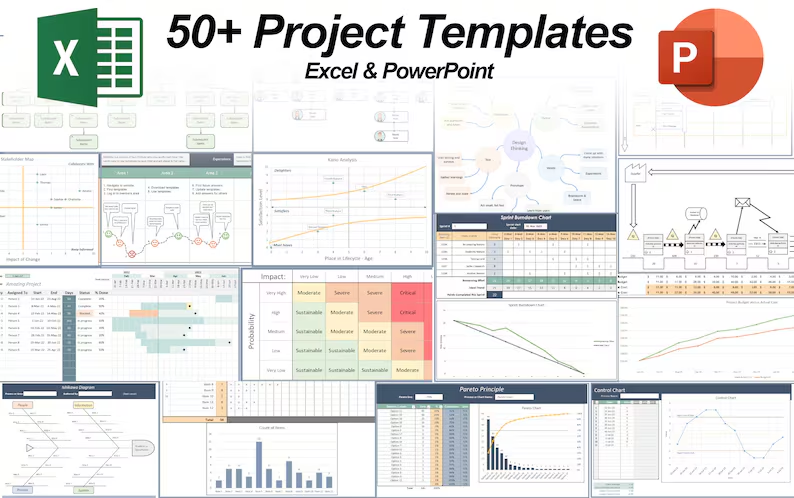
50 Project Management Templates Gantt Chart Risk Matrix and more Excel50+ Project Management Templates in Excel and PowerPoint (Gantt Chart, Risk Matrix and more!)
Project Management Plan TemplatesPre-made Project Management Plan Templates: Save 100 HOURS!